

What is the Possessive ‘s for?
The possessive ‘s is a small but powerful part of English grammar. We use it to show ownership or a relationship between a person and a thing.
- It answers the question “Whose is it?”
- It tells us who something belongs to.
Think of it as a shortcut to say “the book of John” or “the car of my father.”
🎓 Englisch lernen mit der Blended-Methode
Kleingruppen · KI-Tutor rund um die Uhr · Vorbereitung auf die Cambridge-Prüfungen
Pläne von $39 $79 pro Monat
How do we form the Possessive 's?
It is very simple to form the possessive 's with singular nouns and names.
- Take the name of the person or the singular noun.
- Add an apostrophe (') and then the letter s.
- Then, add the thing they own.
Schau dir diese Beispiele an:
Possessive 's with Names
When someone's name is singular, we add 's to the end of their name.
- This is Mary's bag. (The bag belongs to Mary.)
- That is Tom's ball. (The ball belongs to Tom.)
Even if a name ends in s, wie James, we still add 's. Zum Beispiel: James's car.
Possessive 's with Singular Nouns
We also use 's with singular nouns that are not names, like teacher oder dog.
- This is the teacher's desk. (The desk belongs to the teacher.)
- That is the dog's bone. (The bone belongs to the dog.)
Remember, this rule is for singular nouns only. We will learn about plural nouns later.
| Owner | Form | Beispiel |
|---|---|---|
| A singular person's name | Name + 's | John's book |
| A singular noun (person/animal) | Noun + 's | The girl's hat |
Beispiele
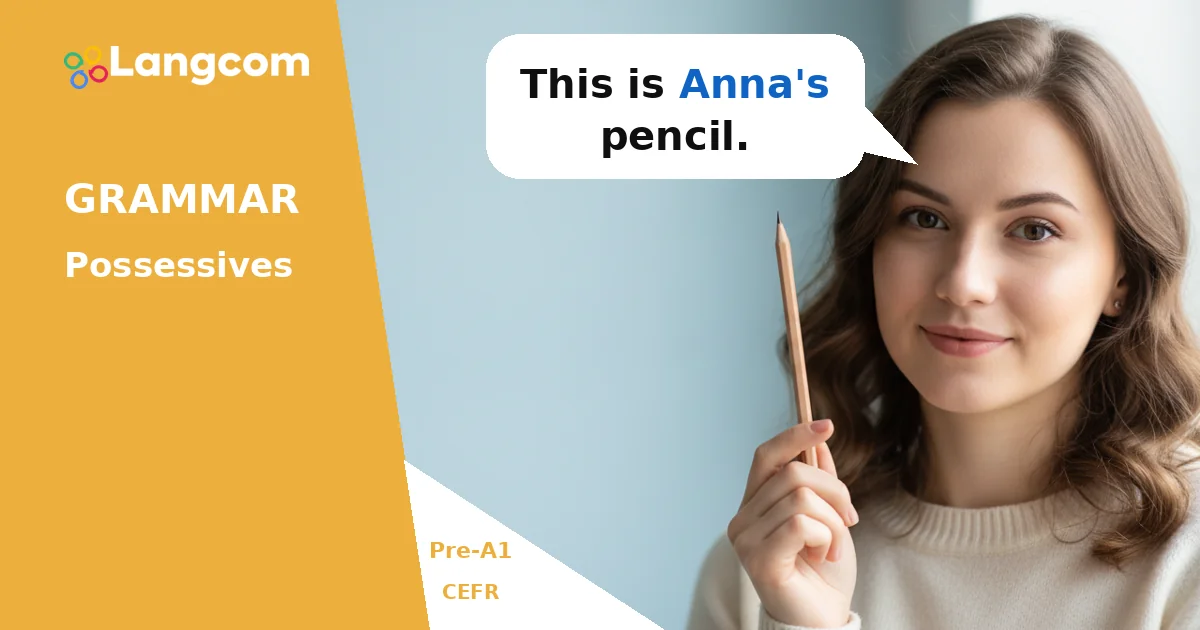
- This is Anna's pencil.
- That is my father's car.
- Where is the cat's toy?
- Is this Peter's book?
- The girl's hat is red.
Übung
💬 Benötigen Sie eine individuelle Beratung?
Als autorisiertes Cambridge-Vorbereitungszentrum können wir Ihnen helfen, den richtigen Kurs und die passende Zertifizierung zu finden. Chatten Sie noch heute mit unseren Beratern.
Chatten Sie mit einem Berater auf WhatsAppHäufige Fehler bei Spanischsprechern
Spanish speakers sometimes make these mistakes:
- Using "of" instead of 's: In Spanish, you might say "el libro de Juan." In English, we use 's.
- Falsch: The book of John.
- Rechts: John's book.
- Forgetting the apostrophe: The apostrophe ' is very important. Without it, Johns book looks like a plural word, not a possessive.
- Falsch: This is Marias bag.
- Rechts: This is Maria's bag.
- Verwirrend it's und its: It's bedeutet it is oder it has. Its is a possessive pronoun (like his oder her).
- Falsch: The dog wants it's bone.
- Rechts: The dog wants its bone.
- Rechts: It's a big dog. (It is a big dog.)
Häufig gestellte Fragen
What does the possessive 's mean?
The possessive 's means that something belongs to someone. For example, Sarah's phone means "the phone of Sarah."
Can I use 's for things that are not people?
Ja, du kannst 's for animals, like the dog's toy. Sometimes you can use it for places or time, but for Pre-A1, focus on people and animals.
Is "its" the same as "it's"?
No, they are different! It's is a short form for it is oder it has. Its shows possession for things or animals, like The cat likes its food.
Why is the apostrophe important in 's?
The apostrophe ' tells you that 's means possession. Without it, the word might look like a plural (more than one) or a verb. For example, dogs means many dogs, but dog's means something belonging to one dog.


0 Kommentare