

How Do We Form Basic Questions in English?
Most English questions follow a specific structure to make them clear.
- We usually put an auxiliary verb (like be, do, have, or a modal verb) before the subject.
- If there is no auxiliary verb in a simple present or past tense statement, we add do oppure did.
This structure helps listeners immediately recognize that you are asking a question.
✍️ Non sai a quale livello ti trovi?
Fai il nostro test di livello gratuito e ricevi un feedback personalizzato da esaminatori certificati Cambridge.
Fai il nostro test di livello GRATUITOWhat Happens When 'Who' or 'What' Is the Subject?
Sometimes, the question word itself is the subject of the sentence. In these cases, the word order changes.
- Quando who, what, oppure which acts as the subject, we keep the normal word order of a statement.
- We do not use an auxiliary verb (do, does, did) in these subject questions.
This is a common point of confusion for learners, so pay close attention to the examples.
Where Do Prepositions Go in Questions?
Prepositions often appear at the end of questions in English, especially in informal or everyday speech.
- In most common questions, the preposition comes at the very end of the sentence. For example, Who are you talking to?
- In very formal English, or in written academic contexts, prepositions can sometimes come at the beginning. However, this is less common in spoken English.
- You can also form short questions using who / what / why + preposition, such as Who with? oppure What for?
When Do We Use Negative Questions?
Negative questions are formed using a negative auxiliary verb (e.g., isn't, haven't, don't).
- We often use negative questions to express surprise or to check if something is true, expecting a 'yes' answer. For example, Didn't you see her at the party? (I'm surprised you didn't).
- They can also be used to confirm information or to make suggestions.
The tone of voice is important when asking negative questions to convey the correct meaning.
How Can We Ask Questions More Politely? (Indirect Questions)
Indirect questions are a more polite and formal way to ask for information. They are especially useful in professional or unfamiliar situations.
- They usually start with a polite phrase like Can you tell me...?, Do you know...?, oppure I wonder...
- After the introductory phrase, the word order changes to that of a statement (subject + verb), and we do not use an auxiliary verb (do, does, did).
- If it's a yes/no question, we use if oppure whether after the introductory phrase.
Mastering indirect questions shows a higher level of English proficiency and politeness.
Esempi
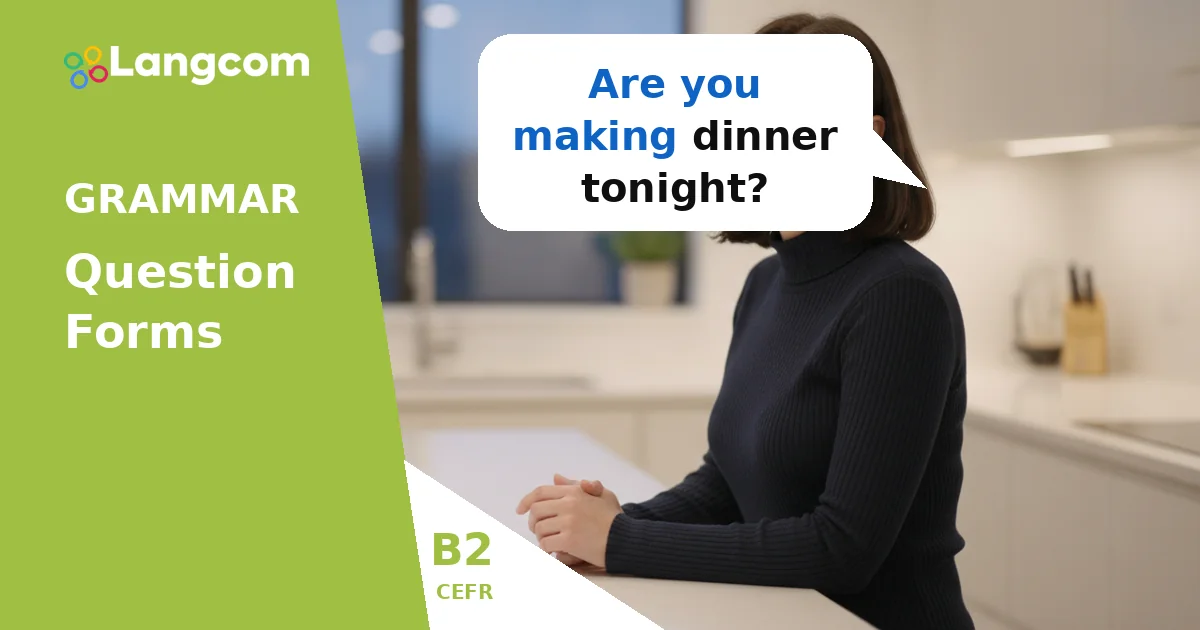
- Are you making dinner tonight?
- Have you eaten yet?
- Who spoke to you about the project?
- What happened next in the story?
- Who were you talking to earlier?
- What are you looking for?
- Do you think it's a good idea to start a new business?
- Why isn't your computer working today?
- Haven't they finished the report yet?
- Can you tell me where the nearest bank is?
- Do you know if she likes foreign films?
- I'm not sure why he left so early.
Esercitazione
Sei pronto a ottenere il tuo certificato?
Il corso Langcom prepara gli studenti agli esami Cambridge, IELTS, TOEFL, DELE, SIELE e Michigan.
Inizia a utilizzare LangcomErrori comuni per chi parla spagnolo
Incorrect Word Order in Subject Questions
Spanish speakers sometimes add an auxiliary verb when the question word is the subject.
- Errato: Who did write this book?
- Corretto: Who wrote this book?
Incorrect Word Order in Indirect Questions
A common error is keeping the direct question word order after the introductory phrase.
- Errato: Do you know why did she become famous?
- Corretto: Do you know why she became famous?
Preposition Placement
Starting a question with a preposition can sound overly formal or unnatural in everyday conversation.
- Less natural (formal): From where are you?
- More natural (common): Where are you from?
Domande frequenti
What is the main difference between direct and indirect questions?
Direct questions ask information directly and use standard question word order (auxiliary + subject). Indirect questions are more polite, start with a phrase like Can you tell me...?, and then use statement word order (subject + verb) without an auxiliary verb.
Why do we sometimes use 'do/did' in questions?
Utilizziamo do oppure did as auxiliary verbs in simple present and simple past tense questions when there is no other auxiliary verb (like be oppure have) or modal verb present. For example, Do you like coffee? oppure Did they go home?
Can I start a question with a preposition?
Yes, you can, but it is generally considered very formal or literary. In most everyday conversations, the preposition comes at the end of the question. For example, To whom did you speak? is formal, while Who did you speak to? is common.
How do negative questions change the meaning?
Negative questions, like Didn't you finish?, often express surprise, disbelief, or an expectation that the answer will be 'yes'. They can also be used to make suggestions or offer advice in a softer way.


0 Commenti