
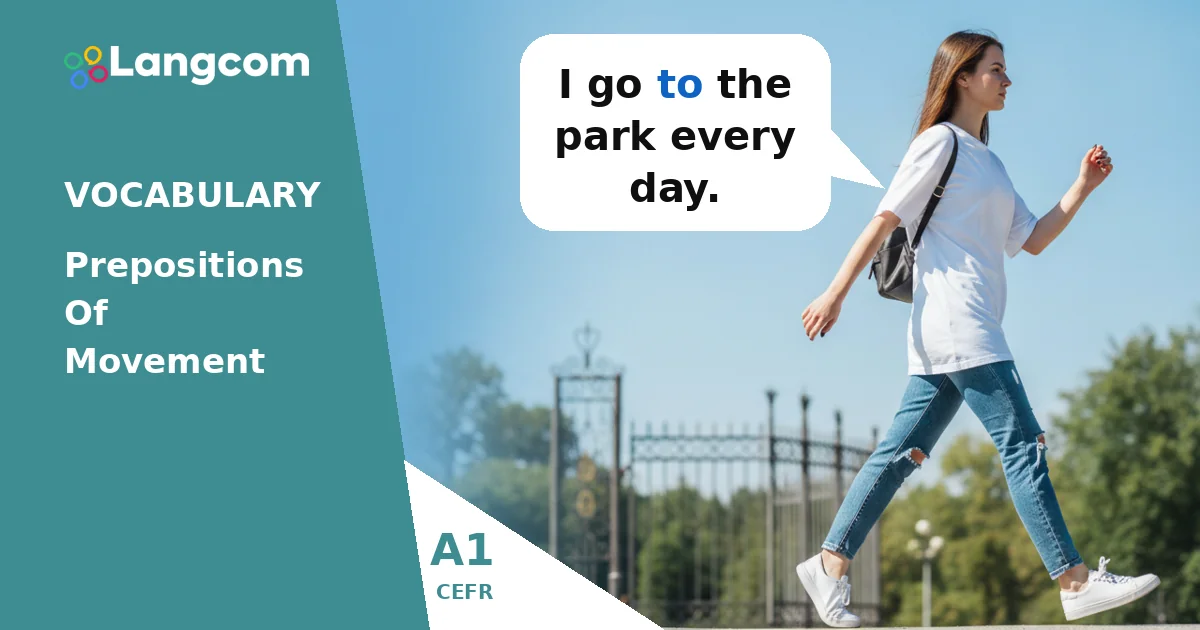

Prepositions of movement tell us about direction and how something moves from one place to another. They help us describe where people, animals, or objects are going. Think of them as small words that connect a verb of movement (like go, walk, run) with a destination or a path. For example, when you say I walk to school, the word to shows the direction of your movement. These words are essential for giving directions, describing actions, and understanding simple stories in English. Learning them helps you speak more clearly and understand native speakers better, even at an A1 level. They are like guides that show the way in your sentences. They show if something is going up, down, into, oppure out of something, or simply to a place.
What Are Prepositions of Movement?
Prepositions of movement are small words that describe how something moves from one place to another. They show the direction of an action.
These words are very important for telling stories, giving directions, and describing actions clearly. They help us understand the path or destination of movement.
🎓 Impara l'inglese con il metodo misto
Piccoli gruppi · Tutor IA disponibile 24 ore su 24, 7 giorni su 7 · Preparazione agli esami di Cambridge
Piani da $39 $79 al mese
Common Prepositions of Movement for A1 Learners
Let's look at some common prepositions of movement and how to use them:
-
to: Shows movement towards a destination.
Esempio: I go to the park every day.
-
from: Shows the starting point of a movement.
Esempio: She came from the library.
-
into: Shows movement inside something.
Esempio: He walked into the room.
-
out of: Shows movement from inside something to the outside.
Esempio: She took the keys out of her pocket.
-
up: Shows movement to a higher position.
Esempio: Go up the stairs.
-
down: Shows movement to a lower position.
Esempio: Come down the hill.
-
through: Shows movement from one side of something to the other, often inside it.
Esempio: The car drove through the tunnel.
-
away from: Shows movement separating from something.
Esempio: The bird flew away from the cat.
-
under: Shows movement to a position below something.
Esempio: The ball rolled under the table.
-
over: Shows movement above something, often crossing it.
Esempio: The dog jumped over the fence.
-
towards: Shows movement in the direction of something, but not necessarily reaching it.
Esempio: He walked towards the bus stop.
-
around: Shows movement in a circle or general area.
Esempio: We walked around the park.
| Preposition | Meaning (Direction) | Esempio |
|---|---|---|
| to | Towards a destination | I walk to school. |
| from | Origin point | She came from the park. |
| into | Entering something | He walked into the room. |
| out of | Exiting something | She took a book out of the bag. |
| up | To a higher place | Go up the stairs. |
| down | To a lower place | Come down the hill. |
| through | From one side to the other (inside) | The car drove through the tunnel. |
| away from | Moving apart from something | The dog ran away from me. |
| under | Below something | The mouse ran under the chair. |
| over | Above something, often crossing it | The bird flew over the house. |
| towards | In the direction of something | He walked towards the bus stop. |
| around | In a circle or general area | We walked around the lake. |
Esempi
- I go to the park every day.
- She came from the library.
- He walked into the room.
- She took the keys out of her pocket.
- Go up the stairs.
- Come down the hill.
- The car drove through the tunnel.
- The bird flew away from the cat.
- The ball rolled under the table.
- The dog jumped over the fence.
- He walked towards the bus stop.
- We walked around the park.
Esercitazione
💬 Hai bisogno di una consulenza personalizzata?
In qualità di Centro autorizzato di preparazione agli esami Cambridge, possiamo aiutarti a scegliere il corso e la certificazione più adatti alle tue esigenze. Contatta oggi stesso i nostri consulenti.
Chatta con un consulente su WhatsAppErrori comuni per chi parla spagnolo
Spanish speakers sometimes make these common mistakes with prepositions of movement:
-
Utilizzo di in anziché into for movement: In Spanish, 'en' can mean both 'in' (position) and 'into' (movement). In English, we use different words.
-
Sbagliato: He walked in the room.
-
A destra: He walked into the room.
-
-
Aggiungere to prima home: In Spanish, you say 'a casa'. But in English, with the word home, we usually don't use to.
-
Sbagliato: I go to home.
-
A destra: I go home.
-
Domande frequenti
What is the difference between 'in' and 'into'?
In shows position (where something is). Into shows movement (where something is going). For example, The book is in the bag (position), but I put the book into the bag (movement).
Do I always need 'to' before a place?
No, not always. For example, with home, we usually say go home oppure come home without to. However, for most other places, you will use to, come go to school oppure go to the shop.
What is the difference between 'over' and 'above'?
Over can show movement from one side to another, often higher than something, as in The bird flew over the house. Above usually shows position, meaning higher than something, but without movement, as in The picture is above the sofa.




0 Commenti