
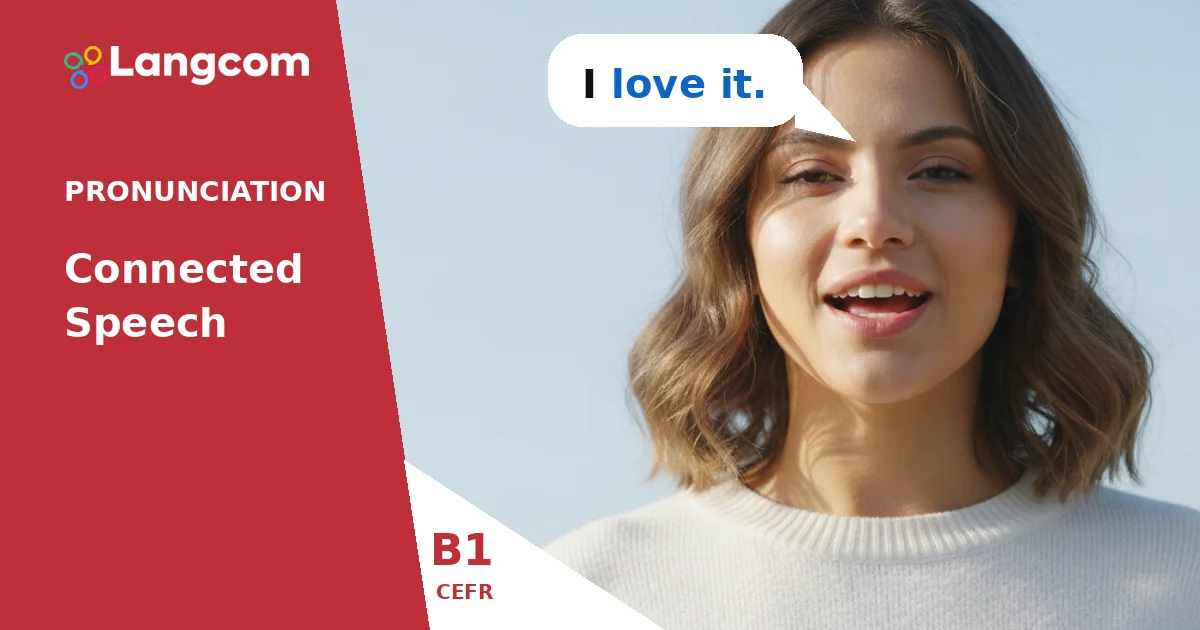

What is Linking in English Pronunciation?
Linking is a key part of connected speech in English. It helps words flow together smoothly, without pauses between them.
- When one word finishes with a consonant sound.
- And the next word starts with a vowel sound.
- We often connect these two sounds. They become one continuous sound.
This is different from how some other languages are spoken, where each word might be pronounced more separately.
🎓 Impara l'inglese con il metodo misto
Piccoli gruppi · Tutor IA disponibile 24 ore su 24, 7 giorni su 7 · Preparazione agli esami di Cambridge
Piani da $39 $79 al mese
Why is Linking Important for B1 Learners?
Understanding and using linking will greatly improve your English at the B1 level.
- Sound More Natural: Your English will sound more like a native speaker's.
- Improve Fluency: You will speak more smoothly and confidently.
- Better Listening: You will understand fast spoken English more easily because you'll recognize linked words.
- Clearer Speech: Linking helps your words flow, making your message clearer.
How to Link Words: The Simple Rule
The rule for linking is simple, but remember to focus on sounds, not just letters.
- Identify the Ending Sound: Does the first word end with a consonant sound? (e.g., t, d, k, s, m, n).
- Identify the Starting Sound: Does the next word begin with a vowel sound? (e.g., a, e, i, o, u, or other vowel sounds like ə).
- Connect Them: Say the consonant sound and the vowel sound together, without a break.
For example, in pick it up, il /k/ from pick links to the /ɪ/ from it, and the /t/ from it links to the /ʌ/ from up.
Common Consonant Sounds for Linking
Many consonant sounds link easily to vowel sounds. Here are some common examples:
- /t/ + Vowel: That is sounds like tha-tis.
- /d/ + Vowel: Need a sounds like nee-da.
- /k/ + Vowel: Look at sounds like loo-kat.
- /g/ + Vowel: Big apple sounds like bi-gapple.
- /s/ + Vowel: Yes, I sounds like ye-sai.
- /n/ + Vowel: On it sounds like o-nit.
Listen carefully to how native speakers connect these sounds in everyday conversation.
Practice Linking for Smoother English
To improve your linking, try these simple steps:
- Listen Actively: Pay attention to how words connect when you listen to English songs, podcasts, or movies.
- Read Aloud: Choose a short text and read it aloud. Focus on connecting words that end in a consonant sound and start with a vowel sound.
- Record Yourself: Speak some sentences and record your voice. Then listen back to hear where you can improve your linking.
- Imitate: Repeat phrases and sentences after a native speaker, trying to match their linked pronunciation.
Consistent practice will make linking feel natural and automatic.
| Ending Consonant Sound | Starting Vowel Sound | Linked Sound Example |
|---|---|---|
| /t/ | /ɪ/ | get_in |
| /d/ | /æ/ | bad_apple |
| /k/ | /ʌ/ | look_up |
| /s/ | /aɪ/ | yes_I_am |
| /n/ | /ɒ/ | on_it |
Esempi
- I love it.
- He's a good actor.
- Can I have an apple?
- We need a break.
- Pick it up, please.
- That's an interesting idea.
- She lives in England.
- Come on in!
Esercitazione
✍️ Non sai a quale livello ti trovi?
Fai il nostro test di livello gratuito e ricevi un feedback personalizzato da esaminatori certificati Cambridge.
Fai il nostro test di livello GRATUITOErrori comuni per chi parla spagnolo
A common mistake for Spanish speakers is to put a small pause between words, even when they should be linked. This can make your speech sound choppy or less natural.
- Incorrect (with pause): I (pause) am (pause) a (pause) student.
- Correct (linked): I am a student. (The /m/ in am links to the /ə/ in a)
Remember, English often blends words together, especially in informal speech. Focus on making your sounds flow together without breaks.
Domande frequenti
What exactly is 'linking' in English pronunciation?
Linking is when you connect a word that ends in a consonant sound to the next word that starts with a vowel sound. You say them as one continuous sound, without a pause.
Why is linking important for B1 English learners?
It helps your English sound more natural and fluent. It also makes it easier for you to understand native speakers, especially when they speak quickly, because you'll recognize how words blend together.
Does linking apply to all words that end in a consonant letter and start with a vowel letter?
Not always. Linking depends on the sounds, not just the letters. For example, hour starts with a silent h, so it begins with a vowel sound (/aʊ/). So, an hour would link.
How can I practice linking effectively?
Listen to native speakers and try to imitate them. Read English texts aloud, focusing on connecting words. You can also record yourself speaking and listen back to identify areas for improvement.
Will linking help me understand fast English conversations?
Yes, definitely! Native speakers link words all the time. By understanding how words connect, you'll be better able to follow rapid speech and catch individual words that might otherwise sound merged and unclear.

0 Commenti