
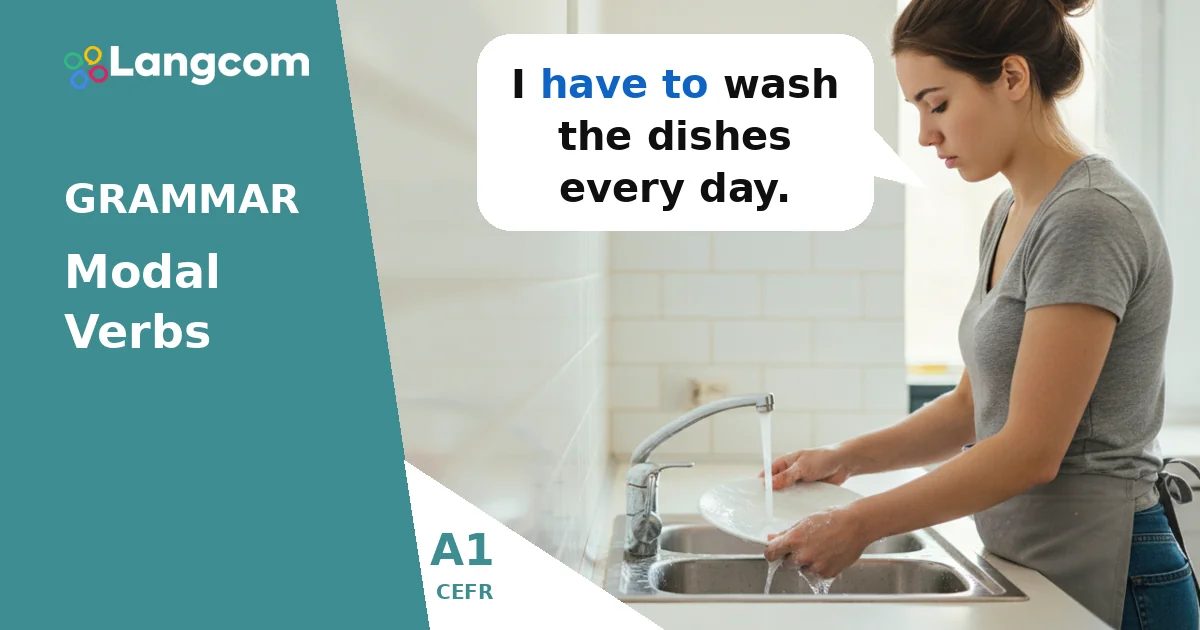

What Does Have to Mean?
In English, we use have to when we talk about things that are necessary or obligatory. It means you must do something because of a rule, a law, or a situation.
Think of it as a responsibility or a task you cannot avoid.
- It shows an external obligation. Someone or something (like a rule) makes you do it.
- It is very common for daily routines, chores, and work or school duties.
🎓 Impara l'inglese con il metodo misto
Piccoli gruppi · Tutor IA disponibile 24 ore su 24, 7 giorni su 7 · Preparazione agli esami di Cambridge
Piani da $39 $79 al mese
How Do We Form Sentences with Have to?
La forma di have to changes a little depending on the subject.
- For I, You, We, They, we use have to.
- For He, She, It, we use has to.
Dopo have to oppure has to, we always use the base form of the verb (the infinitive without 'to').
How Do We Make Negative Sentences with Have to?
To say that something is NOT necessary or NOT an obligation, we use don't have to oppure doesn't have to.
- For I, You, We, They, we use don't have to.
- For He, She, It, we use doesn't have to.
This means you have a choice; it's not compulsory.
How Do We Ask Questions with Have to?
To ask about obligations, we use Do oppure Does all'inizio della domanda.
- For I, You, We, They, we use Do... have to...?
- For He, She, It, we use Does... have to...? (Remember, for he/she/it in questions, we use have to, not has to, because does already shows the third person singular.)
| Oggetto | Positive (+) | Negative (-) | Question (?) |
|---|---|---|---|
| I / You / We / They | have to + verb | don't have to + verb | Do ... have to + verb? |
| He / She / It | has to + verb | doesn't have to + verb | Does ... have to + verb? |
Esempi
- I have to wash the dishes every day.
- My dad has to go to work at 7 o'clock.
- My friends have to do their homework in the afternoon.
- You don't have to cook tonight. We can order pizza!
- She doesn't have to wake up early on Saturdays.
- Do you have to wear a uniform at school?
- Does he have to finish the report today?
Esercitazione
💬 Hai bisogno di una consulenza personalizzata?
In qualità di Centro autorizzato di preparazione agli esami Cambridge, possiamo aiutarti a scegliere il corso e la certificazione più adatti alle tue esigenze. Contatta oggi stesso i nostri consulenti.
Chatta con un consulente su WhatsAppErrori comuni per chi parla spagnolo
Common Mistakes with Have to
Chi parla spagnolo a volte commette questi errori:
- Utilizzo di must to anziché have to: In English, we say I have to go, not I must to go. Ricorda, have to acts like a regular verb for negatives and questions.
- Utilizzo di have to per he/she/it: It's common to forget the 's'. Always say He has to, not He have to.
- Dimenticare do/does in questions and negatives: We don't say You not have to oppure Have you to go? Instead, use You don't have to e Do you have to go?
Domande frequenti
Is have to a modal verb?
While have to expresses obligation like modal verbs (must), it behaves more like a regular verb. It needs do/does for questions and negatives, unlike true modal verbs such as can oppure should.
Qual è la differenza tra have to e must?
For A1 learners, the main difference is that have to usually shows an external obligation (a rule, a law, someone else's decision). Must often shows a strong personal feeling or an obligation from the speaker. For example, I have to wear a uniform (school rule) vs. I must study for the exam (my strong personal decision).
What is the past tense of have to?
The past tense of have to è had to for all subjects. For example, Yesterday, I had to work late.
Why do we say has to per he/she/it?
Just like with the verb have, we add an '-s' or change the form for the third person singular in the present simple. So, he has becomes he has to, following the same grammar rule.




0 Commenti