

What Are -Ever Words?
-Ever words are formed by adding -ever to a question word. They are not used to ask questions.
Instead, they express:
- Indifference: It doesn’t matter which one.
- Uncertainty: We don’t know the specific details.
- Generality: It applies to all possibilities.
They often introduce a clause that means ‘no matter what/who/when/where/which/how’.
✍️ Non sai a quale livello ti trovi?
Fai il nostro test di livello gratuito e ricevi un feedback personalizzato da esaminatori certificati Cambridge.
Fai il nostro test di livello GRATUITOHow Do We Use Each -Ever Word?
Each -ever word has a specific use, building on the meaning of the original question word.
- Whatever (what + ever): Means 'anything that' or 'no matter what'. It refers to things or ideas.
- Whoever (who + ever): Means 'anyone who' or 'no matter who'. It refers to people.
- Whenever (when + ever): Means 'any time that' or 'no matter when'. It refers to time.
- Wherever (where + ever): Means 'any place that' or 'no matter where'. It refers to places.
- Whichever (which + ever): Means 'any one that' or 'no matter which'. It is used when there is a limited choice.
- However (how + ever): Means 'in any way that' or 'no matter how'. It refers to manner or degree.
Grammar Functions of -Ever Words
-Ever words can act as different parts of speech in a sentence:
- Pronouns: Whoever e whatever can replace a noun or noun phrase. For example, Whoever wants to come is welcome.
- Adverbs: Whenever, wherever, e however can modify verbs, adjectives, or other adverbs. For example, You can sit wherever you like.
- Determiners: Whatever e whichever can come before a noun. For example, Take whatever book you want.
They often introduce a dependent clause, which cannot stand alone as a complete sentence.
| Parola | Significato | Esempio |
|---|---|---|
| Whatever | Anything; no matter what | Take whatever you need. |
| Whoever | Anyone; no matter who | Whoever arrives first gets the best seat. |
| Whenever | Any time; no matter when | Call me whenever you like. |
| Wherever | Any place; no matter where | We can meet wherever is convenient. |
| Whichever | Any one (from a choice); no matter which | Choose whichever book you prefer. |
| However | Any way; no matter how | However you look at it, it's a difficult problem. |
Esempi
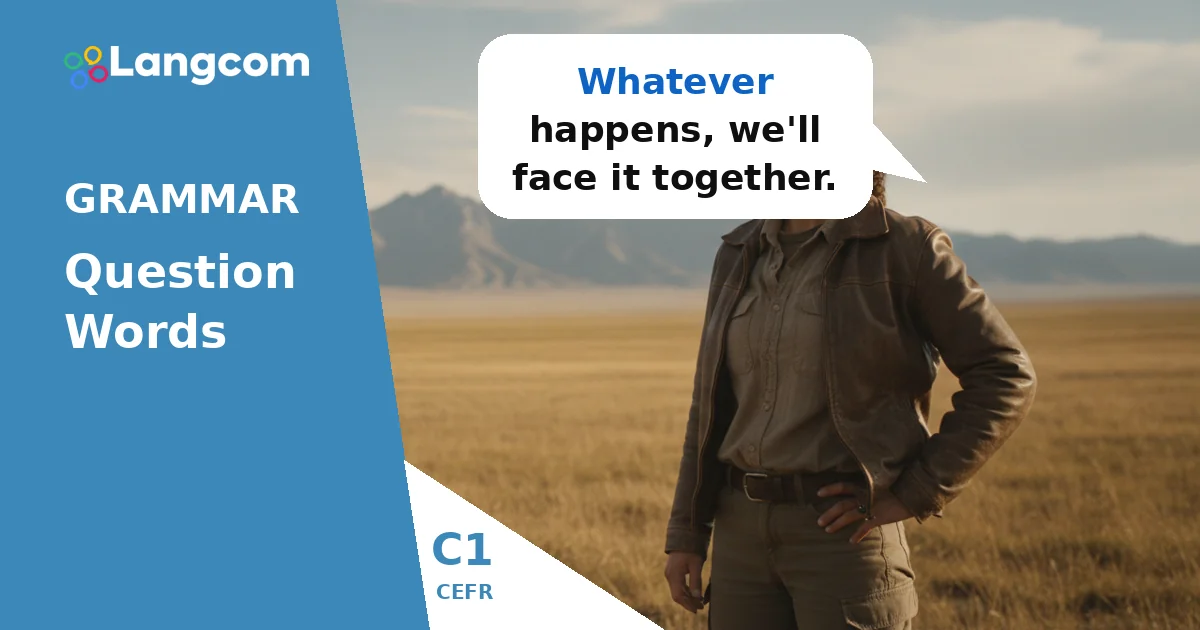
- Whatever happens, we'll face it together.
- Whoever broke the vase should tell the teacher.
- You can visit us whenever you're in town.
- We'll find a way to communicate, however difficult it may be.
- Choose whichever dessert you prefer from the menu.
- Wherever you go, always remember your home.
- I'll do whatever it takes to finish this project on time.
- However much money he earns, he's never satisfied.
Esercitazione
Sei pronto a ottenere il tuo certificato?
Il corso Langcom prepara gli studenti agli esami Cambridge, IELTS, TOEFL, DELE, SIELE e Michigan.
Inizia a utilizzare LangcomErrori comuni per chi parla spagnolo
Many learners make mistakes with -ever words, especially Spanish speakers:
- Confusing with direct questions: Remember, -ever words are NOT for asking questions. Incorrect: Whatever is your name? Correct: Whatever your name is, please sign here.
- Misusing however as a conjunction: However can mean 'but' or 'nevertheless' (e.g., It was raining; however, we went out.). This is different from its -ever word meaning 'no matter how' (e.g., However hard I try, I can't open it.). Pay attention to context.
- Tone of whatever: While grammatically correct, using whatever in response to a question can sound dismissive or rude. For example, if someone asks 'What do you want for dinner?' and you say 'Whatever,' it might imply you don't care in a negative way. Use with caution in spoken English.
- Direct translation from Spanish: Phrases like 'cualquiera que sea' or 'no importa qué' are often best translated using -ever words, but a direct word-for-word translation can sometimes sound unnatural. For example, instead of 'No matter what is the reason,' use Whatever the reason is... oppure Whatever the reason.
Domande frequenti
What is the main difference between a question word and an -ever word?
A question word (like who oppure what) asks for specific information. An -ever word (like whoever oppure whatever) expresses indifference, uncertainty, or generality, meaning 'no matter who/what'.
Can I use 'whyever'?
La parola whyever exists but is very rare in modern English. It's usually replaced by phrases like for whatever reason oppure no matter why. It's best to avoid using whyever in most contexts.
Is 'whatever' always rude?
No, whatever is not always rude. It depends on the context and tone of voice. When used to mean 'anything at all' or 'no matter what,' it's perfectly neutral: Take whatever you like. However, when used as a one-word response to a question, it can sound dismissive or indifferent in a negative way.
Are -ever words formal or informal?
-Ever words are generally neutral and can be used in both formal and informal contexts. Their formality depends more on the overall sentence structure and the situation. They are common in everyday conversation and writing, but also appear in more formal prose to express generality or lack of specificity.



0 Commenti