

What are common school verbs?
In English, many verbs describe actions related to school and learning. These verbs are important for talking about your classes, exams, and academic progress.
Some verbs have similar meanings or are often confused, especially for B1 learners. It’s important to learn their specific uses.
✍️ Non sai a quale livello ti trovi?
Fai il nostro test di livello gratuito e ricevi un feedback personalizzato da esaminatori certificati Cambridge.
Fai il nostro test di livello GRATUITOWhen do we use Pass e Fail?
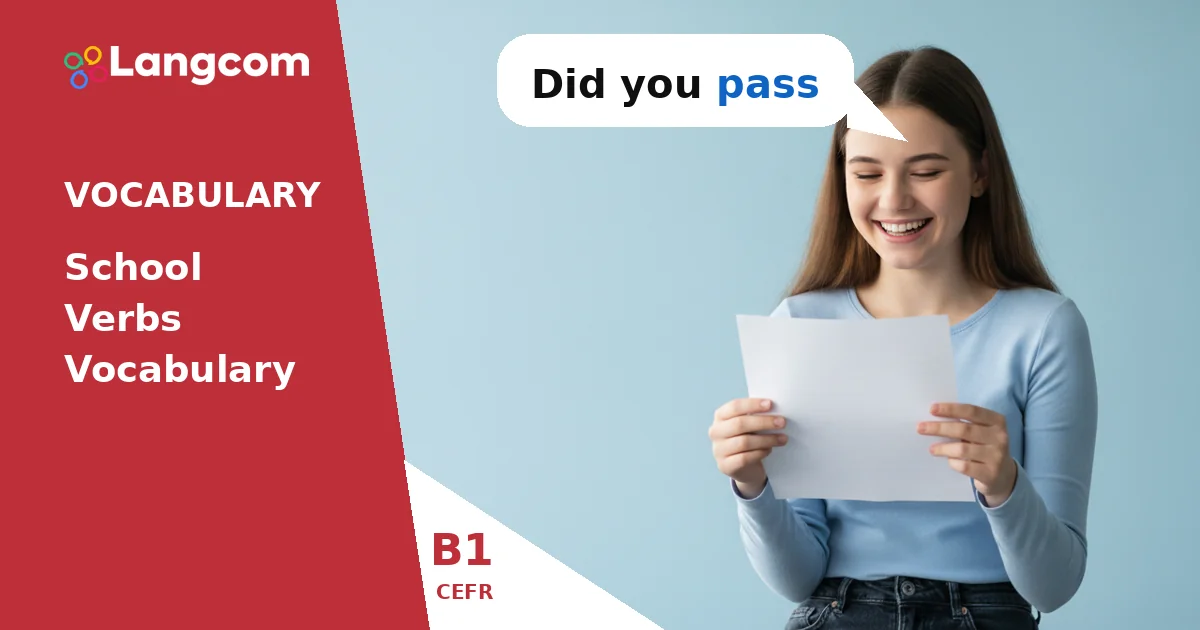
Pass e fail are opposites. They describe the result of an exam, test, or course.
- Utilizziamo pass when you succeed in an exam or course. It means you got a good enough grade.
- Example: She worked hard and passed her driving test.
- Utilizziamo fail when you do not succeed. It means you did not get a good enough grade.
- Example: Unfortunately, he failed the math exam.
How is Take used in school?
Il verbo take has many meanings, but in a school context, it often means to do an exam or a course.
- When you sit for an exam, you take an exam.
- Example: I need to take my English exam next week.
- When you attend a course or subject, you take a course oppure take a subject.
- Example: My sister is taking a photography course at university.
What's the difference: Lose vs. Miss?
Lose e miss are often confused, but they have different meanings in school situations.
- Utilizziamo lose when you no longer have something, or you don't win.
- Example: I lost my pen in class today. (The pen is gone.)
- Utilizziamo miss when you do not attend an event, class, or opportunity.
- Example: I missed the first lesson because I was sick. (I did not go to the lesson.)
- You can also miss an opportunity, like miss a deadline.
When do we use Study e Teach?
Study e teach describe different roles in the learning process.
- Utilizziamo study when you learn information, usually from books or by attending classes. This is what students do.
- Example: I need to study for my history exam tonight.
- Utilizziamo teach when you give knowledge or skills to someone. This is what teachers do.
- Example: My mother used to teach English at a secondary school.
| Verbo | Common Use / Meaning |
|---|---|
| Pass | Succeed in an exam, test, or course. Example: pass the exam. |
| Fail | Not succeed in an exam, test, or course. Example: fail a subject. |
| Take | Do an exam; attend a course or subject. Example: take an exam, take a course. |
| Lose | No longer have something; not win. Example: lose a pen, lose a game. |
| Miss | Not attend a class, event, or opportunity. Example: miss a lesson, miss a deadline. |
| Study | Spend time learning information. Example: study for a test. |
| Teach | Give knowledge or skills to someone. Example: teach English. |
Esempi
- Did you pass your driving test?
- I hope I don't fail this important exam.
- Many students take extra lessons to improve their grades.
- Don't miss the deadline for your essay!
- I lost my textbook, so I can't study properly.
- Professor Davies teaches advanced mathematics.
Esercitazione
Sei pronto a ottenere il tuo certificato?
Il corso Langcom prepara gli studenti agli esami Cambridge, IELTS, TOEFL, DELE, SIELE e Michigan.
Inizia a utilizzare LangcomErrori comuni per chi parla spagnolo
Spanish speakers often make these common mistakes:
- Confuso lose e miss:
- Errato: I lost the class yesterday.
- Corretto: I missed the class yesterday. (Meaning: I did not attend.)
- Utilizzo di lose anziché fail for exams:
- Errato: I lost the exam.
- Corretto: I failed the exam. (Meaning: I did not pass.)
- Utilizzo di do oppure make anziché take for exams:
- Errato: I did an exam. / I made an exam.
- Corretto: I took an exam.
Domande frequenti
What is the difference between 'study' and 'learn'?
Study is the process of spending time to gain knowledge, often from books or classes. Learn is the result of that process – acquiring new knowledge or skills. You study a learn.
Can I use 'take' for subjects, like 'take English'?
Sì, si può dire take English oppure take a history class. It means you are enrolled in or attending that subject or class.
How can I avoid mistakes with these verbs in the B1 Preliminary exam?
Pay close attention to context in reading and listening tasks. For example, if a sentence talks about not attending a class, use miss. If it's about not succeeding in a test, use fail. Practice using these verbs in different sentences to make sure you understand their specific meanings for tasks like 'open cloze' or 'word formation'.
Is 'pass' only for exams?
No, you can also pass a course oppure pass a driving test. It means to successfully complete something that has a required standard.




0 Commenti