
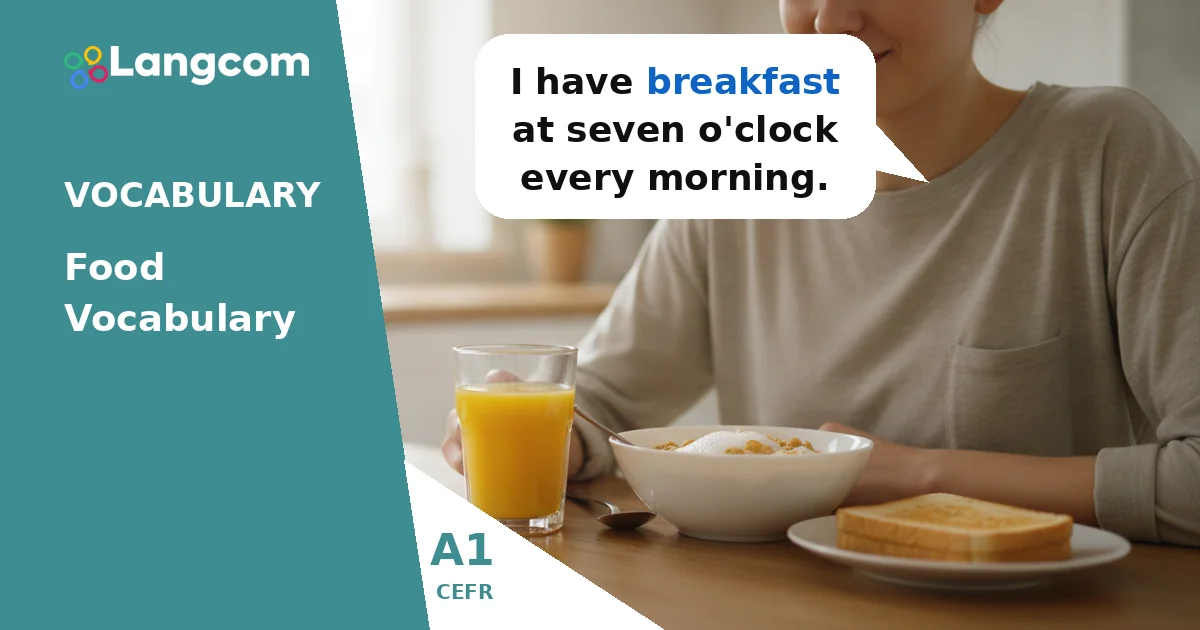

What Are the Main Meals in English?
In English, we have three main meals every day. Each meal has a special name.
-
Breakfast: This is the first meal of the day. We eat breakfast in the morning.
-
Lunch: This is the meal in the middle of the day. We usually eat lunch around noon or early afternoon.
-
Dinner: This is the last meal of the day. We eat dinner in the evening.
Sometimes, people also say supper for the evening meal, but dinner is more common.
🎓 Impara l'inglese con il metodo misto
Piccoli gruppi · Tutor IA disponibile 24 ore su 24, 7 giorni su 7 · Preparazione agli esami di Cambridge
Piani da $39 $79 al mese
How Do We Talk About Eating Meals?
To talk about eating a meal, we usually use the verb have. This is a very common way to speak in English.
-
Diciamo che have breakfast.
-
Diciamo che have lunch.
-
Diciamo che have dinner.
Ricordati di usare have for all three main meals. For example, I have breakfast every day.
How Do We Say Meal Times?
When you want to say the time of your meal, use the preposition at before the time.
-
For example, I have breakfast at seven o'clock.
-
Or, She has lunch at one PM.
You can use exact times like seven o'clock oppure one thirty. You can also use AM for morning and PM for afternoon/evening.
| Meal Name | Typical Time | Example Sentence |
|---|---|---|
| Breakfast | Morning (e.g., 7 AM - 9 AM) | I have breakfast at eight o'clock. |
| Lunch | Midday (e.g., 12 PM - 2 PM) | She has lunch at one PM. |
| Dinner | Evening (e.g., 6 PM - 9 PM) | We have dinner at seven thirty. |
Esempi
- I have breakfast at seven o'clock every morning.
- She has lunch with her friends at twelve thirty.
- We usually have dinner at eight PM.
- What time do you have breakfast?
- They have dinner late on weekends.
Esercitazione
💬 Hai bisogno di una consulenza personalizzata?
In qualità di Centro autorizzato di preparazione agli esami Cambridge, possiamo aiutarti a scegliere il corso e la certificazione più adatti alle tue esigenze. Contatta oggi stesso i nostri consulenti.
Chatta con un consulente su WhatsAppErrori comuni per chi parla spagnolo
Common Mistakes with Meal Vocabulary
Many English learners make small mistakes with meal vocabulary. Here are some common ones to avoid:
-
Using 'eat' instead of 'have': While eat is not wrong, have is more natural and common for talking about meals.
❌ I eat breakfast.
✅ I have breakfast. -
Missing 'at' for time: Always use at before a specific time.
❌ We have dinner seven o'clock.
✅ We have dinner at seven o'clock. -
Using 'the' before meal names: We usually do not use the prima breakfast, lunch, oppure dinner.
❌ I have the lunch.
✅ I have lunch.
Domande frequenti
What is the difference between breakfast, lunch, and dinner?
Breakfast is the first meal in the morning. Lunch is the meal in the middle of the day. Dinner is the last meal in the evening.
Can I use 'eat' instead of 'have' for meals?
Yes, you can use eat, but have is more common and natural in English when talking about the whole meal. For example, I have breakfast is more typical than I eat breakfast.
Do I need 'the' before meal names?
No, usually we do not use the prima breakfast, lunch, oppure dinner. You simply say have breakfast, have lunch, ecc.
How do I ask about someone's meal time?
You can ask: What time do you have breakfast? oppure When do you usually have dinner?



0 Commenti