

What Are Past Modals for Deduction and Speculation?
Past modals for deduction and speculation are special verb forms. We use them to guess or conclude about something that happened in the past. These guesses are based on information or evidence we have now.
The general structure is always modal verb + have + past participle. This structure helps us express how certain we are about a past event.
✍️ Non sai a quale livello ti trovi?
Fai il nostro test di livello gratuito e ricevi un feedback personalizzato da esaminatori certificati Cambridge.
Fai il nostro test di livello GRATUITOWhen to Use Must Have + Past Participle?
Utilizziamo must have + past participle when we are almost certain that something happened in the past. There is strong evidence to support our conclusion.
- It expresses a logical conclusion or a strong deduction.
- Think of it as saying, "I am almost 100% sure this happened."
When to Use Can't Have + Past Participle?
Utilizziamo can't have + past participle when we are almost certain that something did NOT happen in the past. There is strong evidence that makes it impossible.
- It expresses a strong deduction of impossibility.
- Think of it as saying, "I am almost 100% sure this did not happen."
When to Use Could Have + Past Participle?
Utilizziamo could have + past participle when we think something was possible in the past, but we are not certain. It suggests one of several possibilities.
- It expresses a past possibility or a weak deduction.
- It can also suggest a missed opportunity or something that was possible but didn't happen, but for deduction, it means 'perhaps it happened'.
When to Use Might Have + Past Participle oppure May Have + Past Participle?
Utilizziamo might have + past participle e may have + past participle when we are unsure about a past event. There is a possibility, but we don't have strong evidence.
- Both express a weaker possibility than could have.
- May have is slightly more formal than might have, but their meaning for past deduction is very similar.
Comparing Degrees of Certainty
Understanding the subtle differences in certainty is key for C1 English. The choice of modal verb changes how strong your deduction is:
- High Certainty (Positive): must have + past participle
- High Certainty (Negative): can't have + past participle
- Medium Certainty: could have + past participle
- Low Certainty: might have + past participle / may have + past participle
| Modal Form | Degree of Certainty | Meaning/Use |
|---|---|---|
| must have + past participle | High (Positive) | Almost 100% sure something happened |
| can't have + past participle | High (Negative) | Almost 100% sure something did not happen |
| could have + past participle | Medium | Possible that something happened; one of several options |
| might have + past participle | Low | Possible that something happened, but less certain |
| may have + past participle | Low | Possible that something happened, similar to might have (slightly more formal) |
Esempi
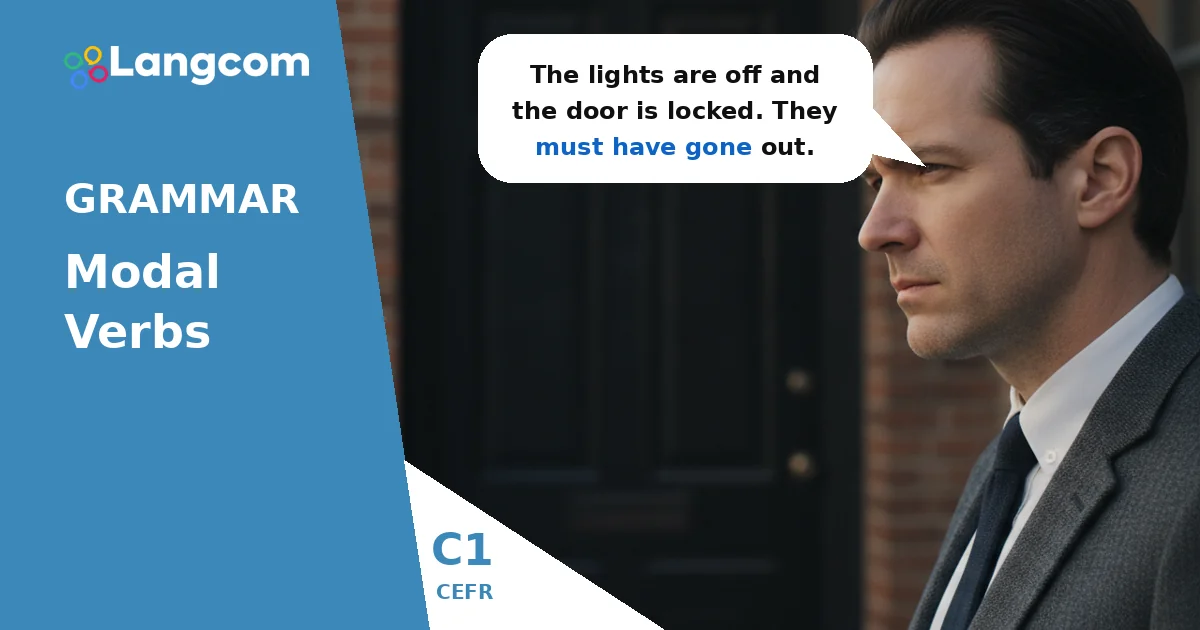
- The lights are off and the door is locked. They must have gone out.
- She looks very tired. She must have worked late last night.
- He can't have finished the entire project in one day; it's too big!
- That can't have been John I saw; he's on holiday in another country.
- I didn't see her at the party. She could have left early.
- The car keys aren't here. I could have left them at the office.
- He didn't answer his phone. He might have been sleeping.
- The package hasn't arrived. It may have been delayed by the snow.
Esercitazione
Sei pronto a ottenere il tuo certificato?
Il corso Langcom prepara gli studenti agli esami Cambridge, IELTS, TOEFL, DELE, SIELE e Michigan.
Inizia a utilizzare LangcomErrori comuni per chi parla spagnolo
Chi parla spagnolo a volte commette questi errori:
- Utilizzo di must anziché must have for past deduction:
Errato: He must be tired yesterday.
Corretto: He must have been tired yesterday. - Confuso must have (deduction) with had to (obligation):
He must have studied hard (deduction: I'm sure he studied hard).
He had to study hard (obligation: it was necessary for him to study hard). - Utilizzo di can't anziché can't have for past impossibility:
Errato: She can't be at home last night.
Corretto: She can't have been at home last night. - Incorrect past participle form: Always remember to use the correct past participle after have (ad esempio, gone, seen, done).
Domande frequenti
What is the basic structure for past modals of deduction?
The basic structure is modal verb + have + past participle. Ad esempio, must have seen, could have gone.
Qual è la differenza tra could have e might have for past deduction?
Both express possibility, but could have suggests a slightly stronger or more definite possibility than might have oppure may have. Might have implies a weaker, more uncertain possibility.
Can I use should have for past deduction?
No, should have + past participle is used to express regret or criticism about something that did not happen but ought to have happened, not for deduction or speculation about what did happen. For example, I should have studied more (regret).
How are past modals of deduction relevant for the C1 Advanced (CAE) exam?
Past modals for deduction are crucial for tasks like Part 2 (Open Cloze) and Part 4 (Key Word Transformation) of the Reading and Use of English paper. They test your ability to understand nuanced meaning and correct grammatical structure, especially when expressing certainty or possibility about past events.



0 Commenti