
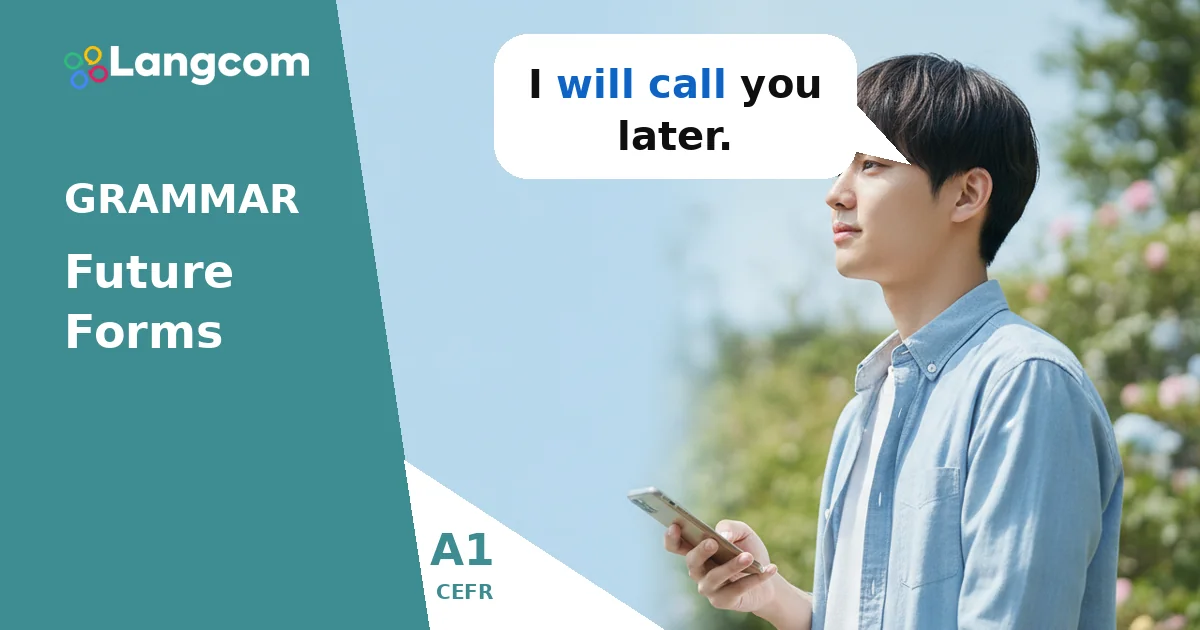

What is the ‘Will’ Future?
The ‘will’ future is a way to talk about things that are going to happen. It helps us speak about tomorrow, next week, or next year.
It is one of the first ways you learn to express future ideas in English.
🎓 Impara l'inglese con il metodo misto
Piccoli gruppi · Tutor IA disponibile 24 ore su 24, 7 giorni su 7 · Preparazione agli esami di Cambridge
Piani da $39 $79 al mese
How Do We Form Sentences with 'Will'?
Forming sentences with will is simple. You do not change will for different subjects.
- Affirmative (Positive) Sentences: Utilizziamo subject + will + base form of the verb.
For example, I will go. oppure She will study.
- Negative Sentences: We add not dopo will. The short form is won't.
Diciamo che subject + will not (won't) + base form of the verb. Ad esempio, They won't come.
- Domande: We put will prima del soggetto.
The structure is Will + subject + base form of the verb? For example, Will you help me?
- Short Answers: Utilizziamo Yes, subject + will. oppure No, subject + won't.
For example, Yes, I will. oppure No, she won't.
When Do We Use 'Will'?
For A1 English, we use will mainly for two situations:
- Predictions: When we think something will happen in the future. We are guessing or stating a future fact.
For example, It will rain tomorrow. (You think it will rain.)
- Spontaneous Decisions: When you decide something at the moment you are speaking. You did not plan it before.
For example, I'm hungry. I will make a sandwich. (You decide now.)
Common Time Expressions for the Future
These words help us show that we are talking about the future with will:
- tomorrow
- next week / month / year
- in 2030 (or any future year)
- later today / tonight
- soon
| Tipo | Structure | Esempio |
|---|---|---|
| Affirmative | Subject + will + base verb | I will travel. |
| Negative | Subject + will not (won't) + base verb | She won't travel. |
| Question | Will + subject + base verb? | Will you travel? |
| Short Answer (Yes) | Yes, subject + will. | Yes, I will. |
| Short Answer (No) | No, subject + won't. | No, I won't. |
Esempi
- I will call you later.
- She won't be here next Monday.
- Will they visit us soon?
- Yes, they will.
- No, I won't.
- It will be sunny tomorrow.
- I think he will pass the exam.
- The train will arrive in ten minutes.
Esercitazione
💬 Hai bisogno di una consulenza personalizzata?
In qualità di Centro autorizzato di preparazione agli esami Cambridge, possiamo aiutarti a scegliere il corso e la certificazione più adatti alle tue esigenze. Contatta oggi stesso i nostri consulenti.
Chatta con un consulente su WhatsAppErrori comuni per chi parla spagnolo
Using Present Simple for Future
Spanish speakers sometimes use the present simple to talk about the future, similar to how it works in Spanish. However, in English, we usually need a future form like will.
- Errato: I go to the cinema tomorrow.
- Corretto: I will go to the cinema tomorrow.
Forgetting the Base Form of the Verb
Remember that after will, the verb must always be in its base form (infinitive without 'to').
- Errato: She will to study.
- Corretto: She will study.
Domande frequenti
Can I use 'will' for plans I made before?
For A1, it's best to use will for predictions or decisions made at the moment of speaking. For plans you made before, English often uses be going to or the present continuous, but you will learn these later.
Is 'will' always used for the future?
Mostly, yes. For A1, think of will as your main word for talking about future predictions and spontaneous decisions. It helps you express what you think will happen or what you decide to do right now.
What is the short form of 'will not'?
The short form of will not è won't. It is very common in spoken English and informal writing.


0 Commenti