
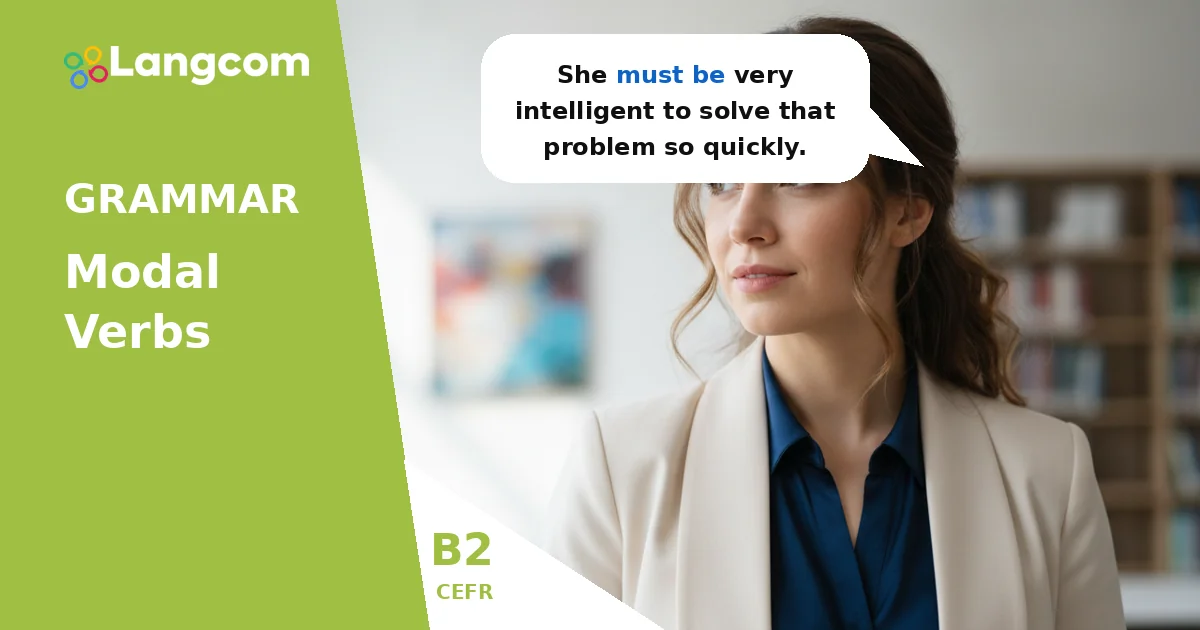

You use modal verbs like must, can’t, could, might, e may to express how certain you are about something. These verbs help you guess or make logical conclusions about present or past situations. For example, if you see someone yawning, you might say, “She must be tired.” This shows you are almost certain.
When you are less certain, you can use could, might, oppure may, as in “He might be at home.” For impossible situations, use can’t, come “It can’t be true.” For past events, you add have + past participle, for instance, “They must have left.” Mastering these modals is key for B2 English communication.
What are Modal Verbs for Speculation and Deduction?
Modal verbs are special verbs that add extra meaning to the main verb in a sentence. For speculation and deduction, they show how sure you are about something.
You use them to make guesses or draw conclusions based on evidence you have. This is common in everyday conversation and in exams like the B2 First.
✍️ Non sai a quale livello ti trovi?
Fai il nostro test di livello gratuito e ricevi un feedback personalizzato da esaminatori certificati Cambridge.
Fai il nostro test di livello GRATUITOHow Do We Speculate About the Present?
To talk about what you think is true or possible right now, you use different modal verbs. Your choice depends on your level of certainty.
- For strong certainty (almost 100% sure): Utilizzo must. This means you have good reasons to believe something is true.
Esempio: "The lights are on. They must be home."
- For strong certainty that something is NOT true (almost 100% sure it's impossible): Utilizzo can't oppure couldn't.
Esempio: "She can't be 40. She looks so young!"
- For uncertainty (less than 50% sure): Utilizzo could, might, oppure may. These all mean 'perhaps' or 'possibly'.
Esempio: "He might be busy, or he could be sleeping."
How Do We Speculate About the Past?
When you want to guess or conclude about something that happened in the past, the structure changes slightly. You use modal + have + past participle.
- For strong certainty about a past event: Utilizzo must have + past participle.
Esempio: "She's soaking wet. It must have rained."
- For strong certainty that a past event was impossible: Utilizzo can't have + past participle oppure couldn't have + past participle.
Esempio: "He can't have seen me. I was hiding."
- For uncertainty about a past event: Utilizzo could have + past participle, might have + past participle, oppure may have + past participle.
Esempio: "They might have forgotten about the meeting."
What is the Difference Between Certainty and Uncertainty?
The main difference is how confident you are in your guess. This is reflected in the modal verb you choose.
- High Certainty: You have strong evidence. Use must (positive) or can't/couldn't (negative).
- Low Certainty: You are just guessing or considering possibilities. Use could, might, oppure may.
Remember that may is slightly more formal than might oppure could, but all three express similar levels of possibility.
| Certainty Level | Present Situation | Past Situation |
|---|---|---|
| Almost 100% Sure (Positive) | must + base verb | must have + past participle |
| Almost 100% Sure (Negative/Impossible) | can't / couldn't + base verb | can't / couldn't have + past participle |
| Less than 50% Sure (Possible) | could / might / may + base verb | could / might / may have + past participle |
Esempi
- She must be very intelligent to solve that problem so quickly.
- It can't be true that he won the lottery; he never buys tickets.
- They might be at the park; I saw their car parked nearby.
- He could be working late tonight, so don't wait for him.
- The package may arrive tomorrow, but it's not guaranteed.
- You must have been very tired after such a long journey.
- She can't have finished the whole project by herself; it's too big.
- They might have gone to the beach, as it's a sunny day.
Esercitazione
Sei pronto a ottenere il tuo certificato?
Il corso Langcom prepara gli studenti agli esami Cambridge, IELTS, TOEFL, DELE, SIELE e Michigan.
Inizia a utilizzare LangcomErrori comuni per chi parla spagnolo
Spanish speakers often make specific mistakes with these modals:
- Confuso must with obligation: In Spanish, 'deber' can mean obligation or deduction. In English, must for deduction means 'it is almost certain', not 'it is obligatory'. For obligation, use have to oppure must (for strong personal obligation).
Errato: "He must study a lot." (If you mean 'he probably studies a lot', use must study. If you mean 'he is obliged to study', use has to study.)
Corretto: "He must be a doctor; he's wearing a white coat." (Deduction)
Corretto: "He has to study for his exam." (Obligation) - Utilizzo di can for possibility: In Spanish, 'puede ser' (can be) expresses possibility. In English, can is generally for ability or permission, not for speculation about something that might be true. Use could, might, oppure may instead.
Errato: "It can be cold tomorrow."
Corretto: "It could be cold tomorrow." - Omitting have for past speculation: Remember the structure modal + have + past participle for past events.
Errato: "She must went home."
Corretto: "She must have gone home."
Domande frequenti
What is the main difference between 'must' and 'might' for speculation?
The main difference is the level of certainty. You use must when you are almost 100% sure something is true based on evidence. You use might (oppure could, may) when you are less certain, perhaps 50% sure or less, that something is possible.
Can I use 'couldn't' for certainty that something is impossible?
Yes, you can use couldn't (oppure can't) to express strong certainty that something is impossible or not true. For example, "That couldn't be John; he's on holiday."
How are these modal verbs tested in the B2 First exam?
In the B2 First (FCE) exam, you might find these modals in the Reading and Use of English paper, especially in Part 2 (Open Cloze) or Part 4 (Key Word Transformation). You may need to complete sentences with the correct modal verb or transform sentences while retaining the meaning of speculation or deduction. They are also important for expressing opinions and making deductions in the Speaking and Writing papers.
Is there a difference between 'could have' and 'might have'?
Entrambi could have e might have express uncertainty about past events. They are often interchangeable. May have is also very similar. The choice often depends on slight nuance or personal preference, but all three indicate possibility, not certainty.


0 Commenti