

What are Common Fruits in English?
Fruits are delicious and healthy foods. Learning their names helps you talk about food in English.
- A banana is a long, yellow fruit. I like bananas.
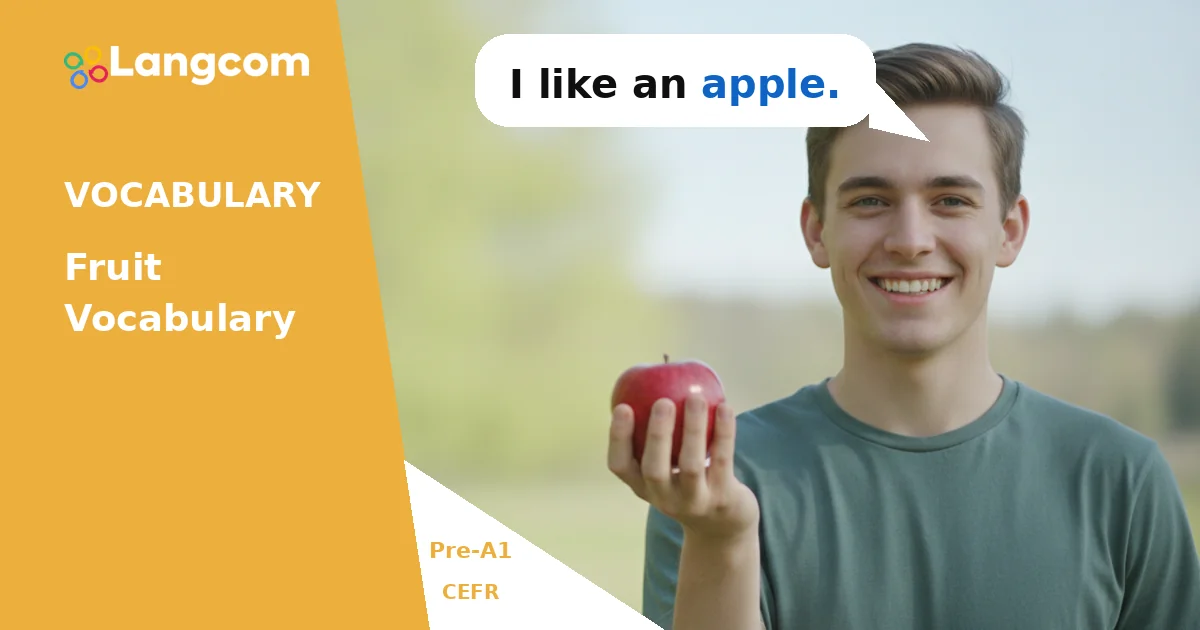
- Un apple is a round fruit, often red or green. She eats an apple.
- Grapes are small, round fruits that grow in bunches. We have green grapes.
- A pear is a sweet fruit, wider at the bottom. He likes pears.
- A kiwi is a small, brown fruit with green inside. Kiwi is good.
- A pineapple is a large, sweet, tropical fruit. I want pineapple juice.
- A watermelon is a big, green fruit with red inside. Watermelon is fresh.
- A coconut is a large, hard fruit from a palm tree. I drink coconut water.
🎓 Impara l'inglese con il metodo misto
Piccoli gruppi · Tutor IA disponibile 24 ore su 24, 7 giorni su 7 · Preparazione agli esami di Cambridge
Piani da $39 $79 al mese
Food Words: Fruits and Vegetables
Sometimes, we learn words for fruits and vegetables together because they are all important foods. In English, some foods are called 'fruits' and some are called 'vegetables'.
Here are some other food words you might learn:
- A carrot is a long, orange vegetable. I eat carrots.
- A pea is a small, green, round vegetable. Peas are small.
- A potato is a round vegetable that grows in the ground. I like potatoes.
It's okay to learn them all as 'food words' for now!
Using 'a' or 'an' with Fruit Names
In English, we use a oppure an before singular nouns. This is important for Pre-A1 learners.
- Utilizzo a before words that start with a consonant sound (b, c, d, f, g, etc.). For example: a banana, a pear, a kiwi.
- Utilizzo an before words that start with a vowel sound (a, e, i, o, u). For example: an apple.
Remember, we do not use a oppure an with plural words like grapes.
| Singular | Plural |
|---|---|
| an apple | apples |
| a banana | bananas |
| a carrot | carrots |
| a coconut | coconuts |
| a grape | grapes |
| a kiwi | kiwis |
| a pea | peas |
| a pear | pears |
| a pineapple | pineapples |
| a potato | potatoes |
| a watermelon | watermelons |
Esempi
- I like an apple.
- Do you eat bananas?
- She has a pineapple.
- We want some grapes.
- He likes carrots.
Esercitazione
💬 Hai bisogno di una consulenza personalizzata?
In qualità di Centro autorizzato di preparazione agli esami Cambridge, possiamo aiutarti a scegliere il corso e la certificazione più adatti alle tue esigenze. Contatta oggi stesso i nostri consulenti.
Chatta con un consulente su WhatsAppErrori comuni per chi parla spagnolo
Spanish speakers sometimes forget to use a oppure an before a singular fruit name, or they forget the plural -s.
- Errato: I like apple.
- Corretto: I like an apple.
- Errato: I eat banana.
- Corretto: I eat a banana.
- Errato: She likes grape. (if talking about many)
- Corretto: She likes grapes.
Domande frequenti
What is the difference between 'a' and 'an'?
Utilizziamo a before words starting with a consonant sound (like a banana). We use an before words starting with a vowel sound (like an apple).
How do I say I like a fruit?
You can say I like apples. oppure I like a banana. If you like many, use the plural. If you like one specific fruit, use a oppure an.
Are all the words in this lesson fruits?
No, some words like carrot, pea, e potato are technically vegetables. But we often learn them together as important food vocabulary for beginners.



0 Commenti