
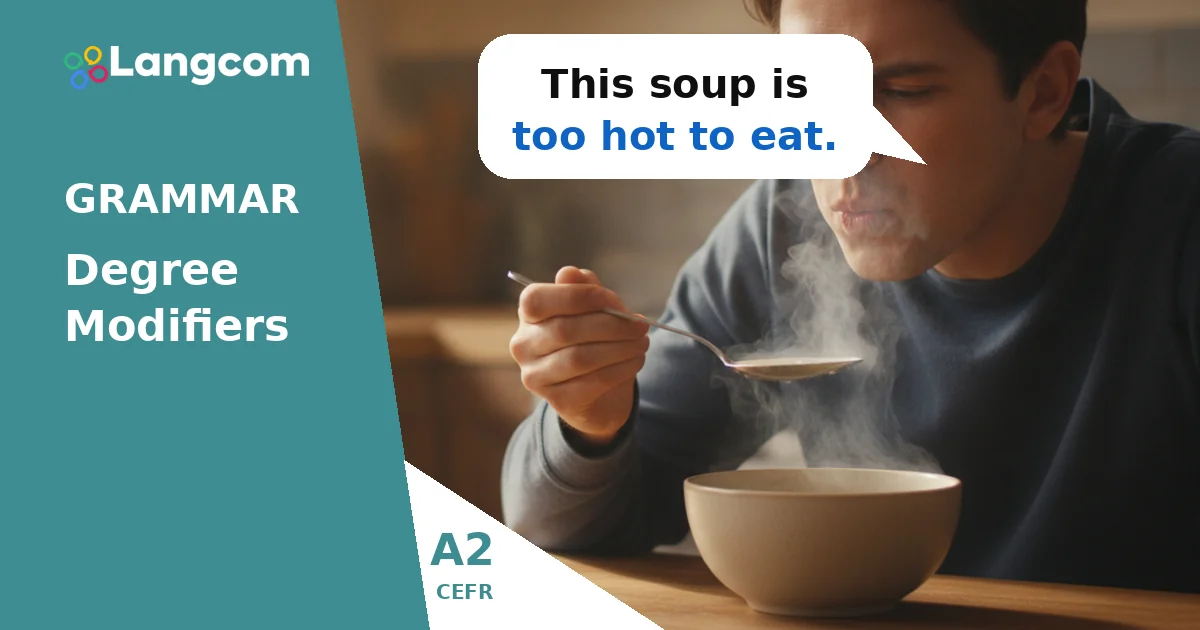

What does ‘too’ mean in English?
Utilizziamo too to say that something is more than necessary, more than wanted, or more than possible.
- It means ‘excessively’ or ‘more than sufficient’.
- We always put too prima an adjective or an adverb.
✍️ Non sai a quale livello ti trovi?
Fai il nostro test di livello gratuito e ricevi un feedback personalizzato da esaminatori certificati Cambridge.
Fai il nostro test di livello GRATUITOHow do we use 'enough'?
Utilizziamo enough to say that something is sufficient, or the correct amount.
- It means 'sufficiently' or 'as much as needed'.
- We put enough dopo an adjective or an adverb.
- We put enough prima a noun (countable or uncountable).
What about 'not enough'?
When we use not enough, it means something is less than necessary or less than wanted.
- It expresses a lack of something.
- The word order rules are the same as for enough: dopo an adjective/adverb, and prima a noun.
Word Order: 'Too' and 'Enough' Summary
The position of too e enough is very important. Look at these patterns:
| Structure | Esempio |
|---|---|
| too + adjective | This coffee is too hot. |
| too + adverb | You are driving too fast. |
| adjective + enough | Are you warm enough? |
| adverb + enough | He didn't run fast enough. |
| enough + noun | We have enough chairs. |
| not + adjective + enough | She isn't tall enough. |
| not + enough + noun | There isn't enough water. |
Esempi
- This soup is too hot to eat.
- He drives too fast.
- Are you warm enough?
- She isn't old enough to vote.
- We have enough food for everyone.
- There isn't enough space in this car.
- I don't have enough time to finish this.
Esercitazione
Sei pronto a ottenere il tuo certificato?
Il corso Langcom prepara gli studenti agli esami Cambridge, IELTS, TOEFL, DELE, SIELE e Michigan.
Inizia a utilizzare LangcomErrori comuni per chi parla spagnolo
Spanish speakers often make mistakes with the word order of enough, especially with adjectives.
- Errato: I am enough strong.
- Corretto: I am strong enough. (Adjective + enough)
Remember that enough always comes AFTER adjectives and adverbs, but BEFORE nouns.
- Errato: We have money enough.
- Corretto: We have enough money. (Enough + Noun)
Also, be careful not to confuse too con very. Very just means 'a lot', but too means 'more than is good or wanted'.
- It's very cold. (Just a fact, it's very cold.)
- It's too cold. (It's so cold that I can't do something, like go outside.)
Domande frequenti
What is the main difference between 'too' and 'enough'?
The main difference is that too means 'more than necessary or desired', while enough means 'sufficient' or 'the right amount'. Not enough means 'less than necessary'.
Can I use 'too' with nouns?
No, we usually use too much with uncountable nouns (e.g., too much sugar) and too many with countable nouns (e.g., too many people). We use too directly before adjectives and adverbs.
Is the word order for 'too' and 'enough' always the same?
No, the word order changes. Too always comes prima adjectives and adverbs (e.g., too slow). Enough comes dopo adjectives and adverbs (e.g., slow enough) but prima nouns (e.g., enough time).
How might 'too' and 'enough' appear in the A2 Key exam?
In the A2 Key exam, you might see too e enough in Reading and Writing Part 6 (Open Cloze) or Part 7 (Word Transformation), where you need to complete sentences or rewrite them using these words correctly to express degree.


0 Commenti