
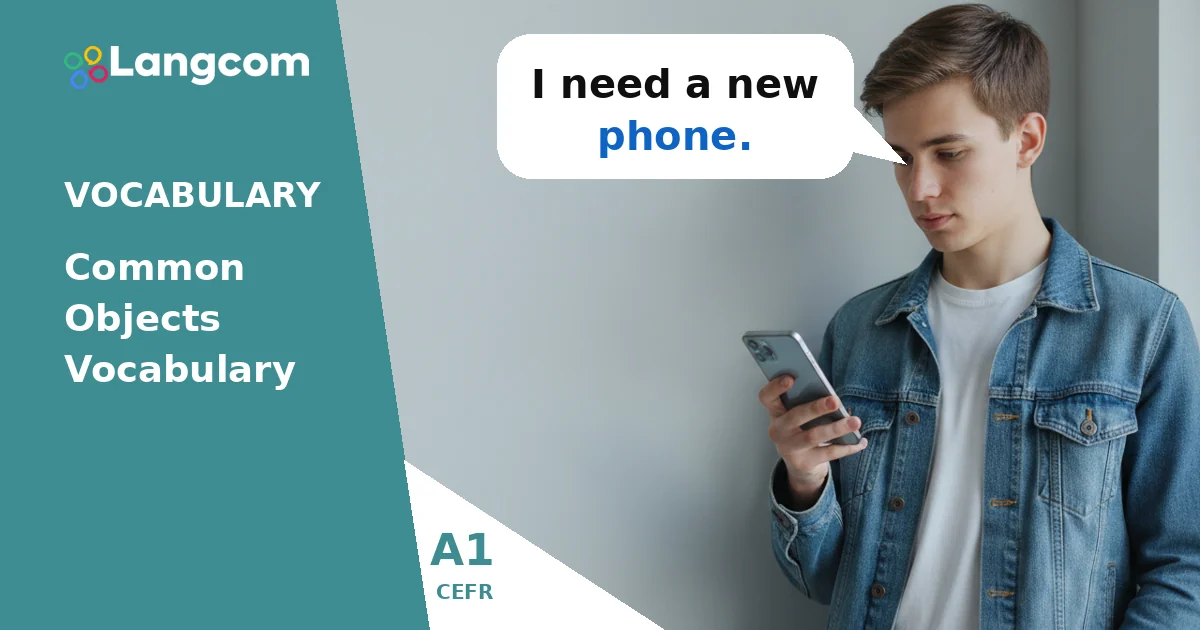

What are Common Objects in English?
Common objects are the things you find in your home, at work, or when you are out. They are everyday items that everyone knows.
Learning these words helps you talk about your daily life. It is important for basic communication in English.
🎓 Impara l'inglese con il metodo misto
Piccoli gruppi · Tutor IA disponibile 24 ore su 24, 7 giorni su 7 · Preparazione agli esami di Cambridge
Piani da $39 $79 al mese
Essential A1 Common Objects Vocabulary
Here is a list of important words for common objects. Try to say each word aloud to practice your pronunciation.
- a book: You read it.
- a newspaper: You read news in it.
- a phone: You use it to call people.
- a key: You use it to open doors.
- a computer: You use it for work or fun.
- a knife: You use it to cut food.
- a ticket: You need it for a bus, train, or movie.
- a watch: You wear it to tell the time.
- an umbrella: You use it when it rains.
- a bottle of water: You drink water from it.
When to Use 'A' and 'An' with Objects?
In English, we use a oppure an before a singular noun. These are called indefinite articles.
- Utilizzo a before words that start with a consonant sound. For example: a book, a phone, a key.
- Utilizzo an before words that start with a vowel sound (a, e, i, o, u). For example: an umbrella.
Remember, it is about the *sound*, not just the letter. For A1, focus on the common words you learn.
How to Use These Words in Simple Sentences?
You can use these words to describe what you see or what you have. Here are some basic sentence structures:
- To identify an object: This is a book. / It's an umbrella.
- To say what you possess: I have a key. / She has a phone.
- To ask about an object: Is this a computer?
Practice making your own sentences using the vocabulary you learned.
| Parola inglese | Example Sentence |
|---|---|
| a book | I am reading a book. |
| a newspaper | He is buying a newspaper. |
| a phone | My phone is new. |
| a key | Do you have a key? |
| a computer | She uses a computer for work. |
| a knife | Be careful with a knife. |
| a ticket | I need a ticket for the bus. |
| a watch | He wears a watch. |
| an umbrella | Take an umbrella, it's raining. |
| a bottle of water | I want a bottle of water. |
Esempi
- I need a new phone.
- This is a very old book.
- Do you have a key for the door?
- It's raining, I need an umbrella.
- She bought a ticket for the concert.
- He is reading a newspaper.
- I always carry a bottle of water.
- My computer is very fast.
Esercitazione
💬 Hai bisogno di una consulenza personalizzata?
In qualità di Centro autorizzato di preparazione agli esami Cambridge, possiamo aiutarti a scegliere il corso e la certificazione più adatti alle tue esigenze. Contatta oggi stesso i nostri consulenti.
Chatta con un consulente su WhatsAppErrori comuni per chi parla spagnolo
Spanish speakers sometimes make mistakes with articles (a/an) because Spanish nouns often have gendered articles (e.g., el libro, la mesa).
- Omitting the article: In English, you almost always need a oppure an before a singular countable noun.
✗ I have book.
✓ I have a book. - Confuso a e an: Remember the sound rule.
✗ a umbrella
✓ an umbrella
Domande frequenti
Why is it important to learn common objects vocabulary?
Learning these words helps you describe your everyday environment and communicate basic needs. It is fundamental for building simple sentences and understanding daily conversations in English.
What is the difference between 'a' and 'an'?
Utilizziamo a before words that start with a consonant sound (e.g., a book). We use an before words that start with a vowel sound (e.g., an umbrella).
Can I use 'the' instead of 'a' or 'an'?
Si utilizza the when you are talking about a specific object that both you and the listener know about (e.g., The book on the table is mine.). For general, non-specific objects, use a oppure an.
How can I practice this new vocabulary?
Look around your room and try to name objects in English. Make simple sentences like This is a chair. oppure I have a pen. You can also label items in your home.

0 Commenti