

Why is City Vocabulary Important for B2 Learners?
At B2 level, you need to discuss complex topics with more detail and accuracy. Cities are central to modern life, so being able to describe them well is very useful.
This vocabulary helps you talk about:
- How cities grow and change.
- The daily experiences of people living in cities.
- Environmental issues and solutions in urban areas.
- The advantages and disadvantages of city life.
✍️ Non sai a quale livello ti trovi?
Fai il nostro test di livello gratuito e ricevi un feedback personalizzato da esaminatori certificati Cambridge.
Fai il nostro test di livello GRATUITOWhat is Urban Development?
Urban development refers to the process of cities growing and changing. This includes building new homes, offices, and infrastructure.
- Residential areas are parts of a city where people live. These areas usually have houses or apartment buildings, not many large shops or offices.
- Local residents are the people who live in a particular area or city.
How Do People Move Around in Cities?
Movement within cities is a big part of daily life. Understanding these terms helps you discuss transport and related issues.
- Public transport includes buses, trains, trams, and subways that everyone can use. It is often a key part of city planning.
- Traffic congestion means there are too many vehicles on the roads, causing slow movement or traffic jams. It is a common problem in many large cities.
- A parking space is a specific area where you can leave your car. Finding one can be difficult in busy city centres.
What Are City Challenges and Solutions?
Cities face many challenges, especially related to the environment and living conditions. Vocabulary helps you discuss these problems and potential solutions.
- Air pollution is damage caused to the air by harmful substances, often from cars and factories. It affects health and the environment.
- Green spaces are parks, gardens, or other natural areas within a city. They are important for recreation, mental health, and improving air quality.
- Quality of life describes the level of enjoyment, health, and comfort in someone's life. Good city planning aims to improve this for its residents.
- A sustainable city is designed to have minimal environmental impact, often using renewable energy and efficient resource management.
- A smart city uses technology to improve services, manage resources, and enhance the quality of life for its local residents.
| Vocabulary Item | Significato |
|---|---|
| Urban development | The process of cities growing and changing, including building new areas. |
| Residential areas | Parts of a city where people live (houses, apartments). |
| Local residents | The people who live in a particular area or city. |
| Public transport | Buses, trains, trams, etc., available for everyone to use. |
| Traffic congestion | Too many vehicles on the road, causing slow or stopped traffic. |
| Parking space | An area where a car can be parked. |
| Air pollution | Harmful substances in the air, often from vehicles and industry. |
| Green spaces | Parks, gardens, or natural areas within a city. |
| Quality of life | The level of enjoyment, health, and comfort in someone's life. |
| Sustainable city | A city designed to reduce its environmental impact. |
Esempi
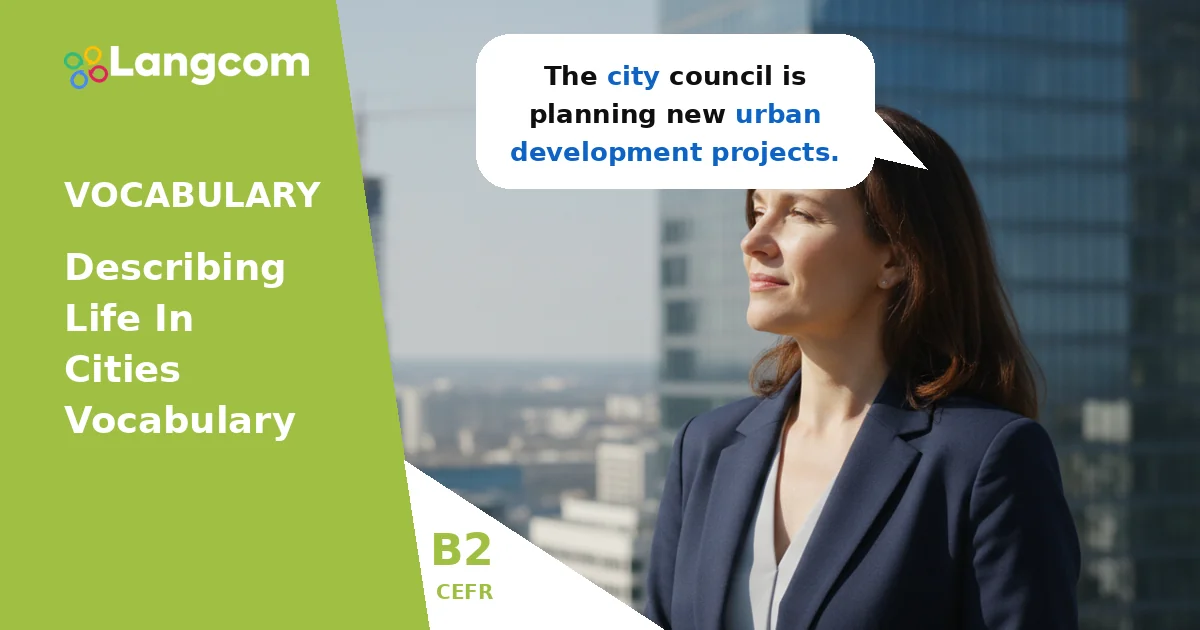
- The city council is planning new urban development projects.
- Our apartment is located in a quiet residential area.
- Many local residents complain about the noise from the new construction.
- Using public transport helps reduce traffic congestion.
- Traffic congestion is a major problem during rush hour.
- It's hard to find a parking space downtown on weekends.
- Air pollution levels are often higher in industrial areas.
- The city has invested in more green spaces for its citizens.
- Improving the quality of life is the main goal of the new city plan.
- Masdar City in the UAE is an example of a sustainable city.
- Smart city initiatives use data to make urban services more efficient.
Esercitazione
Sei pronto a ottenere il tuo certificato?
Il corso Langcom prepara gli studenti agli esami Cambridge, IELTS, TOEFL, DELE, SIELE e Michigan.
Inizia a utilizzare LangcomErrori comuni per chi parla spagnolo
Errori comuni per chi parla spagnolo
- Using 'traffic' instead of traffic congestion: In Spanish, 'tráfico' can mean both general traffic and a traffic jam. In English, if you mean a jam, use traffic congestion or 'traffic jam'.
Errato: There was a lot of traffic this morning. (If you mean a jam)
Corretto: There was a lot of traffic congestion this morning. oppure There was a big traffic jam this morning. - Saying 'life quality' instead of quality of life: This is a direct translation from 'calidad de vida'. Remember the correct English order.
Errato: The city has good life quality.
Corretto: The city has a good quality of life. - Using 'green areas' instead of green spaces: While 'green areas' is understandable, green spaces is the more natural and common collocation in English.
Errato: We need more green areas in the city.
Corretto: We need more green spaces in the city.
Domande frequenti
What is the difference between 'urban' and 'rural'?
Urban refers to cities or towns, while rural refers to the countryside, outside of cities and towns. For example, urban development happens in cities, but rural areas are often used for farming.
Can I use 'inhabitants' instead of local residents?
Yes, 'inhabitants' is also correct and means the same thing: people who live in a place. However, local residents is very common, especially when talking about people living in a specific part of a city or neighbourhood.
How can I practice this vocabulary for my B2 exam?
For B2 exams like Cambridge First (FCE) or IELTS, you might encounter tasks where you need to describe places or discuss social issues. Practice by writing short paragraphs about your own city using these words, or discuss city problems and solutions with a study partner. Focus on using the vocabulary naturally in context.
What does sustainable city mean?
A sustainable city is a city designed to have a minimal environmental impact. This means it uses resources efficiently, reduces waste and pollution, and often relies on renewable energy sources. The goal is to meet the needs of the present without harming the ability of future generations to meet their own needs.



0 Commenti