
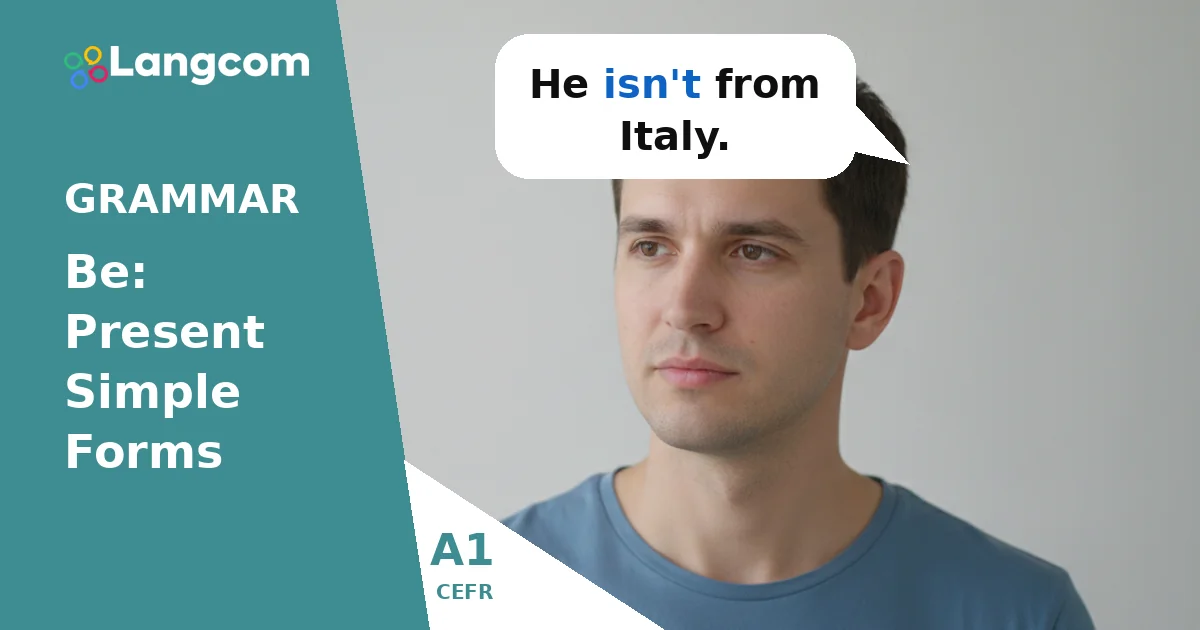

How do we make ‘be’ negative for ‘he’, ‘she’, and ‘they’?
To make a sentence negative with the verb be, we simply add the word not dopo is oppure are.
- For he e she, we use is not.
- For they, we use are not.
We often use shorter forms called contractions in everyday English. These are:
- is not becomes isn’t
- are not becomes aren’t
🎓 Impara l'inglese con il metodo misto
Piccoli gruppi · Tutor IA disponibile 24 ore su 24, 7 giorni su 7 · Preparazione agli esami di Cambridge
Piani da $39 $79 al mese
How do we ask 'yes/no' questions with 'be'?
To ask a question that can be answered with 'yes' or 'no', we change the word order of the sentence. We put Is oppure Are at the beginning.
- La struttura è la seguente: Is/Are + subject (he/she/they) + rest of the sentence?
When someone asks a 'yes/no' question with be, you can give a short answer.
- For positive answers, use Yes, + subject + is/are. Do not use contractions here.
- For negative answers, use No, + subject + isn't/aren't. We usually use contractions here.
How do we ask 'Wh-' questions with 'be'?
'Wh-' questions ask for specific information, not just 'yes' or 'no'. Common 'Wh-' words include who, what, where, e when.
- La struttura è la seguente: Wh- word + is/are + subject (he/she/they) + rest of the sentence?
| Oggetto | Positive | Negativo | Yes/No Question | Wh- Question Example |
|---|---|---|---|---|
| He | He is happy. | He isn't happy. | Is he happy? | Where is he? |
| She | She is a student. | She isn't a student. | Is she a student? | Who is she? |
| They | They are friends. | They aren't friends. | Are they friends? | What are they? |
Esempi
- He isn't from Italy.
- She is not a doctor.
- They aren't sad.
- Is he happy? Yes, he is.
- Is she a teacher? No, she isn't.
- Are they students? Yes, they are.
- Where is he?
- Who is she?
- What are they?
Esercitazione
💬 Hai bisogno di una consulenza personalizzata?
In qualità di Centro autorizzato di preparazione agli esami Cambridge, possiamo aiutarti a scegliere il corso e la certificazione più adatti alle tue esigenze. Contatta oggi stesso i nostri consulenti.
Chatta con un consulente su WhatsAppErrori comuni per chi parla spagnolo
Errori comuni per chi parla spagnolo
When learning English, Spanish speakers sometimes make specific mistakes with be negative and questions:
- Missing Subject Pronoun: In Spanish, you often don't need a subject pronoun. In English, you always need one.
- Errato: Is happy?
- Corretto: Is he happy?
- Incorrect Word Order for Questions: In English, the verb be moves to the beginning for questions.
- Errato: He is happy?
- Corretto: Is he happy?
- Using Contractions in Positive Short Answers: We do not use contractions for positive short answers.
- Errato: Yes, he's.
- Corretto: Yes, he is.
- 'Not' in the Wrong Place: La parola not always comes after is oppure are.
- Errato: Not he is happy.
- Corretto: He is not happy. oppure He isn't happy.
Domande frequenti
What does the verb 'be' mean?
Il verbo be means "ser" or "estar" in Spanish. It helps us talk about who someone is, what something is, where someone is, or how someone feels.
Why do we use contractions like 'isn't' and 'aren't'?
Contractions are very common in spoken English and in informal writing. They make sentences sound more natural and help you speak more quickly.
Can I always say 'is not' or 'are not' instead of 'isn't' or 'aren't'?
Yes, you can. The full forms is not e are not are always correct. They are often used in more formal writing or when you want to emphasize the 'not'.
Do these rules apply to 'I' and 'you' too?
Yes, the basic idea is similar. For I, you use am not (I'm not) and for questions, Am I...? For you, you use are not (you aren't) and for questions, Are you...?

0 Commenti