

What is the Present Perfect Tense?
The Present Perfect tense connects the past to the present. It describes actions that started in the past and continue now, or actions that happened at an unspecified time in the past but have a result in the present.
The form is have oppure has + the past participle of the main verb.
- I have lived here for five years. (Still live here)
- She has seen that movie. (Result: she knows the story now)
🎓 Impara l'inglese con il metodo misto
Piccoli gruppi · Tutor IA disponibile 24 ore su 24, 7 giorni su 7 · Preparazione agli esami di Cambridge
Piani da $39 $79 al mese
How Do We Use 'Just'?
Utilizziamo just to say that something happened a very short time ago. It emphasizes that the action is very recent.
- Just usually comes between have/has e il past participle.
- Utilizziamo just mainly in positive statements.
Esempi:
- I have just finished my homework. (I finished it a moment ago.)
- They have just arrived at the airport. (They arrived very recently.)
When Should I Use 'Already'?
Utilizziamo already to say that something happened before now, or sooner than expected. It shows that an action is complete.
- Already usually comes between have/has e il past participle.
- You can also place already at the end of a sentence, especially for emphasis, but the middle position is more common.
- Utilizziamo already mainly in positive statements and sometimes in questions to show surprise.
Esempi:
- She has already eaten breakfast. (She ate it before now.)
- We have already seen this film. (We saw it before, maybe we don't want to see it again.)
- Have you already finished? (I'm surprised you finished so quickly!)
What About 'Yet'?
Utilizziamo yet to talk about something that we expect to happen. It means 'up to now'.
- Yet always comes at the end of the sentence.
- Utilizziamo yet only in negative sentences and questions.
Esempi:
- I haven't finished my report yet. (I still need to finish it.)
- Has he called you yet? (Are you still waiting for his call?)
- They haven't decided yet where to go. (They will decide later.)
Can I Use Present Perfect with Past Time Expressions?
No, you cannot use the Present Perfect tense with specific past time expressions. This is a very common mistake.
- Use the Present Perfect for actions connected to the present, without a specific past time.
- If you mention a specific time in the past (e.g., yesterday, last week, two hours ago), you must use the Past Simple tense.
Compare these:
- I have seen that movie. (Present Perfect - unspecified time, result now)
- I saw that movie last night. (Past Simple - specific past time)
| Adverb | Significato | Position | Sentence Type |
|---|---|---|---|
| Just | A very short time ago | Between have/has e past participle | Positive statements |
| Already | Before now; sooner than expected | Between have/has e past participle (or at end) | Positive statements, questions (for surprise) |
| Yet | Up to now; expected to happen | At the end of the sentence | Negative statements, questions |
Esempi
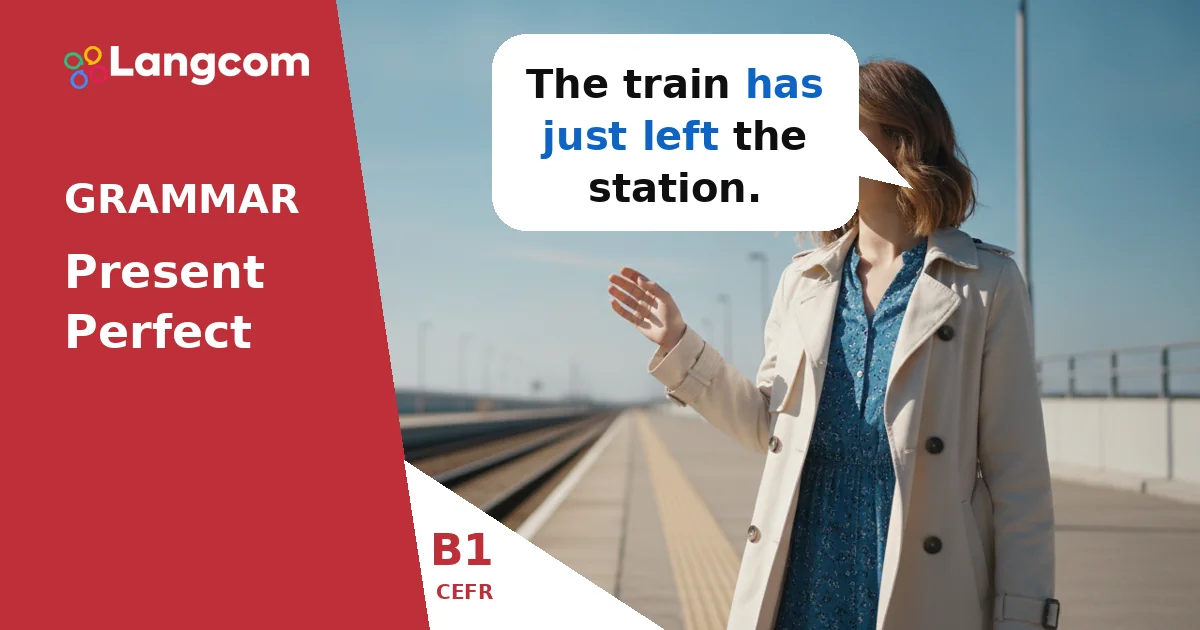
- The train has just left the station.
- Have you just woken up?
- My sister has already bought her plane ticket.
- I've already told you this story.
- They haven't started the meeting yet.
- Has the mail arrived yet?
- We have just finished dinner.
- He has already learned all the new vocabulary.
- The pizza isn't ready yet.
Esercitazione
✍️ Non sai a quale livello ti trovi?
Fai il nostro test di livello gratuito e ricevi un feedback personalizzato da esaminatori certificati Cambridge.
Fai il nostro test di livello GRATUITOErrori comuni per chi parla spagnolo
Many Spanish speakers make these common mistakes when using the Present Perfect with 'just', 'already', and 'yet':
- Using Present Perfect with specific past times: In Spanish, you might say 'He comido esta mañana' (I have eaten this morning). In English, if 'this morning' is finished, you must use Past Simple: I ate this morning. NEVER say I have already eaten yesterday. Instead, say I already ate yesterday (Past Simple) or I have already eaten (Present Perfect, no specific past time).
- Incorrect placement of adverbs: Remember the positions: just e already usually go before the past participle (I have just seen it, not I just have seen it). Yet always goes at the end (I haven't seen it yet, not I haven't yet seen it).
- Confusing 'yet' with 'still': While both relate to ongoing situations, yet is for things that haven't happened but are expected (in negatives/questions), like She hasn't arrived yet. Still is for something that continues to happen, often unexpectedly or for a long time, like She is still sleeping.
- Direct translation of 'ya': The Spanish word 'ya' can mean both already e yet (in questions). Be careful! If it's a negative, use yet (e.g., 'Todavía no he terminado' = I haven't finished yet). If it's positive, use already (e.g., 'Ya lo he hecho' = I have already done it).
Domande frequenti
What is the main difference between 'just' and 'already'?
Just means 'a very short time ago' and emphasizes recency. Already means 'before now' or 'sooner than expected' and emphasizes completion.
Can I use 'yet' in positive sentences?
No, yet is almost always used in negative sentences and questions with the Present Perfect. For positive sentences, you would typically use already oppure just.
Where do 'just', 'already', and 'yet' go in a sentence?
Just e already usually go between have/has e il past participle (ad esempio, I have just eaten. She has already left.). Yet always goes at the end of the sentence (e.g., They haven't arrived yet. Have you seen it yet?).
Why can't I say 'I have already eaten yesterday'?
You cannot use the Present Perfect with specific past time expressions like yesterday. The Present Perfect connects the past to the present without a specific past time. If you mention yesterday, you must use the Past Simple: I already ate yesterday.


0 Commenti