

What are common ways to travel?
There are many ways to travel. We use different words for different types of transport.
- A car is a vehicle with four wheels. Many people use a car to go to work or visit friends.
- A bus is a large vehicle that carries many people, usually on a fixed route. You can take a bus to travel in a city.
- A train is a long vehicle that runs on railway tracks. People use a train for longer journeys between cities.
- A plane is a vehicle that flies in the sky. We travel by plane to go to other countries.
- A boat is a vehicle that travels on water. You can take a boat on a lake or the sea.
- A bike is a bicycle. You pedal it with your feet. It’s good for short distances and exercise.
- A motorbike is a vehicle with two wheels and an engine. It is faster than a bike.
🎓 Impara l'inglese con il metodo misto
Piccoli gruppi · Tutor IA disponibile 24 ore su 24, 7 giorni su 7 · Preparazione agli esami di Cambridge
Piani da $39 $79 al mese
How do we use these words in sentences?
We often use the preposition by with transport words to say how we travel.
- When you travel using a vehicle, you say by car, by bus, by train, by plane, by boat, oppure by motorbike.
- For a bike (bicycle), we usually say by bike oppure on my bike.
- If you walk, you say on foot.
Remember to use the correct word for each type of transport.
Talking about your daily travel
You can use these words to talk about your daily routine or plans.
- To ask someone how they travel: How do you go to school?
- To answer: I go to school by bus. oppure I go to school on my bike.
- To talk about a trip: We will travel by train to the mountains.
- To talk about a holiday: They went to Spain by plane.
| Parola inglese | Meaning / How it travels |
|---|---|
| car | A vehicle with four wheels, travels on roads. |
| bus | A large vehicle for many people, travels on roads. |
| train | A vehicle on railway tracks, travels on land. |
| plane | A vehicle that flies in the air. |
| boat | A vehicle that travels on water. |
| bike | A bicycle, you pedal it, travels on roads/paths. |
| motorbike | A two-wheeled vehicle with an engine, travels on roads. |
Esempi
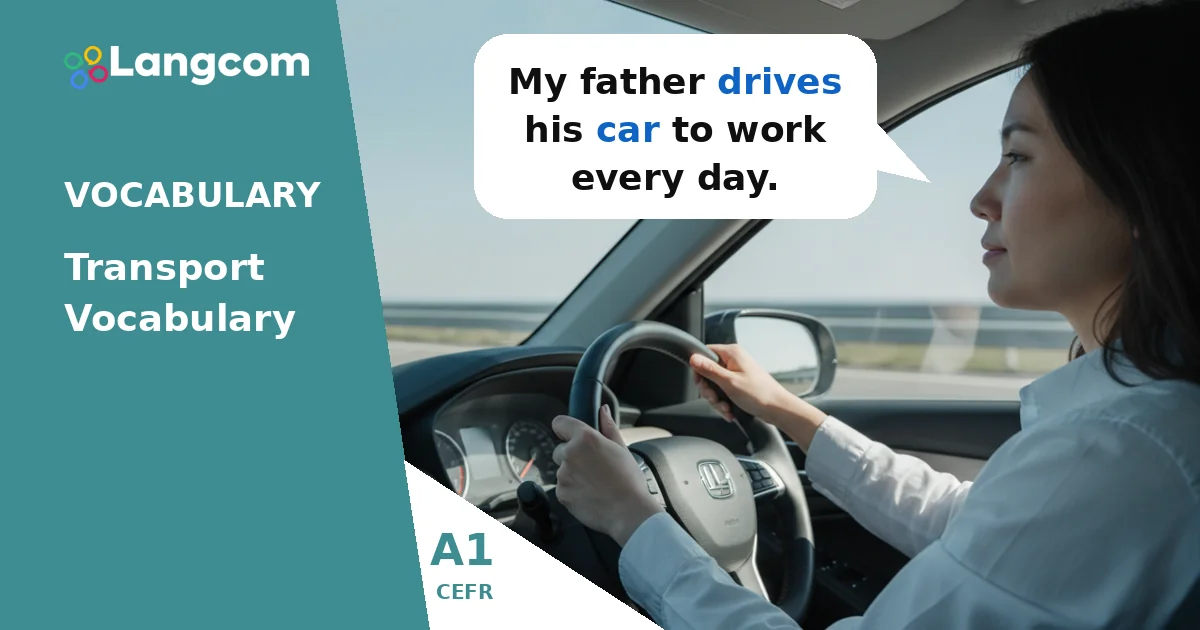
- My father drives his car to work every day.
- I take the bus to the city center.
- The train leaves at 7 o'clock in the morning.
- We fly by plane when we visit my grandparents.
- Let's take a boat trip on the lake.
- She rides her bike to the park.
- He has a fast motorbike.
Esercitazione
💬 Hai bisogno di una consulenza personalizzata?
In qualità di Centro autorizzato di preparazione agli esami Cambridge, possiamo aiutarti a scegliere il corso e la certificazione più adatti alle tue esigenze. Contatta oggi stesso i nostri consulenti.
Chatta con un consulente su WhatsAppErrori comuni per chi parla spagnolo
Chi parla spagnolo a volte commette questi errori:
- Confuso bike e motorbike: A bike is a bicycle (you pedal). A motorbike has an engine.
Corretto: I ride my bike to school.
Errato: I ride my motorbike to school (if you mean a bicycle). - Using 'auto' instead of car: While 'auto' is understood, car is much more common in everyday English.
Corretto: I bought a new car.
Less common: I bought a new auto.
Domande frequenti
What is the difference between a 'bike' and a 'motorbike'?
A bike is a bicycle that you pedal with your feet. A motorbike is a vehicle with two wheels and an engine, so it is much faster and does not require pedaling.
How do I say I travel by walking?
When you walk to a place, you say on foot. Ad esempio, I go to the shop on foot.
Can I use 'on the bus' instead of 'by bus'?
Sì, si può dire on the bus oppure by bus. Both are correct. On the bus focuses on being inside the bus, while by bus focuses on the method of transport.




0 Commenti