

What do “There is” and “There are” mean?
There is y There are are common English phrases. We use them to say that something exists in a place.
There is is for one thing (singular). There are is for two or more things (plural).
For example, There is a book on the table. (one book). There are two chairs in the room. (two chairs).
🎓 Aprende inglés con el método mixto
Grupos reducidos · Tutor de IA disponible las 24 horas del día, los 7 días de la semana · Preparación para los exámenes de Cambridge
Planes de $39 $79 al mes
How do we ask questions about one thing?
To ask about one thing, we change the order of there is. We put Is first.
- Empieza por Is there.
- Añadir a o an.
- Add a singular noun.
- Ejemplo: Is there a cafe?
How do we ask questions about many things?
To ask about two or more things, we change the order of there are. We put Are first.
- Empieza por Are there.
- Añadir any.
- Add a plural noun.
- Ejemplo: Are there any shops?
Why do we use "any" in plural questions?
We often use any in questions with plural nouns. It means "some" or "a number of."
It shows you are asking about an unspecified quantity. For example, Are there any students in the class?
You can also use numbers or other quantifiers if you know the exact amount: Are there two books?
How do we give short answers?
After asking a question with Is there...? o Are there...?, you can give a short answer.
- For singular (one thing):
- Positive: Yes, there is.
- Negative: No, there isn't.
- For plural (two or more things):
- Positive: Yes, there are.
- Negative: No, there aren't.
| Tipo | Formulario de preguntas | Positive Short Answer | Negative Short Answer |
|---|---|---|---|
| Singular | Is there a/an + noun? | Yes, there is. | No, there isn't. |
| Plural | Are there any + noun(s)? | Yes, there are. | No, there aren't. |
Ejemplos
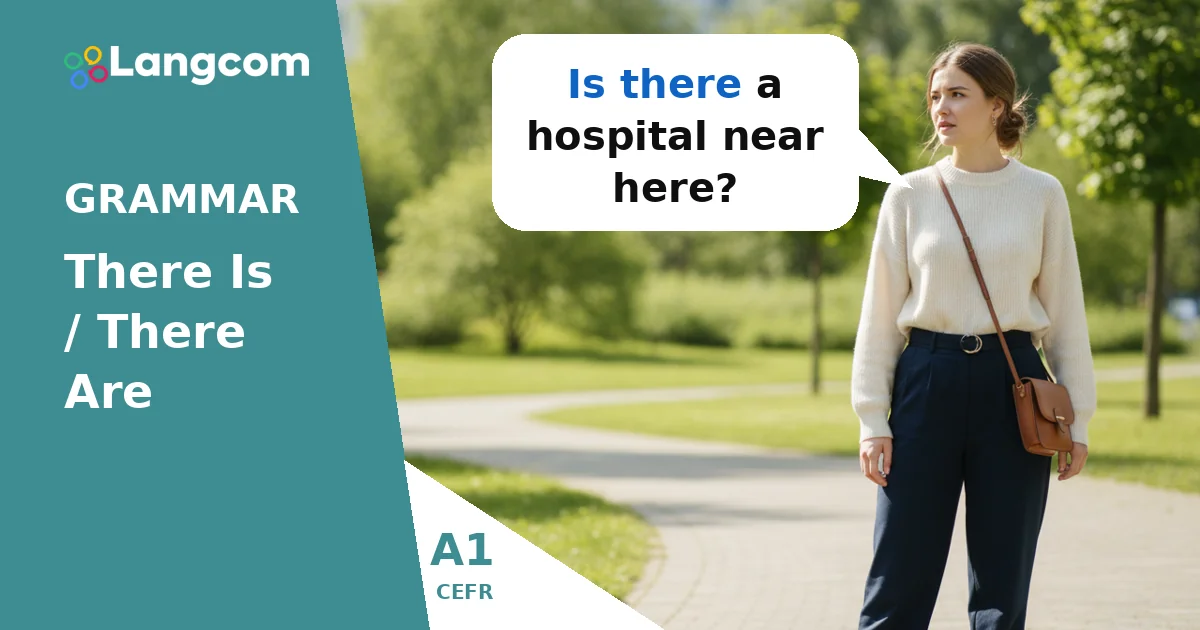
- Is there a hospital near here?
- Yes, there is.
- Is there an airport in your city?
- No, there isn't.
- Are there any restaurants open late?
- Yes, there are.
- Are there many cars on the street?
- No, there aren't.
- Is there a bus stop outside?
- Yes, there is one.
- Are there any good movies playing?
- No, there aren't any.
Práctica
💬 ¿Necesitas asesoramiento personalizado?
Como centro autorizado de preparación para los exámenes de Cambridge, podemos orientarte para que elijas el curso y la certificación más adecuados. Habla hoy mismo con nuestros asesores.
Chatea con un asesor por WhatsAppErrores habituales de los hispanohablantes
Spanish speakers often make these mistakes:
- Direct translation: Do not translate directly from Spanish "¿Hay un parque?" as "There is a park?" The correct form is "Is there a park?"
- Not using "any" with plural questions: Incorrecto: "Are there shops?" Correcto: "Are there any shops?" (or specify a number: "Are there two shops?")
- Incorrect short answers: Incorrecto: "Yes, there's." o "No, there not." Correcto: "Yes, there is." / "No, there isn't." y "Yes, there are." / "No, there aren't."
Preguntas más frecuentes
Can I use "some" in questions with "there is/are"?
We usually use any in questions. We use some in positive sentences: There are some books. Puedes utilizar some in questions when you expect a "yes" answer or are offering something: Are there some cookies left?
What is the difference between "Is there a..." and "Are there any...?"
Is there a...? asks about one singular item. Are there any...? asks about two or more plural items.
Can I use contractions in short answers?
Yes, for negative answers: No, there isn't. y No, there aren't. For positive short answers, we usually do not use contractions: Yes, there is. (not Yes, there's.).




0 Comentarios