

What do There is y There are mean?
There is y There are tell us that something exists. They are very common in English.
We use them to describe what we see in a room, a picture, or a place.
🎓 Aprende inglés con el método mixto
Grupos reducidos · Tutor de IA disponible las 24 horas del día, los 7 días de la semana · Preparación para los exámenes de Cambridge
Planes de $39 $79 al mes
¿Cuándo se utiliza There is?
- Uso There is for one thing (singular noun).
- Also use There is for uncountable nouns (like water, information, sugar).
Examples:
- There is a pen on the desk. (One pen)
- There is a cat under the chair. (One cat)
- There is some milk in the fridge. (Uncountable noun)
¿Cuándo se utiliza There are?
- Uso There are for two or more things (plural nouns).
Examples:
- There are three books on the shelf. (Three books)
- There are many students in the classroom. (Many students)
- There are two apples in the basket. (Two apples)
How to make negative sentences with There is y There are?
To say something does no exist, add not después de is o are.
We often use contractions: isn't y aren't.
- For singular/uncountable: There isn't
- There isn't a car in the garage.
- There isn't any coffee left.
- For plural: There aren't
- There aren't any chairs in the room.
- There aren't five students here.
How to ask questions with There is y There are?
To ask if something exists, change the order of is/are y there.
- For singular/uncountable: Is there...?
- Is there a park nearby?
- Is there any sugar?
- For plural: Are there...?
- Are there any shops open?
- Are there many people at the party?
| Form | Example |
|---|---|
| Positive Singular / Uncountable | There is a cat. / There is some milk. |
| Positive Plural | There are two dogs. |
| Negative Singular / Uncountable | There isn't a cat. / There isn't any milk. |
| Negative Plural | There aren't two dogs. |
| Question Singular / Uncountable | Is there a cat? / Is there any milk? |
| Question Plural | Are there two dogs? |
Ejemplos
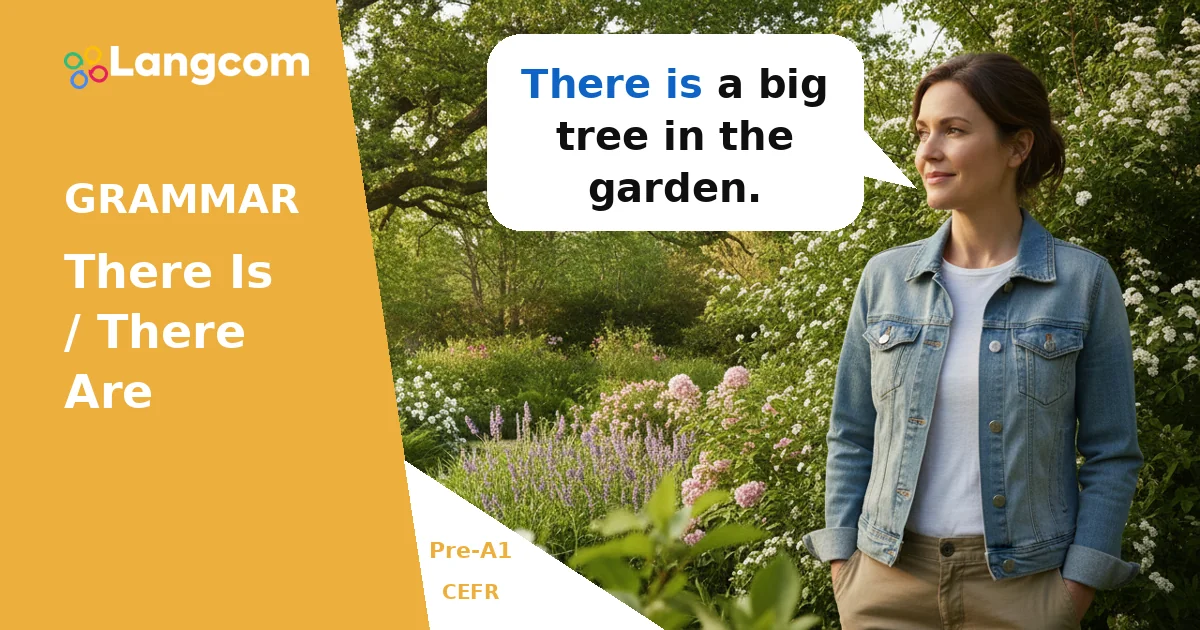
- There is a big tree in the garden.
- There are many birds in the sky.
- There isn't a computer on my desk.
- There aren't any apples in the fridge.
- Is there a bathroom on this floor?
- Are there any good restaurants around here?
- There is some cheese in the sandwich.
- There are five pencils in the box.
Práctica
💬 ¿Necesitas asesoramiento personalizado?
Como centro autorizado de preparación para los exámenes de Cambridge, podemos orientarte para que elijas el curso y la certificación más adecuados. Habla hoy mismo con nuestros asesores.
Chatea con un asesor por WhatsAppErrores habituales de los hispanohablantes
Los hispanohablantes a veces confunden there is / there are con el verbo to have because 'hay' can mean both 'there is/are' and 'has/have' in some contexts.
- Mistake 1: Using It is o They are to introduce existence.
- Incorrecto: It is a book on the table. (This means the book es the table, or identifies it, not that it exists there.)
- Correcto: There is a book on the table.
- Incorrecto: They are three chairs in the room.
- Correcto: There are three chairs in the room.
- Mistake 2: Using have for existence.
- Incorrecto: The city has many parks. (This is grammatically correct but means the city possesses parks. If you want to say parks exist in the city, use there are.)
- Correcto: There are many parks in the city. (This emphasizes the existence of parks in the city.)
Recuerda: There is / There are is for existence. To have is for possession.
Preguntas más frecuentes
¿Cuál es la diferencia entre There is y It is?
There is means something exists. It is identifies something or describes it. For example: There is a dog in the garden. (A dog exists there.) But It is my dog. (This identifies the dog.) or It is big. (This describes the dog.)
¿Puedo usar There is with uncountable nouns?
Yes, absolutely! We use There is for uncountable nouns, just like for singular countable nouns. For example: There is some water in the bottle. o There is a lot of information online.
How do I answer Is there...? o Are there...? questions?
You use short answers:
- For singular: Is there a shop? Yes, there is. / No, there isn't.
- For plural: Are there any books? Yes, there are. / No, there aren't.



0 Comentarios