

Why Do -ED Endings Sound Different?
English pronunciation can be tricky because sounds change. The -ED ending is a perfect example of this.
The sound of -ED changes based on the sound that comes right before it in the base verb. This is because of ‘voiced’ and ‘unvoiced’ sounds.
- Voiced sounds: Your vocal cords vibrate when you make these sounds. Put your hand on your throat and say /b/ o /d/. You will feel a vibration.
- Unvoiced sounds: Your vocal cords do not vibrate. Say /p/ o /t/. There is no vibration.
✍️ ¿No sabes en qué nivel estás?
Realiza nuestra prueba de nivel gratuita y recibe comentarios personalizados de examinadores certificados por Cambridge.
Realice nuestra prueba de nivel GRATUITAThe Three Sounds of -ED: Rules and Examples
There are three main rules for pronouncing the -ED ending. Let's look at each one carefully.
Sound 1: /ɪd/ (o /əd/)
Use the /ɪd/ sound if the base verb ends in a /t/ o /d/ sound.
- This rule adds an extra syllable to the word.
- Examples: want se convierte en wanted (/wɒntɪd/), need se convierte en needed (/niːdɪd/), decide se convierte en decided (/dɪˈsaɪdɪd/).
Sound 2: /t/
Use the /t/ sound if the base verb ends in an unvoiced sound (except /t/).
- These sounds include /p/, /k/, /f/, /s/, /ʃ/ (sh), /tʃ/ (ch).
- No extra syllable is added.
- Examples: work se convierte en worked (/wɜːrkt/), pick se convierte en picked (/pɪkt/), watch se convierte en watched (/wɒtʃt/), kiss se convierte en kissed (/kɪst/).
Sound 3: /d/
Use the /d/ sound if the base verb ends in a voiced sound (except /d/) or a vowel sound.
- Voiced sounds include /b/, /g/, /v/, /z/, /ʒ/ (zh), /dʒ/ (j), /m/, /n/, /ŋ/ (ng), /l/, /r/.
- Vowel sounds are always voiced.
- No extra syllable is added.
- Examples: carry se convierte en carried (/ˈkærid/), show se convierte en showed (/ʃoʊd/), travel se convierte en travelled (/ˈtrævəld/), stay se convierte en stayed (/steɪd/).
| Last Sound of Base Verb | Pronunciation of -ED | Example Verbs |
|---|---|---|
| Ends in /t/ o /d/ | /ɪd/ (extra syllable) | want (wanted), need (needed) |
| Ends in unvoiced sound (e.g., /p/, /k/, /f/, /s/, /ʃ/, /tʃ/) | /t/ (no extra syllable) | work (worked), pick (picked) |
| Ends in voiced sound (e.g., /b/, /g/, /v/, /z/, /m/, /n/, /l/, /r/) or vowel | /d/ (no extra syllable) | play (played), show (showed) |
Ejemplos
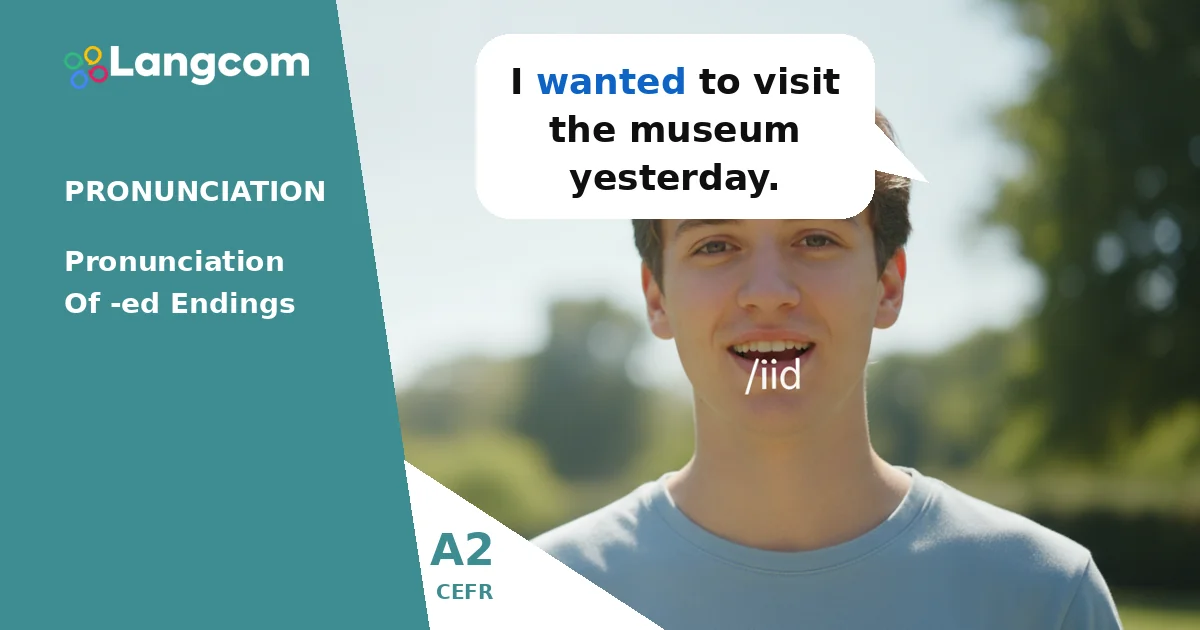
- I wanted to visit the museum yesterday.
- She worked very hard on her project.
- They played football in the park last weekend.
- He decided to study English at Langcom.
- We watched a good movie last night.
- My brother travelled to Spain last summer.
Práctica
¿Estás listo para obtener tu certificado?
El curso Langcom prepara a los alumnos para los exámenes de Cambridge, IELTS, TOEFL, DELE, SIELE y Michigan.
Empieza a utilizar LangcomErrores habituales de los hispanohablantes
A common mistake for Spanish speakers is to pronounce all -ED endings as /ɪd/, similar to how you might say a syllable in Spanish. For example, saying work-ed (/wɜːrktɪd/) instead of worked (/wɜːrkt/).
This adds an extra syllable where there shouldn't be one. It can make your English sound less natural and sometimes harder for native speakers to understand. Remember, the /ɪd/ sound is only for verbs ending in /t/ o /d/.
Preguntas más frecuentes
What are voiced and unvoiced sounds?
Voiced sounds are made when your vocal cords vibrate (e.g., /b/, /d/, /g/). Unvoiced sounds are made without vocal cord vibration (e.g., /p/, /t/, /k/). You can feel the difference by touching your throat.
Is there an easy way to remember the rules?
Yes! The easiest rule is for /ɪd/: if the base verb ends in /t/ o /d/, add /ɪd/. For all other verbs, check if the last sound is voiced (use /d/) or unvoiced (use /t/).
Why is correct -ED pronunciation important for A2 Key?
Correct pronunciation helps you communicate clearly and be understood in the A2 Key speaking test. It also helps you understand spoken English better, which is important for the listening parts of the exam. Mastering these sounds shows good control of basic English pronunciation.
Do these rules apply to adjectives ending in -ED?
Yes, generally the same pronunciation rules apply to adjectives ending in -ED, como por ejemplo bored (/bɔːrd/) or interested (/ˈɪntrəstɪd/). The sound depends on the final sound of the word before -ED is added.



0 Comentarios