

What is the Present Continuous?
The Present Continuous tense describes actions that are happening at the moment of speaking. It tells us what is in progress right now.
Think about what you are doing. Are you reading? Are you listening? These are actions happening at this moment.
🎓 Aprende inglés con el método mixto
Grupos reducidos · Tutor de IA disponible las 24 horas del día, los 7 días de la semana · Preparación para los exámenes de Cambridge
Planes de $39 $79 al mes
How do we form the Present Continuous?
To make the Present Continuous, we use two parts:
- El verbo to be (am, is, o are)
- The main verb + -ing
Affirmative Sentences
Uso Subject + am/is/are + verb-ing.
- I am watching TV.
- He is reading a book.
- They are playing football.
Negative Sentences
Añadir not después de am/is/are. Use Subject + am/is/are + not + verb-ing.
- I am not watching TV.
- She is not reading a book. (o She isn't reading a book.)
- We are not playing football. (o We aren't playing football.)
Questions
Start the question with Am/Is/Are. Use Am/Is/Are + Subject + verb-ing?
- Are you watching TV?
- Is he reading a book?
- Are they playing football?
Short Answers
For 'Yes/No' questions, use short answers:
- Yes, I am. / No, I'm not.
- Yes, she is. / No, she isn't.
- Yes, we are. / No, we aren't.
When do we use the Present Continuous?
We use the Present Continuous for these main situations:
- Actions happening now: Things that are in progress at this exact moment.
- Temporary actions: Things that are happening for a short time, not forever.
Look for these words to help you:
- now
- right now
- at the moment
- today
| Asunto | Afirmativo | Negativo | Pregunta |
|---|---|---|---|
| I | I am working. | I am not working. | Am I working? |
| You | You are working. | You are not working. | Are you working? |
| He/She/It | He is working. | He is not working. | Is he working? |
| We | We are working. | We are not working. | Are we working? |
| They | They are working. | They are not working. | Are they working? |
Ejemplos
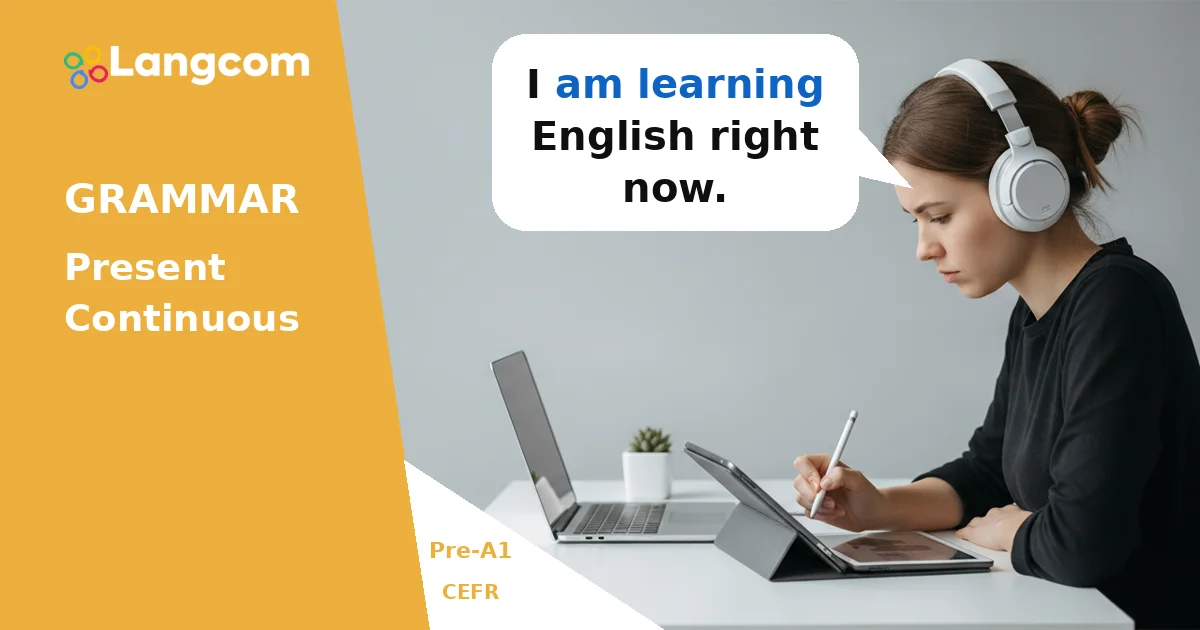
- I am learning English right now.
- She is listening to music.
- They are having dinner at the moment.
- He is not sleeping.
- Are you working today?
- What are you doing?
Práctica
💬 ¿Necesitas asesoramiento personalizado?
Como centro autorizado de preparación para los exámenes de Cambridge, podemos orientarte para que elijas el curso y la certificación más adecuados. Habla hoy mismo con nuestros asesores.
Chatea con un asesor por WhatsAppErrores habituales de los hispanohablantes
Los hispanohablantes a veces cometen estos errores:
- Missing the verb to be: In Spanish, you might say "Yo trabajando" (I working). In English, you must include am/is/are.
Wrong: I working now.
Right: I am working now. - Using Simple Present for actions happening now: In Spanish, sometimes the simple present can mean 'now'. In English, use Present Continuous.
Wrong: She reads a book now.
Right: She is reading a book now. - Olvidando el -ing ending: Every main verb in the Present Continuous needs -ing.
Wrong: They are play football.
Right: They are playing football.
Preguntas más frecuentes
¿Cuál es el uso principal del presente continuo?
The main use is to talk about actions that are happening now, at the moment of speaking.
How is the Present Continuous different from the Simple Present?
The Present Continuous is for actions happening now (p. ej., I am eating). The Simple Present is for habits or routines (e.g., I eat breakfast every day).
Do all verbs use -ing in the Present Continuous?
Yes, for the Present Continuous, the main verb always ends with -ing (p. ej., reading, playing, sleeping).
Can I use 'now' with the Present Continuous?
Sí, now, right now, y at the moment are common words to use with the Present Continuous to show an action is happening immediately.

0 Comentarios