

Why is house vocabulary important for A1 learners?
Learning words for parts of a house helps you talk about your daily life. You can describe your home, your room, or what you see outside.
- It helps you understand simple descriptions of places.
- You can communicate about your environment.
- It builds a strong base for more English vocabulary.
🎓 Aprende inglés con el método mixto
Grupos reducidos · Tutor de IA disponible las 24 horas del día, los 7 días de la semana · Preparación para los exámenes de Cambridge
Planes de $39 $79 al mes
What parts are outside a house?
Many important parts of a house are on the outside. These words help you describe the exterior of a building and its surroundings.
- En roof is the top part of a house. It protects the house from rain and sun.
- A chimney is a tall pipe on the roof. Smoke from a fireplace goes out through it.
- A balcony is a platform outside an upper window. You can stand or sit on it.
- En wall is the outer side of the house. It holds the house up.
- A window is an opening in the wall, usually with glass. You can look outside through it.
- En door is the main entrance. You open it to go inside.
Around the house, you can also find natural elements:
- A tree is a tall plant with a trunk and branches.
- Leaves are the green parts of a tree or plant.
- Grass is a common green plant that covers the ground outside.
What parts are inside a house?
Inside a house, there are different areas and objects. These words help you describe the interior.
- A door is also inside, connecting different rooms.
- A window lets light into a room.
- En wall is the inside surface of a room.
- Stairs are steps that go up or down to another floor.
- En basement is the floor below the ground level of a house.
- A mat is a small piece of material on the floor, often near a door.
| English Word | What it is / Where it is |
|---|---|
| door | An opening for entering or leaving a room or building. |
| leaves | The green parts of a tree or plant. |
| tree | A tall plant with a trunk, branches, and leaves. |
| wall | A side of a building or room. |
| roof | The top covering of a building. |
| chimney | A pipe on the roof for smoke to go out. |
| window | An opening in a wall, usually with glass, to see through. |
| basement | A floor or room below the ground level. |
| balcony | A platform on the outside of an upper floor of a building. |
| stairs | A set of steps for going between different floors. |
| mat | A small piece of material on the floor, often at an entrance. |
| grass | A common green plant that covers the ground. |
Ejemplos
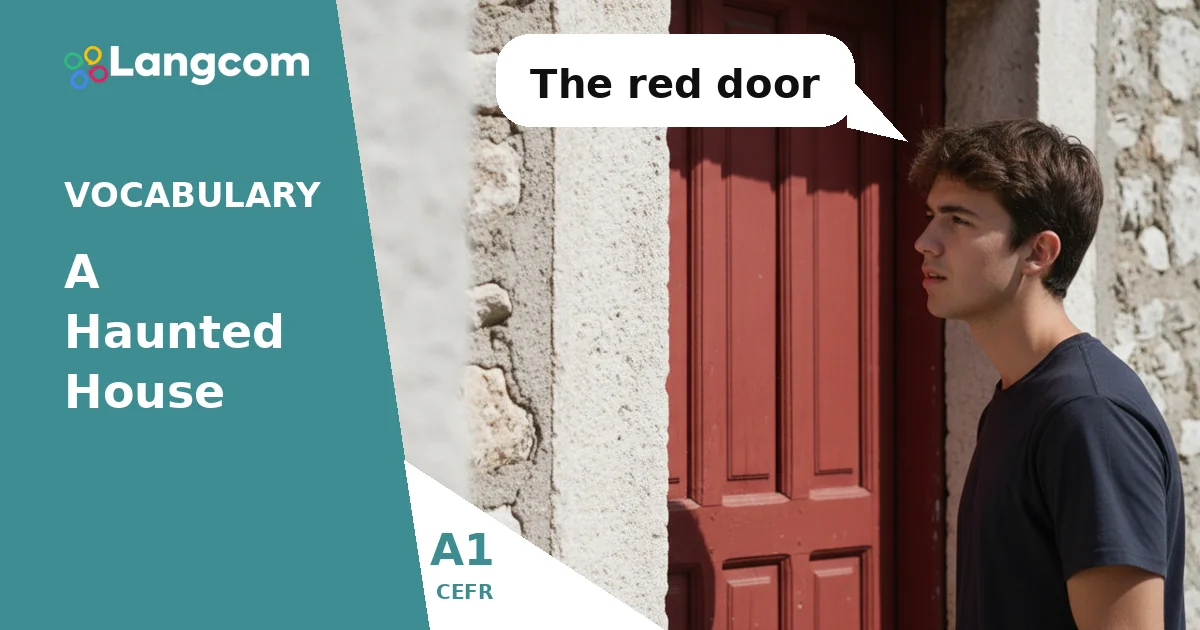
- The red door is open.
- Look at the green leaves on the tree.
- The wall of the house is white.
- There is a chimney on the roof.
- Can you open the window, please?
- My house has a small balcony.
- We go down the stairs to the basement.
- Please wipe your feet on the mat.
- The children play on the grass.
Práctica
💬 ¿Necesitas asesoramiento personalizado?
Como centro autorizado de preparación para los exámenes de Cambridge, podemos orientarte para que elijas el curso y la certificación más adecuados. Habla hoy mismo con nuestros asesores.
Chatea con un asesor por WhatsAppErrores habituales de los hispanohablantes
Be careful with these common mistakes:
- Roof vs. Ceiling: In Spanish, both can be 'techo'. But in English, the roof is the outside top of the house. The ceiling is the inside top of a room. Example: The rain hit the roof. (correct) / The lamp hangs from the ceiling. (correct)
- Wall vs. Fence: A wall is part of a building or a strong, tall barrier. A fence is usually a lighter structure, often made of wood or wire, around a garden or field. Example: The house has a brick wall. (correct) / There is a wooden fence around the garden. (correct)
- Stairs: This word is always plural in English. You say stairs, not 'stair'. Example: Go up the stairs. (correct) / Go up the stair. (incorrect)
Preguntas más frecuentes
What is the difference between a 'door' and a 'window'?
A door is for entering and exiting a room or building. A window is an opening, usually with glass, to let in light and air, or to look outside.
Can 'wall' be used for both inside and outside?
Yes, a wall can be the outer part of a house (exterior wall) or the inner part of a room (interior wall).
Is 'basement' the same as 'attic'?
No, they are different. A basement is a room or floor below the ground level. An attic is a space or room directly under the roof, usually at the top of the house.
How can I remember these new words?
Try to label things in your own home in English. Look at pictures and say the words aloud. Practice using them in simple sentences like This is my door.



0 Comentarios