

Why Use the Simple Past for Unreal Situations?
The simple past tense is versatile. While it commonly describes actions completed in the past, it also has a special function in expressing unreality.
This means we use it to talk about things that are not true, are imaginary, or are wishes for the present or future. It helps us create distance from reality.
- It signals that a situation is hypothetical.
- It shows a desire for something different.
- It allows us to imagine alternative realities.
✍️ ¿No sabes en qué nivel estás?
Realiza nuestra prueba de nivel gratuita y recibe comentarios personalizados de examinadores certificados por Cambridge.
Realice nuestra prueba de nivel GRATUITAHow Do Conditionals Use the Simple Past for Unreality?
In second conditional sentences, the simple past describes an unreal or improbable condition in the present or future.
- Utilizamos if + simple past in the conditional clause.
- The result clause uses would + base form of the verb.
Por ejemplo, If we had a more varied diet, we would reduce our negative effect on the environment. Here, had refers to a hypothetical present diet, not a past one.
Expressing Wishes and Preferences with the Simple Past
You can use the simple past to express wishes, desires, or preferences about the present or future.
- Uso I wish / If only + simple past to express a desire for a present situation to be different. For example, I wish people were more careful about what they ate.
- Uso would rather + subject + simple past to state a preference for someone else's action or a different situation. For instance, My parents would rather we didn’t eat red meat.
Speculating and Imagining with the Simple Past
When you want to speculate or describe an imaginary scenario, specific phrases combine with the simple past.
- Uso What if / Imagine (if) / Suppose + simple past.
- These phrases introduce a hypothetical question or situation.
Consider these examples:
- What if we created a new food product based on insect protein?
- Imagine if we started a company based on our new product!
- Suppose we all stopped eating beef. What would we eat instead?
Using the Simple Past for Comparisons and Urgency
The simple past also appears in comparisons and expressions of urgency.
- For comparisons, use as if / as though / even if + simple past. This describes how something appears, often contrary to reality. For example, We cannot keep ignoring the problems as if they didn’t exist.
- To express the need to start doing something, use It’s (about / high) time (we) + simple past. This implies that an action should have already started. For instance, It’s high time we started exploring alternatives.
| Structure | Meaning / Use | Example |
|---|---|---|
| If + simple past | Unreal/improbable condition (present/future) | If I knew the answer, I would tell you. |
| I wish / If only + simple past | Wish for a different present/future reality | I wish I lived closer to the beach. |
| Would rather + subject + simple past | Preference for someone else's action/situation | I'd rather you didn't smoke inside. |
| What if / Imagine (if) / Suppose + simple past | Speculation, imaginary situations | What if we could fly? |
| As if / As though / Even if + simple past | Unreal comparisons, contrary appearance | He talks as if he owned the place. |
| It’s (about / high) time (we) + simple past | Urgency, action is overdue | It's high time we addressed this issue. |
Ejemplos
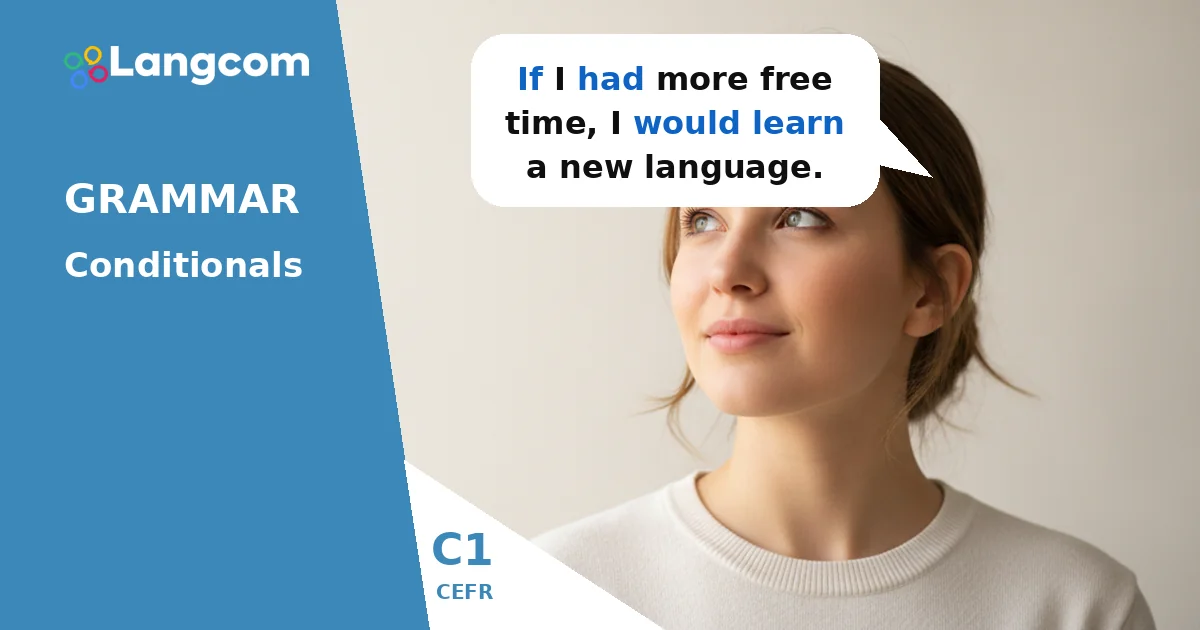
- If I had more free time, I would learn a new language.
- I wish I knew the answer to that complex question.
- She acts as if she were the boss of everyone here.
- What if we didn't have to work on Fridays?
- It's time we discussed this issue seriously.
- My friend would rather I didn't tell anyone her secret.
- Even if I won the lottery, I wouldn't quit my job.
Práctica
¿Estás listo para obtener tu certificado?
El curso Langcom prepara a los alumnos para los exámenes de Cambridge, IELTS, TOEFL, DELE, SIELE y Michigan.
Empieza a utilizar LangcomErrores habituales de los hispanohablantes
Spanish speakers often make a few common mistakes when using the simple past for unreal situations, mainly due to direct translation from Spanish subjunctive or conditional forms.
- Using the conditional instead of the simple past: In Spanish, you might say "Si yo tendría más dinero..." for a hypothetical. In English, it's incorrect to say If I would have more money.... The correct form is If I had more money...
- Using the present tense: Sometimes, the present tense is mistakenly used for unreal wishes. For example, I wish I am taller is wrong. The correct form is I wish I were taller (o I wish I was taller, which is common in informal speech but were is preferred for formal contexts).
- Confuso would rather structure: A common error is I would rather you didn't went. Remember, it's would rather + subject + simple past, so the correct form is I would rather you didn't go.
Preguntas más frecuentes
What is the main difference between using the simple past for real vs. unreal situations?
When the simple past refers to a real situation, it describes an action or state that happened and finished in the past, like I visited Paris last year. For unreal situations, it describes something hypothetical, imaginary, or desired in the present or future, like If I visited Paris, I would see the Eiffel Tower. The key is that the unreal situation is contrary to present fact or highly improbable.
Can I use 'was' instead of 'were' with 'I' or 'he/she/it' in unreal situations?
Yes, informally, it is common to hear I wish I was taller o If he was here, he would help. However, in formal English, especially in written contexts and for C1 level, were is preferred for all subjects in unreal conditional clauses and after I wish / If only (p. ej., If I were you...).
Does the simple past for unreal situations always refer to the present?
No, it can refer to the present or the future. For example, If I had a day off tomorrow, I would go to the beach refers to a future hypothetical situation. The key is that it's unreal or hypothetical *from the perspective of the present moment*.
What is the difference between 'It's time' and 'It's high time'?
It's time suggests that an action should happen now. It's high time adds a stronger sense of urgency, implying that the action is overdue and should have happened already. Both are followed by the simple past for unreal situations, as in It's time we left o It's high time you started studying for your exam.

0 Comentarios