
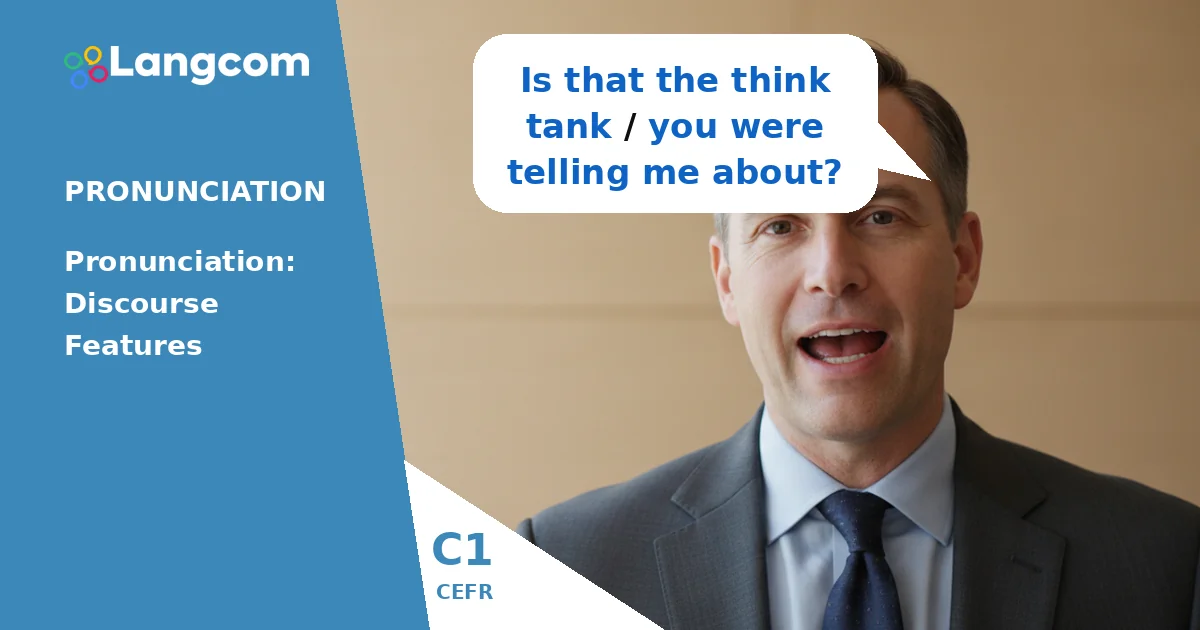

What Are Word Groups in English?
Word groups are fundamental units of spoken English. They are natural segments of speech that express a single idea or a complete piece of information.
- Think of them as ‘chunks’ of meaning.
- They are also called sense groups o intonation units.
- Each word group typically contains one main stressed word or syllable.
- A slight pause often separates one word group from the next.
Recognizing these groups helps you understand the rhythm and flow of natural English conversation and formal speech.
✍️ ¿No sabes en qué nivel estás?
Realiza nuestra prueba de nivel gratuita y recibe comentarios personalizados de examinadores certificados por Cambridge.
Realice nuestra prueba de nivel GRATUITAWhy Is Listening for Word Groups Important for C1 Learners?
At the C1 level, you encounter complex and extended spoken texts. Listening for word groups is a powerful strategy to improve your comprehension significantly.
- Enhanced Comprehension: It helps you process information in meaningful chunks, not just individual words. This is vital for understanding longer sentences and complex ideas.
- Identifying Main Ideas: The main stress within a word group often highlights the most important information. This helps you quickly grasp the speaker's key message.
- Following Natural Speech: Native speakers naturally use word groups. Learning to recognize them helps you follow faster, more authentic conversations and lectures.
- Improved Fluency: Understanding how words are grouped together in speech also improves your own spoken fluency and pronunciation.
How Do You Identify Word Groups When Listening?
Identifying word groups involves listening for several key phonetic features:
- Main Stress: Listen for the most prominent word or syllable within a group. This word usually carries the most important meaning.
- Pauses: Notice the short, natural breaks in speech. These pauses often mark the boundaries between word groups. They might be very subtle.
- Intonation: Pay attention to how the speaker's pitch changes. Intonation often rises or falls at the end of a word group, signaling a complete thought or a transition.
- Meaning: Each word group typically expresses a single idea or a coherent piece of information. Try to understand the 'mini-message' of each chunk.
Practice actively listening for these features to train your ear.
Practical Tips for Improving Your Word Group Listening
To develop your skill in identifying word groups, try these techniques:
- Active Listening: Focus specifically on pauses and stressed words when listening to English audio (podcasts, news, movies). Try to mentally divide the speech into chunks.
- Shadowing: Listen to a short audio clip and try to repeat it simultaneously, mimicking the speaker's rhythm, stress, and intonation. This trains your ear and mouth together.
- Transcribe and Mark: Take a short audio segment and transcribe it. Then, listen again and try to mark where you hear pauses and main stresses, indicating the word group boundaries.
- Focus on Meaning Chunks: Instead of trying to understand every single word, focus on grasping the meaning of each word group as a whole.
Ejemplos
- Is that the think tank / you were telling me about?
- Then you create a "blacklist" / of sites or tools / that distract you the most.
- No other app on the market / offers a feature like this.
- We felt like that / there'd be a lot of demand for it.
- You physically have to block the sites / that distract you the most.
- We're aiming to give users / all the flexibility / they could possibly want.
Práctica
¿Estás listo para obtener tu certificado?
El curso Langcom prepara a los alumnos para los exámenes de Cambridge, IELTS, TOEFL, DELE, SIELE y Michigan.
Empieza a utilizar LangcomErrores habituales de los hispanohablantes
Spanish speakers often face specific challenges when listening for word groups due to differences in language rhythm:
- Syllable-Timed vs. Stress-Timed: Spanish is a syllable-timed language, meaning each syllable takes roughly the same amount of time. English is stress-timed, where stressed syllables are pronounced more strongly and regularly, with unstressed syllables compressed. This difference can make it harder to identify the distinct pauses and prominent stresses that define English word groups.
- Word-by-Word Processing: Learners might try to understand every single word, rather than processing speech in larger, meaningful chunks. This can lead to feeling overwhelmed by fast speech.
- Missing Main Stress: Difficulty in identifying which word within a word group carries the most important stress can obscure the main point of that chunk of information.
Focusing on the overall rhythm and the 'melody' of English can help overcome these habits.
Preguntas más frecuentes
What is the difference between a word group and a sentence?
A word group is a unit of spoken language, defined by its rhythm, stress, and intonation, and usually conveying a single idea. A sentence is a grammatical unit of written language that expresses a complete thought. A single sentence can contain one or many word groups, depending on its length and complexity.
Do all sentences have multiple word groups?
No, not all sentences have multiple word groups. A very short, simple sentence like I'm hungry. might be one single word group. Longer or more complex sentences, however, are typically broken down into several word groups by speakers to make them easier to understand.
How does listening for word groups help with C1 exams?
For C1 exams, especially listening tasks, recognizing word groups is crucial. It helps you quickly identify key information, follow complex arguments, and understand the speaker's attitude or intention. This skill is vital for tasks like listening to lectures or interviews, where you need to grasp main points and specific details from extended speech.
Is 'word group' the same as 'chunking'?
Yes, in the context of listening and processing spoken language, 'chunking' is a very similar concept to identifying word groups. Both refer to the mental process of breaking down continuous speech into smaller, manageable, and meaningful units to improve comprehension. Word groups are the linguistic units that facilitate this 'chunking' process.



0 Comentarios