

What Are Compound Nouns?
A compound noun is a noun made up of two or more words. These words combine to form a new word with a single meaning.
- They can be written as one word: notebook, sunscreen.
- They can be written as two separate words: traffic light, post office.
- They can be hyphenated: sister-in-law, check-out.
✍️ ¿No sabes en qué nivel estás?
Realiza nuestra prueba de nivel gratuita y recibe comentarios personalizados de examinadores certificados por Cambridge.
Realice nuestra prueba de nivel GRATUITAThe Main Rule: Stress on the First Word
For most common English compound nouns, the main stress is on the first word. This means you say the first part louder and with a higher pitch.
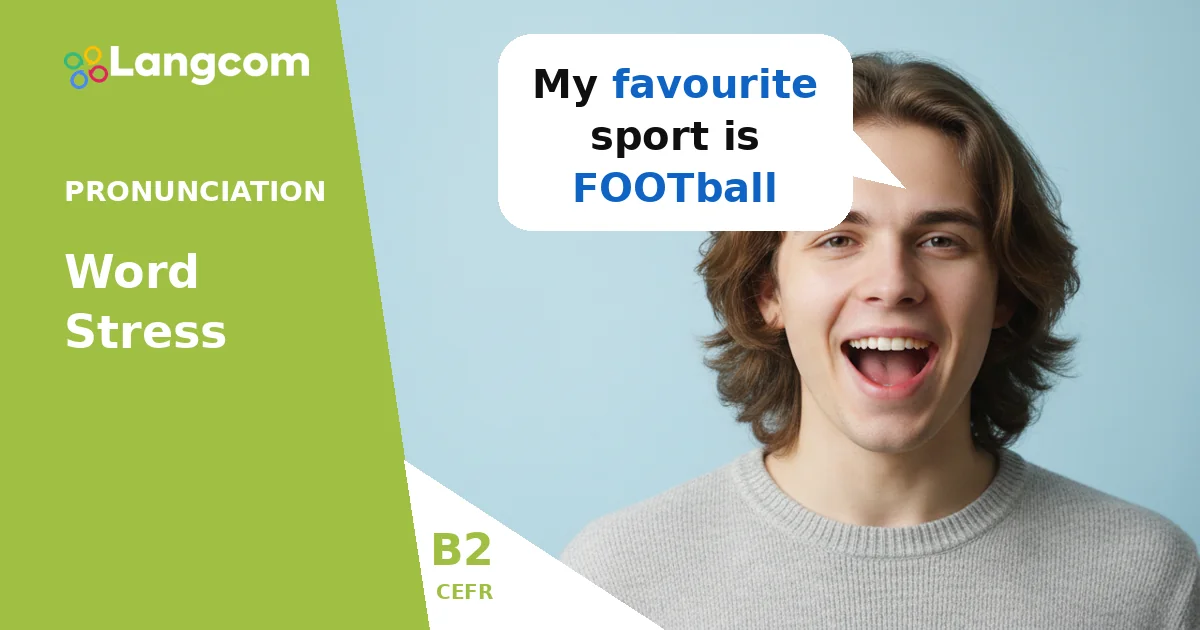
- Think of FOOTball. We stress FOOT, no ball.
- Another example is SUNglasses. The stress is on SUN.
- This rule applies because the first word often tells you the type or purpose of the noun.
Compound Nouns vs. Adjective + Noun Phrases
This is a very important distinction for B2 learners. The stress pattern helps you tell the difference between a compound noun and an adjective describing a noun.
- Compound Noun: BLACKbird (stress on BLACK). This refers to a specific type of bird.
- Adjective + Noun Phrase: a black BIRD (stress on BIRD). This refers to any bird that happens to be black.
Consider another example:
- Compound Noun: GREENhouse (stress on GREEN). This is a building for growing plants.
- Adjective + Noun Phrase: a green HOUSE (stress on HOUSE). This is a house that is painted green.
Why Is Correct Stress Important?
Using the correct stress pattern for compound nouns is crucial for several reasons:
- Clarity: It helps avoid misunderstandings, as seen with GREENhouse vs. green HOUSE.
- Natural Sound: Your pronunciation will sound more natural and fluent to native speakers.
- Easier Listening: It helps listeners understand your meaning more quickly and easily.
| Compound Noun (Stress on 1st word) | Adjective + Noun (Stress on 2nd word) |
|---|---|
| GREENhouse (a building for plants) | a green HOUSE (a house that is green) |
| BLACKbird (a specific type of bird) | a black BIRD (any bird that is black) |
| HOTdog (a type of food) | a hot DOG (an animal that is hot) |
| WHITEboard (a board for writing) | a white BOARD (any board that is white) |
Ejemplos
- My favourite sport is FOOTball.
- I need new SUNglasses for the beach.
- Look at that beautiful RAINbow after the storm!
- A BLACKbird sang a lovely song in the garden.
- She lives in a green HOUSE, not a GREENhouse where plants grow.
- I bought a HOTdog from the street vendor for lunch.
- Be careful, the hot DOG might be aggressive.
Práctica
¿Estás listo para obtener tu certificado?
El curso Langcom prepara a los alumnos para los exámenes de Cambridge, IELTS, TOEFL, DELE, SIELE y Michigan.
Empieza a utilizar LangcomErrores habituales de los hispanohablantes
Spanish speakers often place stress more evenly across words or sometimes on the last syllable. This can lead to a common mistake with English compound nouns: stressing the second word instead of the first.
- Incorrecto: post OFFICE (This sounds like an office that is 'post', which doesn't make sense.)
- Correcto: POST office (This is the place where you send mail.)
- Incorrecto: tooth BRUSH (This sounds like a brush that is 'tooth', not the object for cleaning teeth.)
- Correcto: TOOTHbrush (This is the correct pronunciation for the item you use to clean your teeth.)
This mistake can change the meaning of what you are saying or make your speech sound less natural to a native English speaker.
Preguntas más frecuentes
What is the main rule for stress in compound nouns?
The main stress usually falls on the first word of the compound noun.
Why is it important to stress compound nouns correctly?
Correct stress helps avoid confusion, especially when distinguishing between a compound noun (p. ej., GREENhouse) and an adjective + noun phrase (p. ej., a green HOUSE). It also makes your pronunciation sound more natural and clear.
How can I improve my stress in compound nouns?
Listen carefully to native speakers, practice saying compound nouns aloud, and pay attention to how the stress changes the meaning in pairs like BLACKbird vs. black BIRD. Recording yourself and comparing it to native speech can also be very helpful.
Are there any exceptions to this rule?
While the first word stress rule applies to most common compound nouns, there are a few exceptions. For example, some proper nouns (e.g., New YORK) or specific idiomatic expressions might have different patterns. However, focusing on the main rule will cover most cases for B2 learners.




0 Comentarios