
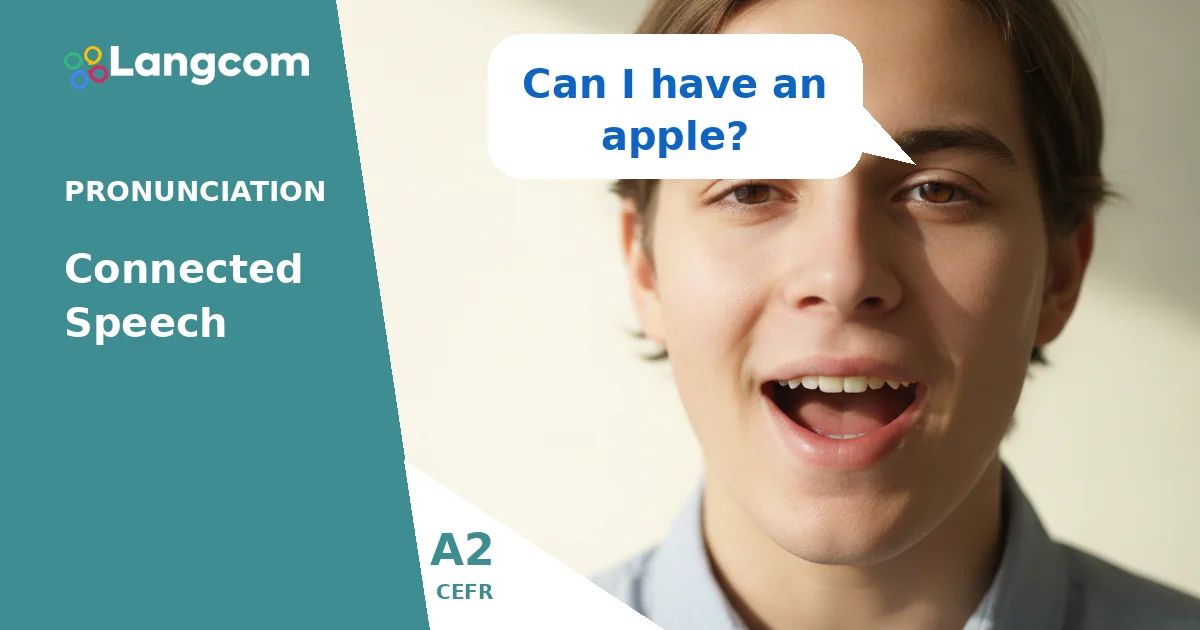

What is Connected Speech in English?
When native English speakers talk, they usually do not say each word separately. Instead, words often flow together, creating a smooth sound.
This natural flow of speech is called connected speech. It makes English sound faster and more natural.
🎓 Aprende inglés con el método mixto
Grupos reducidos · Tutor de IA disponible las 24 horas del día, los 7 días de la semana · Preparación para los exámenes de Cambridge
Planes de $39 $79 al mes
How Do Words Join? Consonant + Vowel Linking
One of the most common ways words join is when a word ends with a consonant sound and the next word begins with a vowel sound.
- The final consonant sound of the first word moves and connects to the beginning of the next word.
- Think of it like there is no space between the two words.
- This linking helps you speak more smoothly, without stopping between every word.
Remember, it's about the sounds, not always the letters. For example, the 'h' in hour is silent, so an hour links 'n' to 'ou'.
Why is Connected Speech Important for A2 Learners?
Learning about connected speech is very helpful for your English journey.
- Improve Listening: When you know words can link, it's easier to understand what native speakers say. You won't get confused by words sounding different than you expect.
- Sound More Natural: Your own English will sound more fluent and less 'choppy'. This makes you easier to understand and more confident.
- Boost Confidence: As you practice, you'll feel more comfortable speaking English in real conversations.
Tips for Practicing Connected Speech
You can improve your connected speech with simple practice.
- Listen Carefully: Pay attention to how native speakers link words in movies, songs, or podcasts. Try to hear the connections.
- Repeat Phrases: Choose short phrases and repeat them, focusing on joining the sounds. For example, turn it on.
- Record Yourself: Speak a sentence and record it. Then listen back. Do your words flow together?
- Read Aloud: Read English texts aloud, trying to link words naturally.
| Word 1 (ends with consonant sound) | Word 2 (starts with vowel sound) | How it sounds (linked) |
|---|---|---|
| get | up | ge-tup |
| turn | on | tur-non |
| pick | it | pi-ckit |
| read | a book | rea-da book |
| find | out | fi-ndout |
Ejemplos
- Can I have an apple? (Sounds like: Ca-nI ha-ve-a-napple?)
- Take it easy. (Sounds like: Ta-ke-it-easy.)
- Turn off the light. (Sounds like: Tur-noff the light.)
- Come in, please. (Sounds like: Co-min, please.)
- What is it? (Sounds like: Wha-ti-sit?)
- I need a lot of money. (Sounds like: I nee-da lo-tof money.)
Práctica
💬 ¿Necesitas asesoramiento personalizado?
Como centro autorizado de preparación para los exámenes de Cambridge, podemos orientarte para que elijas el curso y la certificación más adecuados. Habla hoy mismo con nuestros asesores.
Chatea con un asesor por WhatsAppErrores habituales de los hispanohablantes
Many Spanish speakers tend to pronounce each English word very clearly and separately. This is because Spanish often has clearer word boundaries.
- Pausing Too Much: A common mistake is putting a small pause between words, even when they should link. For example, saying get... up en lugar de ge-tup.
- Not Linking Sounds: This can make your speech sound unnatural or 'choppy'. It also makes it harder for you to understand when others link words.
- Focusing Only on Letters: Remember, it's about the sounds. A word like house ends with a consonant sound /s/, but hour ends with a vowel sound /aʊər/ because the 'h' is silent.
Preguntas más frecuentes
What is connected speech?
It's how words join together when people speak naturally, making speech flow smoothly without pauses between every word. For example, I love it sounds like I lo-vit.
Why do English speakers join words?
Joining words makes speech faster, smoother, and more efficient. It's a natural part of spoken English rhythm and pronunciation.
Is connected speech important for A2 learners?
Yes, it's very important! It helps you understand native speakers better and makes your own English sound more natural and fluent, boosting your confidence.
How can I practice consonant + vowel linking?
Listen to English audio and try to notice where words link. Then, practice repeating phrases aloud, focusing on making the final consonant sound of one word connect to the starting vowel sound of the next, like in pick it up.


0 Comentarios