

What are ‘Can’ and ‘Can’t’ for?
Utilizamos can y can’t to talk about abilities. An ability is something you know how to do or something you are physically able to do.
- Uso can for positive sentences. It means you have the ability.
- Uso can’t (o cannot) for negative sentences. It means you do not have the ability.
🎓 Aprende inglés con el método mixto
Grupos reducidos · Tutor de IA disponible las 24 horas del día, los 7 días de la semana · Preparación para los exámenes de Cambridge
Planes de $39 $79 al mes
How do we form sentences with 'Can'?
The structure for sentences with can is very simple. We use can after the subject and before the main verb. The main verb is always in its base form (infinitive without 'to').
- Positive: Subject + can + base verb
- Ejemplo: I can speak English.
- Negative: Subject + can't / cannot + base verb
- Ejemplo: She can't swim.
Can is a modal verb. This means it does not change its form for he, she, o it. You do not add '-s'.
- Correcto: He can play the guitar.
- Incorrecto: He cans play the guitar.
How do we ask questions with 'Can'?
To ask a question about ability, we put can at the beginning of the sentence, before the subject.
- Question: Can + subject + base verb?
- Ejemplo: Can you cook Italian food?
For short answers, we use can o can't.
- Positive short answer: Yes, + subject + can.
- Ejemplo: Yes, I can.
- Negative short answer: No, + subject + can't.
- Ejemplo: No, she can't.
What about 'Could' and 'Couldn't' for Past Ability?
Just like can y can't are for the present, could y couldn't are for the past.
- Uso could for positive sentences about past ability.
- Ejemplo: When I was five, I could ride a bike.
- Uso couldn't (o could not) for negative sentences about past ability.
- Ejemplo: My grandfather couldn't use a computer.
The rules for questions and short answers are similar to can.
- Question: Could + subject + base verb? (p. ej., Could you speak French when you were young?)
- Short Answer: Yes, I could. / No, I couldn't.
| Form | Present Ability | Past Ability |
|---|---|---|
| Positive | Subject + can + base verb (p. ej., I can sing.) | Subject + could + base verb (p. ej., I could sing.) |
| Negative | Subject + can't + base verb (p. ej., She can't sing.) | Subject + couldn't + base verb (p. ej., She couldn't sing.) |
| Question | Can + subject + base verb? (p. ej., Can you sing?) | Could + subject + base verb? (p. ej., Could you sing?) |
| Short Answer | Yes, I can. / No, I can't. | Yes, I could. / No, I couldn't. |
Ejemplos
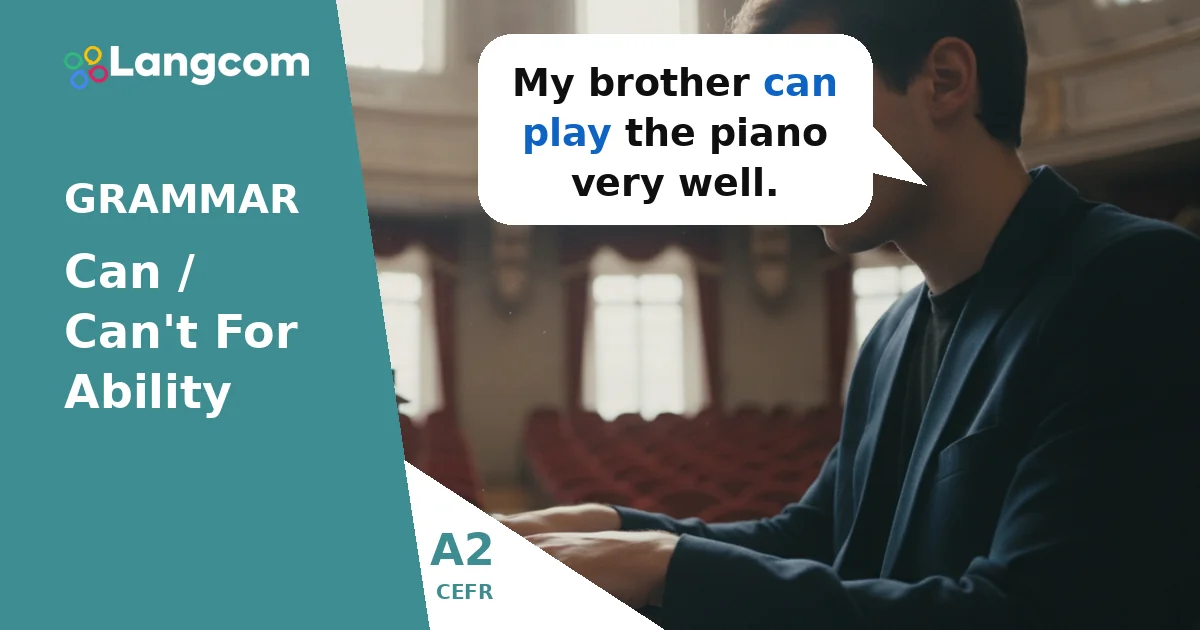
- My brother can play the piano very well.
- I can't understand this lesson.
- Can they help us tomorrow?
- Yes, they can.
- No, I can't come to the party.
- When I was a child, I could climb trees easily.
- She couldn't find her keys yesterday.
Práctica
💬 ¿Necesitas asesoramiento personalizado?
Como centro autorizado de preparación para los exámenes de Cambridge, podemos orientarte para que elijas el curso y la certificación más adecuados. Habla hoy mismo con nuestros asesores.
Chatea con un asesor por WhatsAppErrores habituales de los hispanohablantes
A los hispanohablantes a veces les cuesta distinguir entre can because of direct translation from Spanish or using incorrect auxiliary verbs.
- Incorrect Auxiliary Verb: In Spanish, you might use 'do' or 'don't' with verbs. In English, can is a modal verb and acts as its own auxiliary.
- Incorrecto: Do you can swim?
- Correcto: Can you swim?
- Incorrecto: I don't can speak English.
- Correcto: I can't speak English.
- Using 'to' after 'can': Remember, the verb after can is always in its base form without 'to'.
- Incorrecto: He can to play football.
- Correcto: He can play football.
Preguntas más frecuentes
What is the difference between 'can' and 'could'?
Can is for abilities in the present (e.g., I can run fast now.). Could is for abilities in the past (e.g., I could run fast when I was young.).
Can I use 'can' for permission?
Yes, you can also use can to ask for or give permission, but this lesson focuses on ability. For example, Can I go home now?
Is 'can't' the same as 'cannot'?
Sí, can't is the common contraction (short form) of cannot. They mean exactly the same thing.
Do I add '-s' to 'can' for 'he/she/it'?
No, can is a modal verb, so it never changes form. You always say he can, she can, it can.


0 Comentarios