
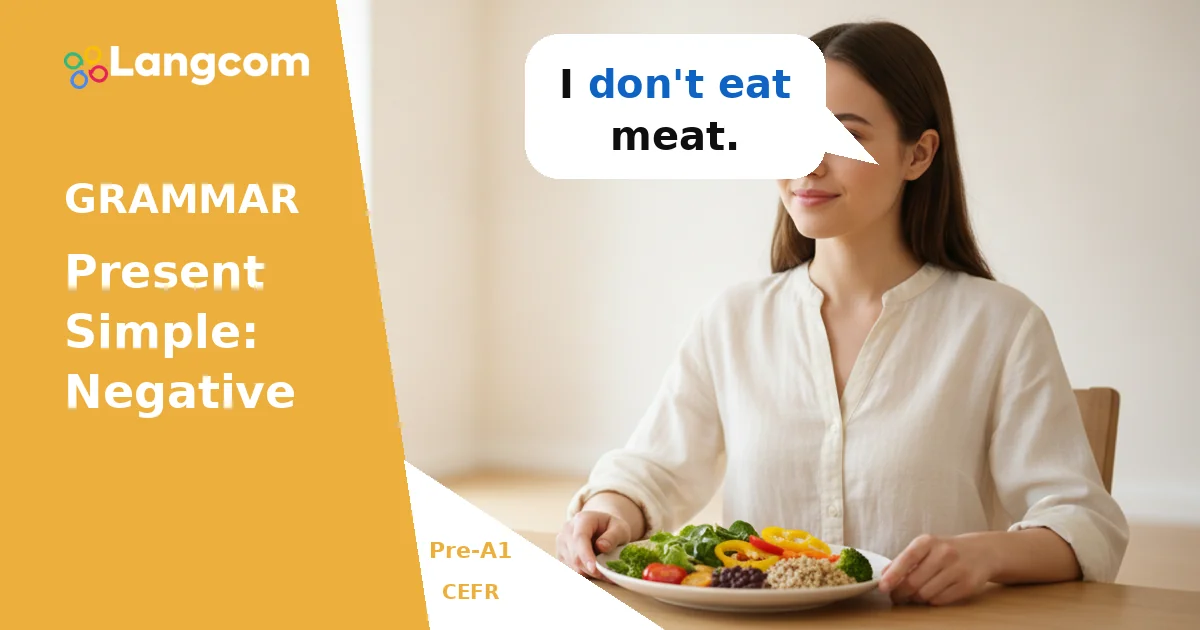

How Do We Make Negative Sentences in Present Simple?
To make a sentence negative in the Present Simple, we add a special word before the main verb. This word is don’t or doesn’t.
These are short forms:
- don’t is short for do not.
- doesn’t is short for does not.
The main verb in the sentence always stays in its base form. This means it does not change, even for he, she, it.
🎓 Learn English with the Blended method
Small groups · 24/7 AI Tutor · Cambridge preparation
Plans from $39 $79 per month
When Do We Use ‘Don’t’?
We use don’t when the subject of the sentence is:
- I
- You
- We
- They
- Or a plural noun (e.g., my friends, the students).
The structure is: Subject + don’t + base form of the verb.
When Do We Use ‘Doesn’t’?
We use doesn’t when the subject of the sentence is:
- He
- She
- It
- Or a singular noun (e.g., my dad, the dog).
The structure is: Subject + doesn’t + base form of the verb. Remember, the verb does not end in ‘-s’ after doesn’t.
| Subject | Negative Form | Main Verb |
|---|---|---|
| I | don’t | work |
| You | don’t | work |
| We | don’t | work |
| They | don’t | work |
| He | doesn’t | work |
| She | doesn’t | work |
| It | doesn’t | work |
Examples
- I don’t eat meat.
- You don’t live in a big city.
- We don’t watch TV in the morning.
- They don’t play football on Tuesdays.
- He doesn’t like pizza.
- She doesn’t work on weekends.
- It doesn’t rain much in summer here.
Practice
💬 Need personalized guidance?
As an Authorized Cambridge Preparation Centre, we can guide you to the right course and certification. Chat with our advisors today.
Chat with an Advisor on WhatsAppCommon mistakes for Spanish speakers
Spanish speakers often say I no like coffee. This is incorrect in English. You must use don’t or doesn’t. The correct way is I don’t like coffee.
Another common mistake is adding ‘-s’ to the verb after doesn’t. For example, She doesn’t likes pizza is wrong. The correct form is She doesn’t like pizza. The verb always stays in its base form after don’t or doesn’t.
Frequently asked questions
What is the short form of do not and does not?
The short form of do not is don’t. The short form of does not is doesn’t.
Does the verb change after don’t or doesn’t?
No, the main verb always stays in its base form after don’t or doesn’t. For example, He doesn’t eat, not He doesn’t eats.
Can I use don’t or doesn’t for all verbs?
You use don’t or doesn’t for most action verbs in the Present Simple. For the verb to be (am, is, are), you make it negative differently (e.g., I am not, He is not).



0 Comments