
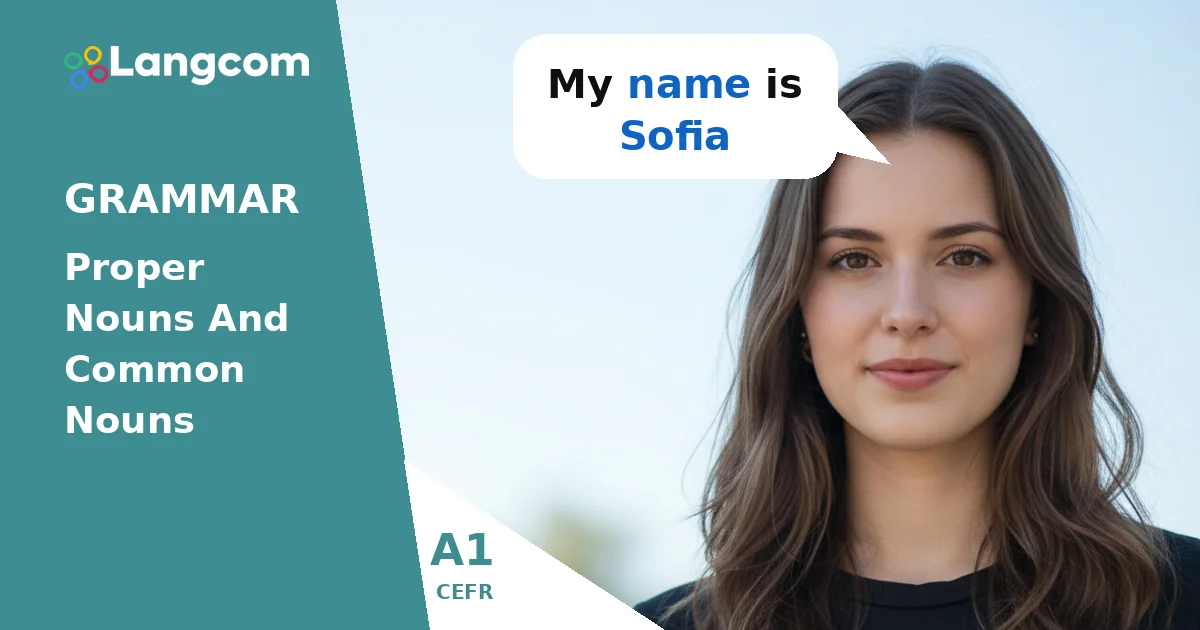

Proper nouns are specific names for people, places, or things, and they always start with a capital letter. Common nouns are general names for people, places, or things, and they usually start with a lowercase letter. Understanding this difference is important for correct English writing. For example, “teacher” is a common noun, but “Mr. Smith” is a proper noun. Similarly, “city” is a common noun, but “London” is a proper noun. Always remember to use a capital letter for proper nouns to make your English clear and correct.
What Are Nouns in English?
Nouns are words that name people, places, things, or ideas. They are a very important part of every sentence.
In English, we divide nouns into two main types: proper nouns und common nouns.
🎓 Englisch lernen mit der Blended-Methode
Kleingruppen · KI-Tutor rund um die Uhr · Vorbereitung auf die Cambridge-Prüfungen
Pläne von $39 $79 pro Monat
What is a Proper Noun?
A proper noun is a specific name for one person, one place, or one thing. It is unique.
-
Always use a capital letter to start a proper noun.
-
Examples of proper nouns include:
- People's names: Maria, John, Dr. Lee
- Specific places: Spain, Paris, Mount Everest
- Days of the week: Monday, Friday
- Months of the year: January, August
- Holidays: Christmas, Easter
- Names of companies or brands: Langcom, Google
What is a Common Noun?
A common noun is a general name for a person, place, or thing. It is not specific.
-
Usually use a lowercase letter to start a common noun.
-
Examples of common nouns include:
- General people: girl, boy, teacher, doctor
- General places: city, country, school, park
- General things: book, table, car, phone
- Animals: cat, dog, bird
Why is Capitalization Important for Nouns?
Using capital letters for proper nouns helps people understand your writing. It shows that you are talking about something specific.
It also makes your English look correct and professional. Always remember this rule!
| Proper Noun (Specific Name) | Common Noun (General Name) |
|---|---|
| Maria | girl |
| Spain | country |
| Monday | day |
| January | month |
| Langcom | academy |
Beispiele
- My name is Sofia.
- I have a dog.
- We live in Madrid, a big city.
- I go to school every day.
- Today is Tuesday.
- My birthday is in July.
Übung
💬 Benötigen Sie eine individuelle Beratung?
Als autorisiertes Cambridge-Vorbereitungszentrum können wir Ihnen helfen, den richtigen Kurs und die passende Zertifizierung zu finden. Chatten Sie noch heute mit unseren Beratern.
Chatten Sie mit einem Berater auf WhatsAppHäufige Fehler bei Spanischsprechern
Spanish speakers sometimes make mistakes with capitalization in English. Remember these key differences:
-
Days of the week and months: In Spanish, these are not capitalized. In English, they are proper nouns und always start with a capital letter.
-
Falsch: My favorite month is july.
-
Richtig: My favorite month is July.
-
-
Nationalities and languages: In Spanish, these are not capitalized. In English, they are proper nouns und always start with a capital letter.
-
Falsch: I speak spanish and english.
-
Richtig: I speak Spanish and English.
-
Häufig gestellte Fragen
What is the main difference between a proper noun and a common noun?
The main difference is specificity. A proper noun is a specific name (like “London”), and a common noun is a general name (like “city”). Proper nouns always use a capital letter.
Do I always capitalize proper nouns?
Yes, you must always capitalize proper nouns in English, no matter where they appear in a sentence. This includes names of people, places, days, months, and specific organizations.
What about the first word of a sentence?
Always capitalize the first word of any sentence, even if it is a common noun. Zum Beispiel:, “Dogs are friendly animals.” Hier, “Dogs” starts with a capital letter because it is the first word of the sentence, even though “dog” is a common noun.




0 Kommentare