

Why is the English Alphabet Important?
The English alphabet is the base of the language. It has 26 letters.
Learning the letters helps you read, write, and spell words correctly. It is very important for clear communication.
- You can spell your name or other words.
- You can understand when someone spells a word for you.
- Man kann sagen, email addresses und phone numbers.
🎓 Englisch lernen mit der Blended-Methode
Kleingruppen · KI-Tutor rund um die Uhr · Vorbereitung auf die Cambridge-Prüfungen
Pläne von $39 $79 pro Monat
How Do We Say the Letters?
Each letter in the English alphabet has a specific sound when we say it alone. These sounds are important for spelling.
- When you say your name, you often need to spell it out loud. For example, M-A-R-I-A.
- When you hear a new word, someone might spell it for you. For example, B-O-O-K.
Practice saying each letter clearly. This will help you understand and be understood.
What is Personal Information?
Personal information is basic data about you. It helps people identify you.
When you meet new people or fill out a form, you often share this information.
- Your first name is the name given to you at birth.
- Your last name (oder surname) is your family name.
- Your email address is how people send you electronic messages.
- Your phone number is how people call you.
How Do We Spell Names and Words?
Spelling is saying the letters of a word one by one. This is very common when names are difficult to understand.
- If your name is Juan, you might say: "My name is Juan. That's J-U-A-N."
- If someone asks for your last name, you might say: "My last name is Garcia. G-A-R-C-I-A."
Always speak slowly and clearly when spelling.
How Do We Say Email Addresses?
Email addresses use letters, numbers, and special symbols. You need to know how to say these symbols.
- The symbol @ is always called at.
- The symbol . (dot) is called dot.
- Sometimes, you see _ (underscore). This is called underscore.
Zum Beispiel, [email protected] is said as "maria dot gomez at langcom dot com."
| English Term | Was das bedeutet |
|---|---|
| First name | Your personal given name (e.g., Anna, David) |
| Last name / Surname | Your family name (e.g., Smith, Garcia) |
| Email address | Your address for electronic mail (e.g., [email protected]) |
| Phone number | Your number for telephone calls (e.g., 555-123-4567) |
| Spell | To say the letters of a word in order |
| @ (at) | A symbol used in email addresses |
| . (dot) | A symbol used in email addresses and websites |
Beispiele
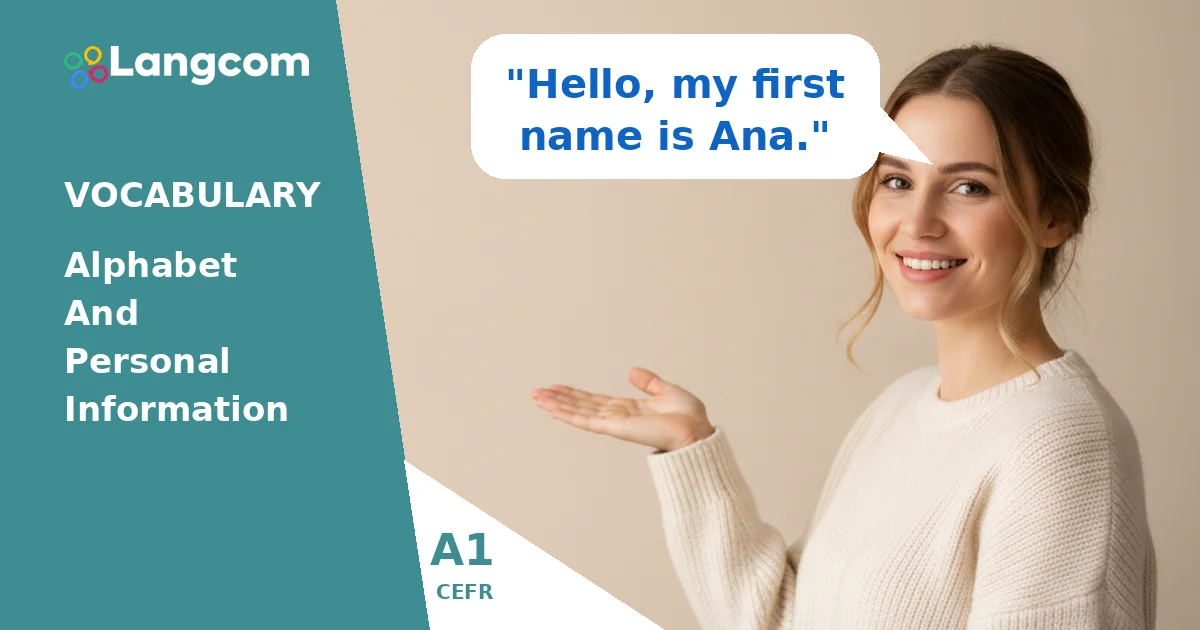
- "Hello, my first name is Ana."
- "What's your last name?"
- "Can you spell that, please?"
- "It's A-N-A."
- "My email address is [email protected]."
- "My phone number is 555-123-4567."
- "How do you spell 'book'? B-O-O-K."
Übung
💬 Benötigen Sie eine individuelle Beratung?
Als autorisiertes Cambridge-Vorbereitungszentrum können wir Ihnen helfen, den richtigen Kurs und die passende Zertifizierung zu finden. Chatten Sie noch heute mit unseren Beratern.
Chatten Sie mit einem Berater auf WhatsAppHäufige Fehler bei Spanischsprechern
Many Spanish speakers make mistakes with certain English letter sounds:
- A vs. E: Auf Englisch, A sounds like 'ei' (as in 'day'), and E sounds like 'ii' (as in 'see'). Be careful not to confuse them.
- I vs. E: Englisch I sounds like 'ai' (as in 'my'), and English E sounds like 'ii'.
- J vs. Y: Englisch J sounds like 'dʒei' (as in 'jump'), while English Y sounds like 'wai' (as in 'yes').
- B vs. V: Auf Englisch, B is a 'b' sound (lips together), and V is a 'v' sound (teeth on lip).
For personal information, remember:
- Verwendung first name und last name (oder surname). Do not use 'apellido' directly.
- Always say at für @ und dot für . in email addresses.
Häufig gestellte Fragen
What is the difference between 'first name' and 'last name'?
Your first name is your personal given name, like Maria oder Juan. Your last name (also called surname) is your family name, like Gomez oder Smith.
How do I spell my name in English?
You say each letter of your name one by one, using the English pronunciation for each letter. For example, if your name is Sofia, you would say "S-O-F-I-A."
What do 'at' and 'dot' mean in an email address?
In an email address, at is the English word for the symbol @. Dot is the English word for the symbol . (period or full stop).
Why is it important to learn the alphabet sounds?
Learning the alphabet sounds helps you spell words correctly, understand when others spell words, and pronounce new words better. It is key for clear communication in English.


0 Kommentare