

Was ist das Präsens?
We use the Present Simple to talk about things that happen regularly or are always true.
- Routines and Habits: Actions you do often. I wake up at 7 AM every day.
- Fakten und allgemeine Wahrheiten: Dinge, die immer wahr sind. The sun rises in the east.
- Zeitpläne und Fahrpläne: Feste Termine. The train leaves at 8:00.
The form is simple: subject + verb. Für he, she, it, fügen wir hinzu -s to the verb.
🎓 Englisch lernen mit der Blended-Methode
Kleingruppen · KI-Tutor rund um die Uhr · Vorbereitung auf die Cambridge-Prüfungen
Pläne von $39 $79 pro Monat
What is the Present Continuous?
We use the Present Continuous to talk about actions happening right now, at this moment.
- Actions Happening Now: What you are doing at this exact time. She is reading a book right now.
- Temporary Situations: Actions that are happening for a short time. I am living with my parents this month.
The form is subject + am/is/are + verb-ing. Remember to use am für I, is für he/she/it, und are für you/we/they.
When to Use Each Tense: Simple vs. Continuous
It is important to choose the correct tense to express your meaning clearly.
- Verwendung Present Simple for things that are permanent, regular, or always true.
- Verwendung Present Continuous for things that are happening at the moment of speaking or are temporary.
Look for keywords to help you decide:
- Present Simple Keywords: every day, always, usually, often, sometimes, never, on Mondays.
- Present Continuous Keywords: now, right now, at the moment, today, this week, currently.
| Feature | Present Simple | Present Continuous |
|---|---|---|
| Usage | Routines, habits, facts, schedules | Actions happening now, temporary actions |
| Form | verb (add -s for he/she/it) | am/is/are + verb-ing |
| Keywords | every day, always, usually | now, at the moment, today |
| Example | I play tennis. | I am playing tennis now. |
Beispiele
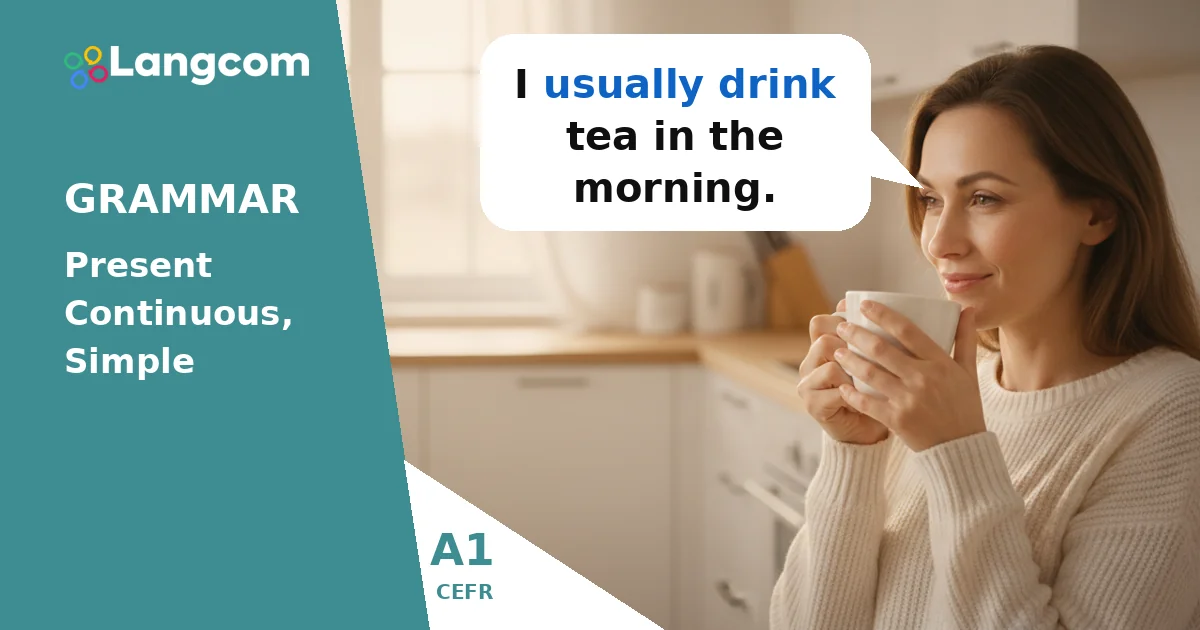
- I usually drink tea in the morning. (Present Simple: habit)
- I am drinking coffee now. (Present Continuous: action happening at this moment)
- She works in an office. (Present Simple: fact/routine)
- She is working from home today. (Present Continuous: temporary action)
- They play football every Saturday. (Present Simple: routine)
- They are playing football in the park right now. (Present Continuous: action happening now)
- The water boils at 100 degrees Celsius. (Present Simple: general truth)
- The water is boiling! Be careful. (Present Continuous: action happening now)
Übung
💬 Benötigen Sie eine individuelle Beratung?
Als autorisiertes Cambridge-Vorbereitungszentrum können wir Ihnen helfen, den richtigen Kurs und die passende Zertifizierung zu finden. Chatten Sie noch heute mit unseren Beratern.
Chatten Sie mit einem Berater auf WhatsAppHäufige Fehler bei Spanischsprechern
Spanish speakers sometimes use the Present Simple when they should use the Present Continuous.
- Falsch: I eat dinner now. (This sounds like a habit, not an action happening at this moment.)
- Richtig: I am eating dinner now. (This correctly shows the action is happening at this moment.)
Another common mistake is forgetting am/is/are mit dem -ing form.
- Falsch: He playing tennis.
- Richtig: He is playing tennis.
Häufig gestellte Fragen
What is the main difference between Present Simple and Present Continuous?
Die Present Simple is for routines, habits, and facts. The Present Continuous is for actions happening at the moment of speaking or temporary situations.
How do I form the Present Simple for 'he', 'she', 'it'?
Für he, she, und it, dann fügt man hinzu -s to the verb. For example, He works, She reads, It rains.
How do I form the Present Continuous?
Du verwendest am, is, oder are, plus the -ing form of the main verb. For example, I am learning, She is studying, They are watching.
Can I use 'always' with the Present Continuous?
Usually, always is for the Present Simple. However, you can use always + Present Continuous to talk about something that happens very often and is annoying, like He is always complaining!



0 Kommentare