

Why is learning body parts important in English?
Learning the names of body parts helps you in many daily situations. It is basic vocabulary for talking about yourself and others.
- Talking about health: When you feel sick, you need to tell a doctor where it hurts. For example, My head hurts oder I have a pain in my stomach.
- Describing people: You can describe how someone looks. For example, She has long hair and blue eyes.
- Understanding instructions: You might hear instructions like Raise your hand oder Touch your toes.
- Daily conversations: Many common expressions use body parts, like to lend a hand (to help).
🎓 Englisch lernen mit der Blended-Methode
Kleingruppen · KI-Tutor rund um die Uhr · Vorbereitung auf die Cambridge-Prüfungen
Pläne von $39 $79 pro Monat
What are the main parts of the head and face?
Die head is the top part of your body. On your head, you have your face.
- Hair: What covers your head. He has short, brown hair.
- Eye / Eyes: You use them to see. She has beautiful green eyes.
- Ear / Ears: You use them to hear. My ears are cold.
- Nose: You use it to smell and breathe. He has a small nose.
- Mouth: You use it to eat, drink, and speak. Close your mouth when you chew.
- Tooth / Teeth: Inside your mouth, you use them to chew. Brush your teeth twice a day.
- Tongue: The muscle inside your mouth. Stick out your tongue!
What about the body, arms, and legs?
Below your head, you have your neck, which connects your head to your main body.
- Neck: Connects your head to your body. I have a long neck.
- Shoulder / Shoulders: The part where your arm connects to your body. He carried the bag on his shoulder.
- Arm / Arms: The upper limbs from your shoulder to your hand. She has strong arms.
- Hand / Hands: At the end of your arms, you use them to hold things. Wash your hands before eating.
- Finger / Fingers: The five parts at the end of each hand. He has long fingers.
- Back: The rear surface of your body. My back hurts after lifting that box.
- Stomach: The part of your body where food is digested. I have a full stomach.
- Leg / Legs: The lower limbs you use for walking. She has long legs.
- Foot / Feet: At the end of your legs, you use them to stand and walk. My feet are tired.
- Toe / Toes: The five parts at the end of each foot. He stubbed his toe.
| Singular | Plural |
|---|---|
| arm | arms |
| ear | ears |
| eye | eyes |
| finger | fingers |
| foot | feet |
| hand | hands |
| head | heads |
| leg | legs |
| mouth | mouths |
| nose | noses |
| shoulder | shoulders |
| stomach | stomachs |
| tooth | teeth |
| toe | toes |
Beispiele
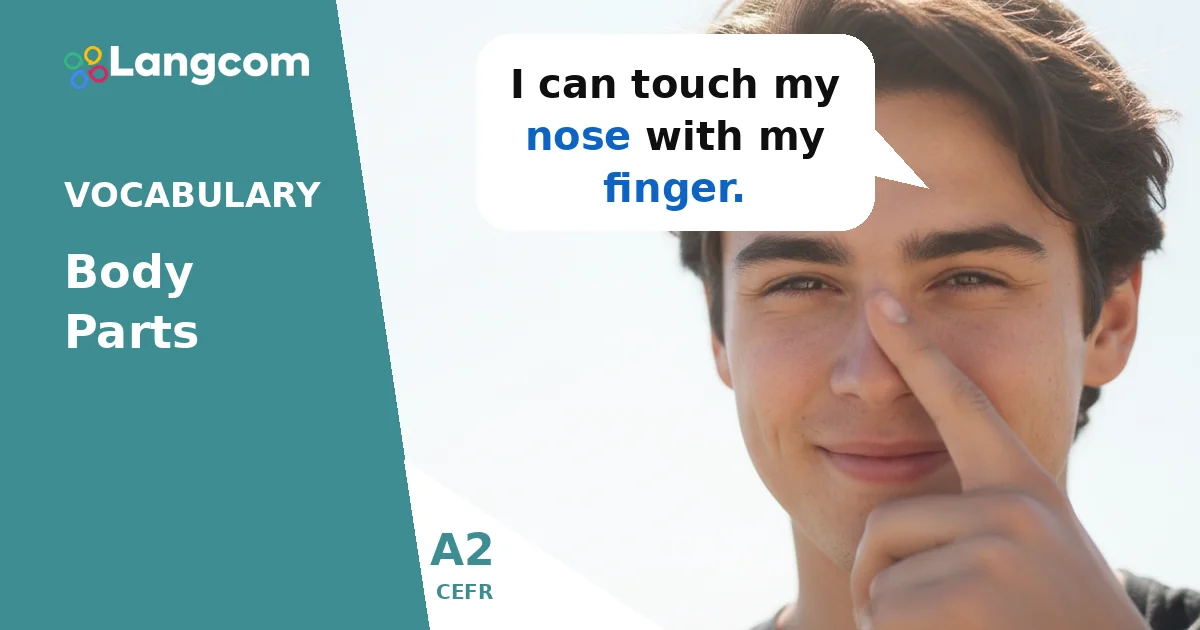
- I can touch my nose with my finger.
- She has beautiful long hair.
- My stomach hurts after eating too much.
- He broke his arm playing football.
- Please close your mouth when you are eating.
- My feet are cold, I need some socks.
Übung
💬 Benötigen Sie eine individuelle Beratung?
Als autorisiertes Cambridge-Vorbereitungszentrum können wir Ihnen helfen, den richtigen Kurs und die passende Zertifizierung zu finden. Chatten Sie noch heute mit unseren Beratern.
Chatten Sie mit einem Berater auf WhatsAppHäufige Fehler bei Spanischsprechern
Spanish speakers sometimes make these mistakes:
- Singular vs. Plural: Remember that some body parts have irregular plural forms. For example, one foot aber two feet. Also, one tooth aber many teeth.
- Using 'the' instead of 'my/his/her': In Spanish, you often say 'la cabeza' or 'el brazo'. In English, we usually use possessive adjectives when talking about our own body parts. For example, say I hurt my leg, nicht I hurt the leg.
- Confusing 'arm' and 'hand': Ein arm is the whole part from the shoulder to the wrist. A hand is only the end part of the arm, including the fingers.
- Confusing 'leg' and 'foot': A leg is the whole part from the hip to the ankle. A foot is only the end part of the leg, below the ankle.
Häufig gestellte Fragen
Why is it important to learn body parts in English?
Learning body parts is essential for describing people, talking about health, understanding directions, and using many common English expressions. It's fundamental vocabulary for A2 level communication.
Are there any common English phrases that use body parts?
Yes, many! For example, to lend a hand means to help. To keep an eye on something means to watch it carefully. To have a sweet tooth means to like sweet foods.
How might body parts vocabulary appear in the A2 Key (KET) exam?
In the A2 Key (KET) exam, you might see body parts vocabulary in the Reading and Writing parts. For example, you might need to read a description of a person and identify them, or write a short message about feeling unwell, using words like headache oder stomach ache. It can also appear in the Speaking part when describing people or talking about your health.


0 Kommentare