
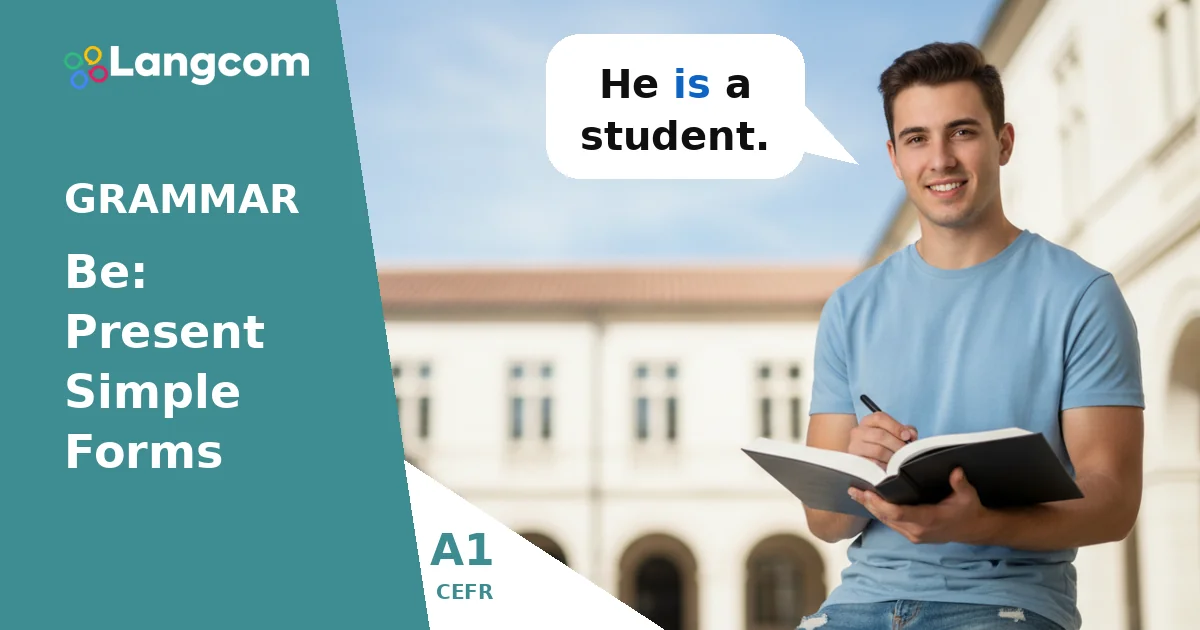

What is the verb ‘be’?
Das Verb be is one of the most important verbs in English. We use it to talk about who or what someone or something is, where they are, or how they feel.
It changes its form depending on the subject. For he, she, und they, we use specific forms.
🎓 Englisch lernen mit der Blended-Methode
Kleingruppen · KI-Tutor rund um die Uhr · Vorbereitung auf die Cambridge-Prüfungen
Pläne von $39 $79 pro Monat
How do we use 'is' with 'he' and 'she'?
When you talk about one male person, you use the pronoun he. When you talk about one female person, you use the pronoun she.
- Für he und she, the form of be ist is.
- We can say He is oder She is.
- In spoken English and informal writing, we often use a shorter form called a contraction: he's und she's.
How do we use 'are' with 'they'?
When you talk about two or more people or things, you use the pronoun they.
- Für they, the form of be ist are.
- We say They are.
- The contraction for they are ist they're.
Why are contractions important?
Contractions are very common in everyday English. Native speakers use them all the time when they talk.
- They make your English sound more natural.
- He is und he's bedeuten dasselbe.
- She is und she's bedeuten dasselbe.
- They are und they're bedeuten dasselbe.
| Pronoun | Full Form (+) | Contracted Form (+) |
|---|---|---|
| he | he is | he's |
| she | she is | she's |
| they | they are | they're |
Beispiele
- He is a student.
- She is from Brazil.
- They are happy.
- He's my brother.
- She's at home.
- They're good friends.
- He is tall.
- She is a doctor.
- They are in the park.
Übung
💬 Benötigen Sie eine individuelle Beratung?
Als autorisiertes Cambridge-Vorbereitungszentrum können wir Ihnen helfen, den richtigen Kurs und die passende Zertifizierung zu finden. Chatten Sie noch heute mit unseren Beratern.
Chatten Sie mit einem Berater auf WhatsAppHäufige Fehler bei Spanischsprechern
Many Spanish speakers sometimes forget to use the verb be because in Spanish, you can often omit the subject pronoun and the verb 'ser/estar' is implied. However, in English, the verb be is almost always necessary.
- Falsch: He happy.
- Richtig: He is happy. oder He's happy.
Ein weiterer häufiger Fehler ist die Verwechslung von is und are:
- Falsch: They is friends.
- Richtig: They are friends. oder They're friends.
Häufig gestellte Fragen
What does 'be' mean when we use 'is' or 'are'?
When we use is oder are, the verb be helps us describe someone's identity (He is a teacher.), their nationality (She is Spanish.), or their location (They are here.).
Can I use 'it is' with 'be'?
Yes, you can! Just like he is und she is, wir verwenden it is (oder it's) for a single thing or animal. For example, It is a book.
Is 'he's' always 'he is'?
For A1 English, yes, you can think of he's as he is. Later, you will learn that he's can also mean he has, but for now, focus on he is.
Why is it important to learn 'be' forms correctly?
Learning the correct forms of be is very important because it is a basic building block for almost all English sentences. Using it correctly helps you make clear and understandable sentences right from the start.

0 Kommentare