

What Do Under- و Over- Mean?
These two prefixes are opposites and add specific meanings to base words. Understanding their core ideas is key to using them correctly.
- The prefix under- generally means ‘below’, ‘not enough’, or ‘less than what is normal or required’. It suggests a deficiency or a lower position.
- The prefix over- generally means ‘above’, ‘too much’, or ‘more than what is normal or required’. It suggests an excess or a higher position.
✍️ لست متأكدًا من مستواك؟
خُذ اختبار تحديد المستوى المجاني الخاص بنا واحصل على تعليقات مخصصة من ممتحنين معتمدين من كامبريدج.
قم بإجراء اختبار تحديد المستوى المجانيHow Do They Change Word Meaning?
When under- أو over- attach to a word, they significantly alter its meaning, often creating an antonym or a word with an intensified or diminished sense.
- With Verbs: They describe an action performed insufficiently or excessively. For example, to cook يصبح to undercook (not cook enough) or to overcook (cook too much).
- With Adjectives: They describe a quality that is present to an insufficient or excessive degree. For instance, confident يصبح underconfident (not confident enough) or overconfident (too confident).
- With Nouns: They can refer to a quantity, status, or position that is below or above a standard. For example, payment يصبح underpayment (not enough payment) or overpayment (too much payment).
Common Uses of Under- و Over-
These prefixes are highly versatile and appear in many contexts. Here are some common categories:
- Quantity or Degree: Expressing 'too little' or 'too much' of something.
مثال: The soup was underseasoned. (not enough salt/spices)
مثال: He tends to overthink things. (think too much) - Position or Location: Indicating something is below or above.
مثال: The train runs underground. (below the ground)
مثال: The overhead locker was full. (above your head) - Status or Condition: Describing a state that is insufficient or excessive.
مثال: Many developing countries are still underdeveloped. (not developed enough)
مثال: She was overwhelmed by the amount of work. (too much to handle) - Performance or Action: Referring to an action done insufficiently or excessively.
مثال: Don't underestimate your opponent. (don't rate them too low)
مثال: He often overreacts to small problems. (reacts too strongly)
Hyphenation: Under- و Over- as Prefixes
At the C1 level, it's important to be aware of hyphenation conventions, which can sometimes vary.
- General Rule: Most words formed with under- و over- are written as one word, without a hyphen. For example, overwhelm, underestimate, overachieve.
- Exceptions for Clarity: A hyphen might be used if the base word begins with the same vowel as the prefix ends, to avoid awkward spelling (e.g., re-elect, but this is less common with under- و over-).
- American vs. British English: There can be slight differences. American English tends to prefer closed forms (no hyphen) more consistently. British English might sometimes use a hyphen for clarity, especially with longer or less common words, though the trend is generally towards closed forms in both varieties. Always consult a reliable dictionary for specific words.
| Prefix | المعنى | مثال على كلمة | جملة مثال |
|---|---|---|---|
| Under- | Too little, below, insufficient | Underestimated | They underestimated the cost of the project. |
| Over- | Too much, above, excessive | Overestimated | We overestimated how much food we would need. |
أمثلة
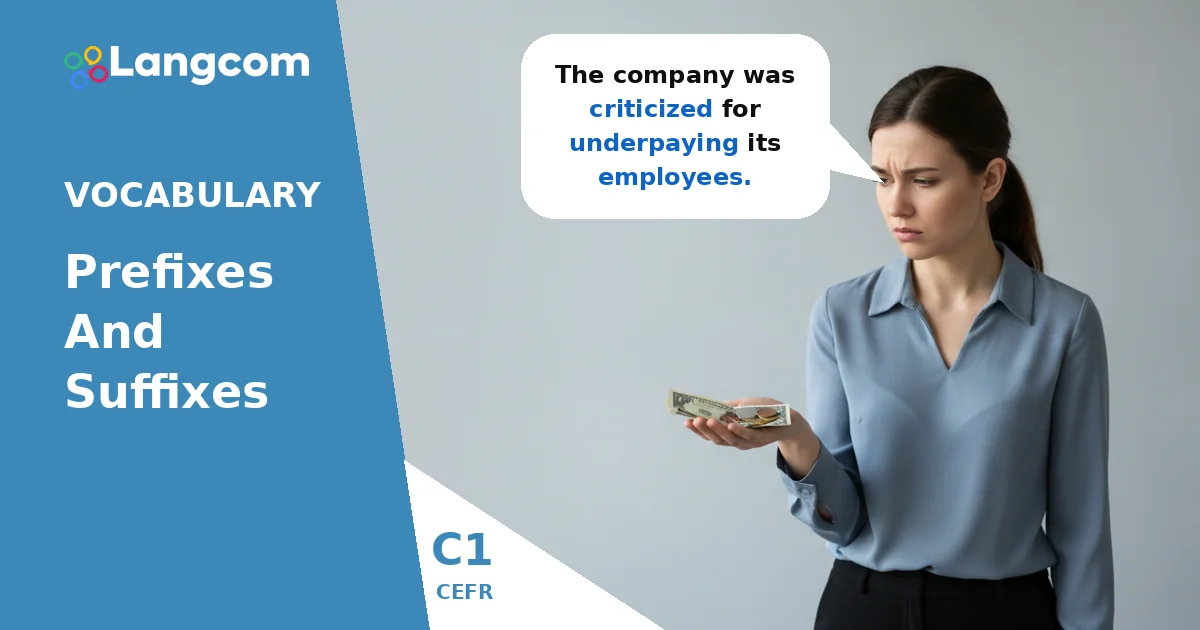
- The company was criticized for underpaying its employees.
- He felt overwhelmed by the amount of information.
- It's easy to underestimate the power of a good night's sleep.
- The restaurant was overcrowded during peak hours.
- She's a bit oversensitive to criticism.
- The project was completed under budget and ahead of schedule.
- Don't overdo it on your first day at the gym.
- The film was underrated by critics but loved by audiences.
التدريب
هل أنت مستعد للحصول على شهادتك؟
يُعد برنامج Langcom الطلاب لامتحانات كامبريدج وIELTS وTOEFL وDELE وSIELE وMichigan.
ابدأ مع Langcomالأخطاء الشائعة لدى المتحدثين باللغة الإسبانية
الأخطاء الشائعة لدى المتحدثين باللغة الإسبانية
Spanish speakers sometimes make mistakes when using under- و over- due to direct translation or confusion with separate adverbs.
- Using 'too much' or 'not enough' instead of the prefix: While grammatically correct, using the prefix is often more concise and natural at a C1 level.
Incorrect: He is too much confident.
Correct: He is overconfident.
Incorrect: The meat was cooked not enough.
Correct: The meat was undercooked. - Confusing with other negative/positive prefixes: تذكر under- و over- specifically relate to 'too little'/'too much' or 'below'/'above', not general negation like un- أو dis-.
Incorrect: He is underhappy. (استخدم unhappy أو not happy enough) - Incorrect hyphenation: While less common, sometimes learners might incorrectly hyphenate words that should be solid.
Incorrect: over-estimate
Correct: overestimate
الأسئلة الشائعة
ما هو الفرق الرئيسي بين under- و over-?
The main difference is their core meaning: under- implies 'too little', 'below', or 'insufficient', while over- implies 'too much', 'above', or 'excessive'.
Can under- و over- be used with any word?
No, they cannot be used with any word. They combine with specific verbs, adjectives, and nouns to form established words. You usually wouldn't create new words with them unless it's for a specific, often informal, context.
هل under- و over- always written as one word with the base word?
Generally, yes, they are written as one word (e.g., overcome, undergo). However, there can be exceptions for clarity or slight variations between American and British English, especially for less common terms. Always check a dictionary if unsure.
Do these prefixes have a positive or negative connotation?
They can have both, depending on the context. For example, overachieve can be positive, while overreact is negative. Similarly, understated can be positive (elegant simplicity), but underpaid is negative.

0 تعليق