

How Do We Ask Yes/No Questions About One Person?
When you want to know a simple ‘yes’ or ‘no’ answer about what someone (he, she) or something (it) does, you start your question with Does.
- First, use Does.
- Then, add the subject: he, she, ، أو it.
- Next, use the main verb in its base form (without -s).
- Finally, add the rest of the sentence.
Look at the pattern:
Does + he/she/it + base verb + …?
🎓 تعلم اللغة الإنجليزية باستخدام الطريقة المختلطة
مجموعات صغيرة · مدرس ذكاء اصطناعي متاح على مدار الساعة · التحضير لامتحانات كامبريدج
خطط من $39 $79 في الشهر
What About Questions with 'Who', 'What', 'Where', 'When', 'Why', 'How'?
If you want more specific information, you can use question words like What, Where, When, Why, ، أو How. These words come at the very beginning of the question.
- Start with the question word (What, Where, etc.).
- ثم، أضف does.
- Next, add the subject: he, she, ، أو it.
- After that, use the main verb in its base form.
Look at the pattern:
Question Word + does + he/she/it + base verb + ...?
كيف نقدم إجابات موجزة؟
For 'yes' or 'no' questions, we often give short answers. These answers are simple and polite.
- For a positive answer, say: Yes, he/she/it does.
- For a negative answer, say: No, he/she/it doesn't. (doesn't هو اختصار لـ does not)
أمثلة
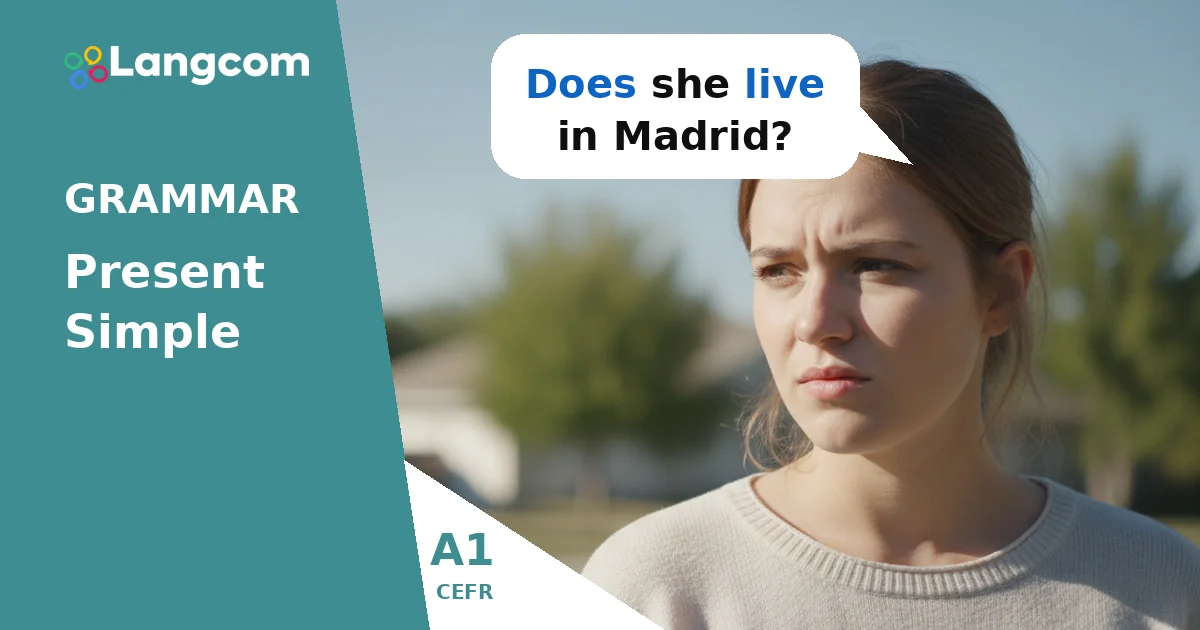
- Does she live in Madrid?
- Yes, she does.
- No, she doesn't.
- Does he like coffee?
- What time does he wake up?
- Where does she work?
- When does the shop open?
- Why does it rain a lot here?
- How does he travel to work?
التدريب
💬 هل تحتاج إلى إرشادات مخصصة؟
بصفتنا مركزًا معتمدًا للتحضير لاختبارات كامبريدج، يمكننا توجيهك نحو الدورة والشهادة المناسبتين لك. تحدث مع مستشارينا اليوم.
دردش مع مستشار على واتسابالأخطاء الشائعة لدى المتحدثين باللغة الإسبانية
Many Spanish speakers make these common mistakes:
- إضافة -s to the verb: Remember, after does, the main verb is always in its base form. You should say Does she work?, ، وليس Does she works?
- النسيان does: You cannot say He lives here? for a question. You must use Does he live here?
- استخدام do بدلاً من does: بالنسبة لـ he, she, ، و it, always use does. So, it's Does he play football?, ، وليس Do he play football?
الأسئلة الشائعة
What is the main rule for 'he/she/it' questions in Present Simple?
The main rule is to use the helping verb does before the subject (he, she, ، أو it), and then use the main verb in its base form. For example, Does she speak English?
Why do we use 'does' and not 'do' for 'he/she/it'?
In the Present Simple, does is the special form of the verb do that we use only for third-person singular subjects: he, she, ، و it. بالنسبة لـ I, you, we, ، و they, ، نستخدم do.
Does the main verb change after 'does'?
No, the main verb never changes after does. It always stays in its base form (the infinitive without 'to' and without -s). على سبيل المثال،, Does he live?, ، وليس Does he lives?
Can I use 'does' for 'you' or 'we'?
لا، لا يمكنك استخدام does من أجل you أو we. For these subjects, you must use do. على سبيل المثال،, Do you like pizza? و Do we have class today?
What are the short answers for 'he/she/it' questions?
For positive short answers, you say Yes, he does., Yes, she does., ، أو Yes, it does. For negative short answers, you say No, he doesn't., No, she doesn't., ، أو No, it doesn't.


0 تعليق