

What Are Object Pronouns?
Object pronouns are words that replace a noun when that noun is the object of a verb or a preposition. This means the noun receives the action of the verb.
They help us avoid repeating the same noun many times. This makes your sentences sound more natural.
- Subject pronouns (like I, he, she) do the action.
- Object pronouns (like me, him, her) receive the action.
🎓 تعلم اللغة الإنجليزية باستخدام الطريقة المختلطة
مجموعات صغيرة · مدرس ذكاء اصطناعي متاح على مدار الساعة · التحضير لامتحانات كامبريدج
خطط من $39 $79 في الشهر
When Do We Use Object Pronouns?
You use object pronouns in two main situations:
- After a verb: The object pronoun receives the action of the verb. For example, in I see him, him receives the action of see.
- After a preposition: Prepositions are words like to, for, with, at, about. For example, in Talk to me, me comes after the preposition to.
Remember, object pronouns always come *after* the word that they are the object of.
Which Object Pronouns Should I Use?
Each subject pronoun has a matching object pronoun. It is important to learn these pairs.
- الاستخدام it و them for things, animals, or places. For example, I like the book. I read it.
- For people, use me, you, him, her, us, them.
| Subject Pronoun | Object Pronoun | مثال |
|---|---|---|
| I | me | I talked to Manuel. He called me. |
| you | you | You were in town. I saw you. |
| he | him | He's a great singer. I like him. |
| she | her | She lives nearby. I often visit her. |
| it | it | It's a nice town. I like it. |
| we | us | We were at the party. Did you see us? |
| they | them | These shoes are nice. I can't buy them. |
أمثلة
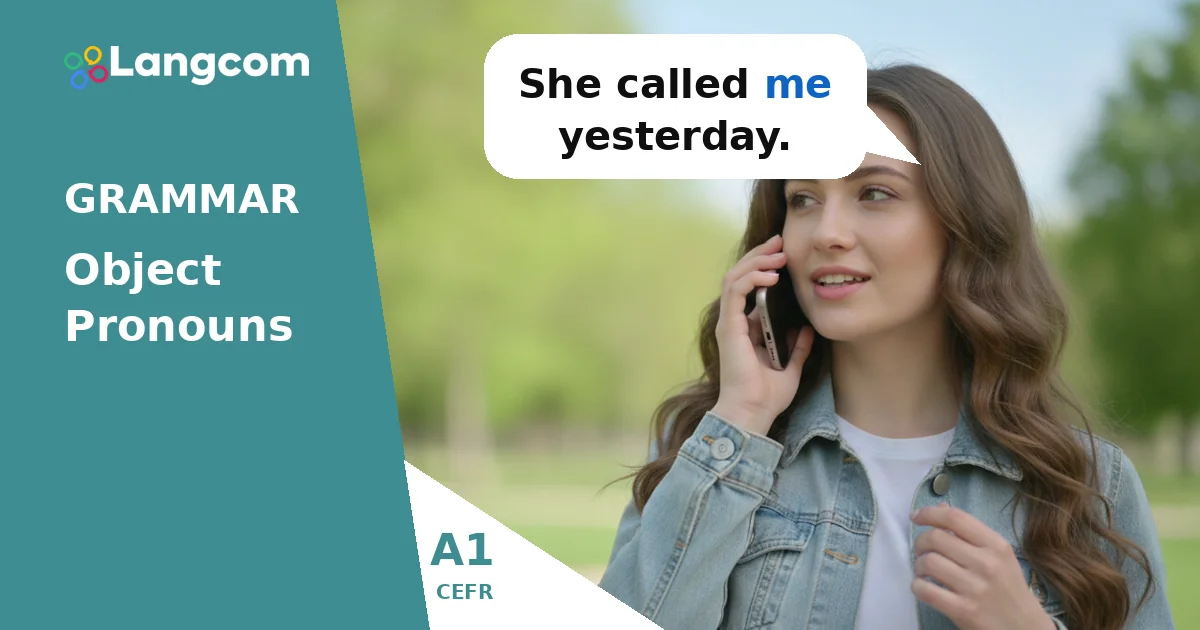
- She called me yesterday.
- I saw you at the park.
- My brother is nice. I like him.
- This is my friend. Do you know her?
- The book is interesting. I am reading it.
- We are going to the cinema. Come with us!
- Where are my keys? I can't find them.
التدريب
💬 هل تحتاج إلى إرشادات مخصصة؟
بصفتنا مركزًا معتمدًا للتحضير لاختبارات كامبريدج، يمكننا توجيهك نحو الدورة والشهادة المناسبتين لك. تحدث مع مستشارينا اليوم.
دردش مع مستشار على واتسابالأخطاء الشائعة لدى المتحدثين باللغة الإسبانية
For Spanish speakers, a common mistake is using a subject pronoun like she أو he when an object pronoun like her أو him is needed. In Spanish, the subject and object forms are often the same or very similar (e.g., ella for both 'she' and 'her' in some contexts, or él for 'he' and 'him').
- خطأ: I see he.
- الصحيح: I see him.
- خطأ: Give the book to she.
- الصحيح: Give the book to her.
Always remember that after a verb or a preposition, you need an object pronoun in English.
الأسئلة الشائعة
What is the main difference between subject and object pronouns?
Subject pronouns (I, he, she) perform the action in a sentence. Object pronouns (me, him, her) receive the action or come after a preposition.
Can I use 'it' for a person?
No, you should not use it for a person. It is used for things, animals, or places. For people, use him أو her.
Where do object pronouns usually go in a sentence?
Object pronouns typically come after the main verb or after a preposition in a sentence. For example, She likes me أو Talk to him.
Why are object pronouns important for A1 English learners?
Object pronouns are fundamental for A1 learners because they help you form basic, correct sentences. They make your English sound natural and help you avoid repetition when talking about people, things, or animals.

0 تعليق