

What is the Future Perfect Tense?
The future perfect tense helps us talk about actions that will be finished before a certain point or another event in the future.
It emphasizes the completion of an action by a future deadline.
- Form: will have + past participle
- مثال: By the time you arrive, I will have already cooked dinner.
We use this tense for two main situations:
- Actions completed before a specific future time: This tells us that an action will be entirely done by a particular moment in the future. For example, By next month, she will have saved enough money for her trip.
- Actions completed before another future action: This shows one action finishing before a second future action begins. For instance, They will have finished the project before the manager returns.
✍️ لست متأكدًا من مستواك؟
خُذ اختبار تحديد المستوى المجاني الخاص بنا واحصل على تعليقات مخصصة من ممتحنين معتمدين من كامبريدج.
قم بإجراء اختبار تحديد المستوى المجانيWhat is the Future Continuous Tense?
The future continuous tense describes an action that will be in progress at a specific time in the future. It focuses on the duration or ongoing nature of an activity.
- Form: will be + verb + -ing (present participle)
- مثال: At 3 PM tomorrow, I will be working on my presentation.
This tense is useful for several scenarios:
- Actions in progress at a future point: This highlights an activity that will be happening at a precise moment in the future. For example, This time next week, we will be relaxing on the beach.
- Planned future events or arrangements: It can describe events that are already planned or expected to happen. For instance, I will be meeting my friends later this evening.
- Asking politely about someone's plans: We can use it to inquire about future intentions in a less direct way. For example, Will you be using the computer this afternoon?
How are Future Perfect and Future Continuous Different?
The core difference between these two tenses lies in whether the action is completed or ongoing at a future point.
- Future Perfect: Focuses on the *completion* of an action by a future deadline. The action is finished.
- Future Continuous: Focuses on an action *in progress* at a future point. The action is happening.
Consider these examples to see the distinction:
- By 7 PM, I will have eaten dinner. (Dinner is finished by 7 PM.)
- At 7 PM, I will be eating dinner. (Dinner is in progress at 7 PM.)
- When you call, she will have left for work. (She is gone before your call.)
- When you call, she will be driving to work. (She is in the middle of driving when you call.)
When to Use Each Tense: Advanced Scenarios
At a C1 level, you can explore more nuanced uses of these tenses.
- Future Perfect for assumptions about the past: Sometimes, we use the future perfect to make a guess or assumption about something that has probably already happened, from a future perspective. For example, They will have arrived at the airport by now.
- Future Continuous for routine or expected actions: It can describe actions that are part of a routine or are expected to happen naturally in the future. For instance, I'll be working late again tomorrow.
- Avoiding Future Continuous with Stative Verbs: Remember that stative verbs (like know, believe, love) are generally not used in continuous forms. So, I will be knowing the answer is incorrect. Instead, use I will know the answer.
| ميزة | Future Perfect | Future Continuous |
|---|---|---|
| Form | will have + past participle | will be + verb + -ing |
| Main Use | Action completed before a future point | Action in progress at a future point |
| Focus | Completion / Result | Duration / Ongoing Activity |
| Keywords | By (time/date), before, when | At (time), this time next (week/year), while |
| Example | By 5 PM, I will have finished my report. | At 5 PM, I will be writing my report. |
أمثلة
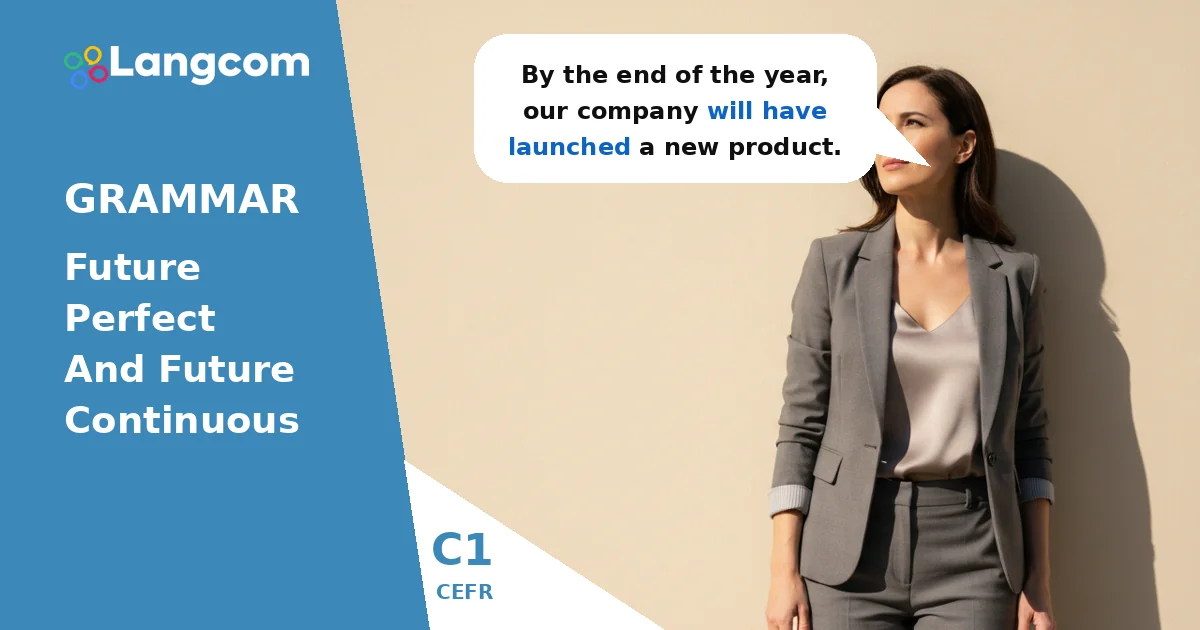
- By the end of the year, our company will have launched a new product.
- This time next month, I will be studying for my final exams.
- When you get home, I will have already packed my suitcase.
- Don't call me between 2 and 4 PM; I will be having a meeting.
- In ten years, artificial intelligence will have transformed many industries.
- Next Saturday, we will be celebrating my sister's birthday.
- Will you have finished your report by the deadline?
- At midnight, many people will be watching the fireworks display.
التدريب
هل أنت مستعد للحصول على شهادتك؟
يُعد برنامج Langcom الطلاب لامتحانات كامبريدج وIELTS وTOEFL وDELE وSIELE وMichigan.
ابدأ مع Langcomالأخطاء الشائعة لدى المتحدثين باللغة الإسبانية
Spanish speakers sometimes make specific errors when using these tenses:
- Confusing completion with ongoing action: A common mistake is using the future continuous when the future perfect is needed for a completed action by a deadline.
- خطأ: By next year, I will be finishing my master's degree.
- الصحيح: By next year, I will have finished my master's degree. (The degree will be completed.)
- Incorrect form for future perfect: Sometimes the auxiliary verbs are mixed up.
- خطأ: I will have be finished by then.
- الصحيح: I will have finished by then. (Remember will have + past participle)
- Incorrect form for future continuous: نسيان be verb or the -ing form.
- خطأ: At 8 PM, I will working.
- الصحيح: At 8 PM, I will be working. (Remember will be + -ing)
- Over-reliance on simple future: While the simple future can sometimes express future events, it lacks the specificity of completion or ongoing action at a future point that these advanced tenses provide. For C1, aim for precision.
الأسئلة الشائعة
Can I use 'going to' with these tenses?
لا،, going to is typically used with the simple future or present continuous for future plans. The forms for future perfect (will have + past participle) and future continuous (will be + -ing) already include the auxiliary will and do not combine with going to.
Are these tenses common in everyday speech?
Yes, especially the future continuous is quite common for talking about plans or what you'll be doing. The future perfect is used when you need to specify an action's completion before a future point, which is frequent in professional or academic contexts.
What's the difference between 'I will be working' and 'I will work'?
I will be working (future continuous) emphasizes that the action of working will be in progress at a specific future time. I will work (simple future) simply states that you will work in the future, without specifying if it's ongoing at a particular moment or completed by then. The continuous form often implies a temporary activity or a planned event.
How do these tenses relate to other future forms?
These tenses add more detail than the simple future (will + verb) or present continuous for future (am/is/are + -ing). The future perfect focuses on completion by a future point, while the future continuous highlights an action in progress at a future point. They allow for greater precision in describing future events, which is essential for C1 communication.


0 تعليق