

What Are -ed and -ing Adjectives?
Many adjectives in English are formed from verbs. These adjectives help us describe things and people.
They often come in pairs, one ending in -ed and the other in -ing. For example, from the verb to bore, we get bored و boring.
✍️ لست متأكدًا من مستواك؟
خُذ اختبار تحديد المستوى المجاني الخاص بنا واحصل على تعليقات مخصصة من ممتحنين معتمدين من كامبريدج.
قم بإجراء اختبار تحديد المستوى المجانيWhen to Use -ed Adjectives?
-ed adjectives describe *feelings* or *emotions*. They tell us how a person or an animal experiences something.
- الاستخدام -ed adjectives to talk about yourself.
- الاستخدام -ed adjectives to talk about other people or animals.
Think of -ed as "experiencing the feeling."
- I am interested in history. (History makes me feel interest.)
- She was surprised by the news. (The news caused her to feel surprise.)
- The dog looked confused by the new toy. (The toy made the dog feel confusion.)
When to Use -ing Adjectives?
-ing adjectives describe *the cause* of a feeling. They tell us about the quality of a person, thing, or situation that produces an emotion in others.
- الاستخدام -ing adjectives to describe things.
- الاستخدام -ing adjectives to describe situations or events.
- You can also use -ing adjectives to describe a person if they *cause* a feeling in others.
Think of -ing as "causing the feeling."
- History is interesting. (History causes interest.)
- The news was surprising. (The news caused surprise.)
- That new toy is confusing. (The toy causes confusion.)
- He is a very boring person. (He causes others to feel bored.)
Common Pairs of -ed and -ing Adjectives
Here are some common pairs of adjectives that follow this pattern:
- bored / boring
- interested / interesting
- excited / exciting
- tired / tiring
- surprised / surprising
- annoyed / annoying
- frustrated / frustrating
- confused / confusing
- disappointed / disappointing
- amazed / amazing
| الفعل | -ed Adjective (Feeling) | -ing Adjective (Causing Feeling) |
|---|---|---|
| relax | relaxed | relaxing |
| surprise | surprised | surprising |
| excite | excited | exciting |
| bore | bored | boring |
| interest | interested | interesting |
| annoy | annoyed | annoying |
| frustrate | frustrated | frustrating |
أمثلة
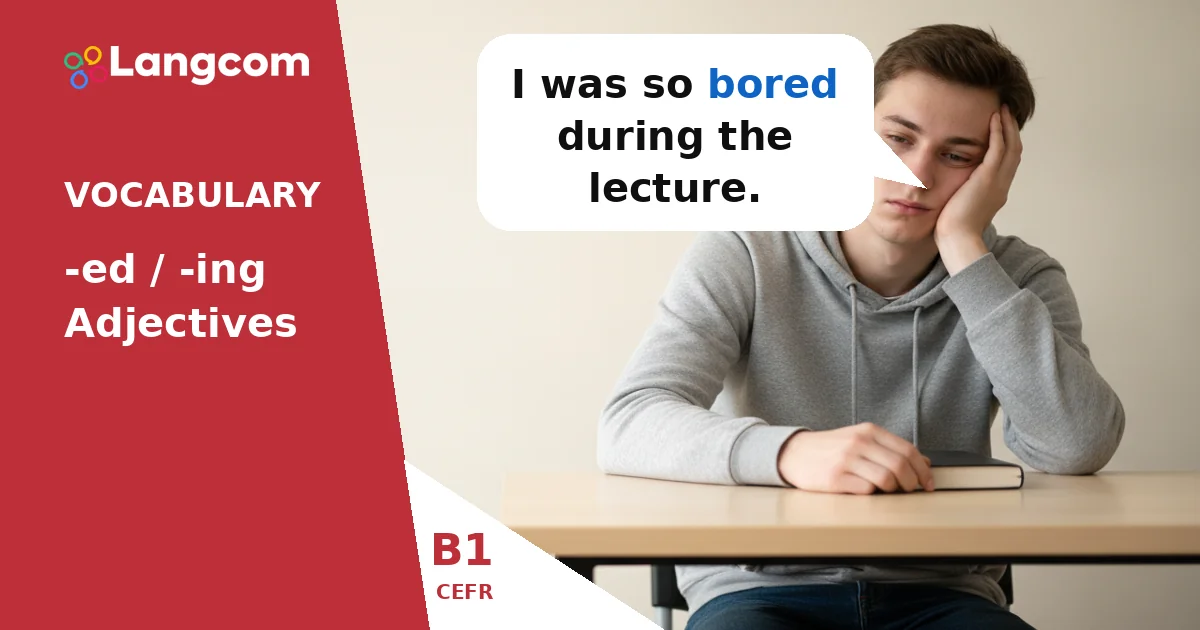
- I was so bored during the lecture.
- The lecture was incredibly boring.
- Are you interested in learning new languages?
- Learning new languages is very interesting.
- She felt embarrassed when she fell.
- Falling in public can be an embarrassing experience.
- We were all very excited about the trip.
- The trip to the mountains was exciting.
التدريب
هل أنت مستعد للحصول على شهادتك؟
يُعد برنامج Langcom الطلاب لامتحانات كامبريدج وIELTS وTOEFL وDELE وSIELE وMichigan.
ابدأ مع Langcomالأخطاء الشائعة لدى المتحدثين باللغة الإسبانية
A very common mistake for Spanish speakers is to confuse these adjectives. In Spanish, you might use a similar structure for both, but English is different.
خطأ: I am boring.
This means "I cause others to feel bored." You are not interesting. This is probably not what you want to say!
الصحيح: I am bored.
This means "I feel bored." You are experiencing the feeling of boredom.
Remember: If you feel it, use -ed. If it causes the feeling, use -ing.
الأسئلة الشائعة
What is the main difference between -ed and -ing adjectives?
-ed adjectives describe how someone *feels* (e.g., I am tired). -ing adjectives describe the *thing or situation that causes the feeling* (e.g., The work is tiring).
Can -ing adjectives describe people?
نعم،, -ing adjectives can describe people, but only if that person *causes* a feeling in others. For example, He is an annoying person means he causes others to feel annoyed.
Are these adjectives only for emotions?
They are primarily used for emotions or states of mind. The -ed form describes the experience of that emotion, and the -ing form describes what evokes it.
How are -ed and -ing adjectives tested in the B1 Preliminary exam?
In the B1 Preliminary (PET) exam, you might find these adjectives in the Word Formation task (Part 3 of Reading and Writing). You may need to change a verb into the correct -ed أو -ing adjective to complete a sentence, showing you understand the difference in meaning.


0 تعليق