

Why is Body Parts Vocabulary Important?
Knowing the names of body parts helps you talk about many things. You can describe how you feel or what someone looks like.
This vocabulary is useful in real-life situations. Imagine you are at the doctor or buying clothes. You need these words!
✍️ لست متأكدًا من مستواك؟
خُذ اختبار تحديد المستوى المجاني الخاص بنا واحصل على تعليقات مخصصة من ممتحنين معتمدين من كامبريدج.
قم بإجراء اختبار تحديد المستوى المجانيWhat are the Main Body Parts in English?
Let's learn some common words for different parts of your body.
- The Head and Face: These parts are at the top of your body.
- head: The top part of your body. I wear a hat on my head.
- hair: The soft threads on your head. She has long, brown hair.
- eye: You use your eyes to see. He has blue eyes.
- nose: You use your nose to smell. My nose is cold.
- mouth: You use your mouth to eat and speak. Please close your mouth when you chew.
- ear: You use your ears to hear. My ears are cold.
- tooth (الجمع: teeth): You use your teeth to chew food. Brush your teeth every morning.
- The Upper Body: These parts are from your neck to your waist.
- neck: Connects your head to your body. My neck hurts from looking down.
- arm: You have two arms. You use them to carry things. He has strong arms.
- hand: At the end of your arm. You use your hands to hold things. Wash your hands before eating.
- finger: You have five fingers على كل منها hand. She wears a ring on her finger.
- back: The rear part of your body, from your neck to your waist. My back is tired.
- stomach: The part of your body where food goes. I have a full stomach after dinner.
- The Lower Body: These parts are below your waist.
- leg: You have two legs. You use them to walk and run. He broke his leg playing football.
- foot (الجمع: feet): At the end of your leg. You use your feet to stand and walk. My feet are cold.
- toe: You have five toes على كل منها foot. She painted her toenails.
How to Use Body Parts in Sentences?
You can use body parts to describe people, talk about actions, or discuss health.
- وصف الأشخاص: She has long hair. He has big hands.
- Talking about actions: I clap my hands. We walk with our feet.
- Discussing health: My stomach hurts. He has a pain in his back.
| جزء من الجسم | What it does / Example Use |
|---|---|
| Head | You think with your head. My head is big. |
| Eye | You see with your eyes. She has green eyes. |
| Nose | You smell with your nose. My nose is running. |
| Mouth | You eat and speak with your mouth. Open your mouth. |
| Ear | You hear with your ears. Listen with your ears. |
| Arm | You carry things with your arms. He has strong arms. |
| Hand | You hold things with your hands. Shake my hand. |
| Finger | You point with your fingers. She has long fingers. |
| Back | The rear part of your body. My back hurts. |
| Stomach | Food goes into your stomach. I have a full stomach. |
| Leg | You walk and run with your legs. My legs are tired. |
| Foot | You stand on your feet. My feet are cold. |
أمثلة
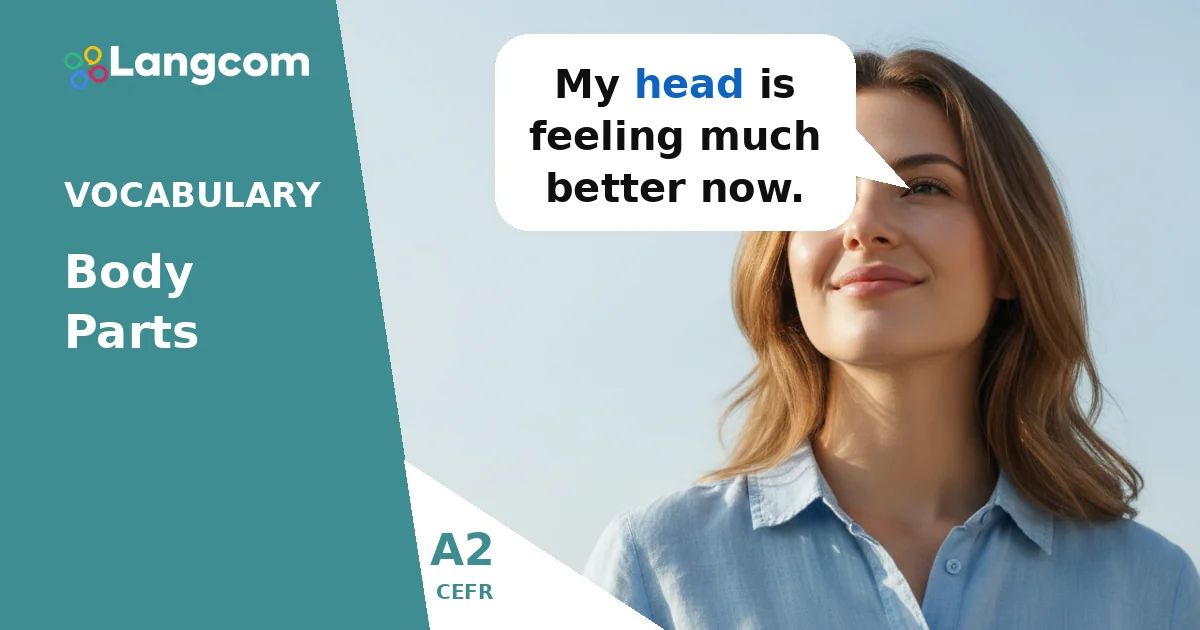
- My head is feeling much better now.
- She can touch her nose with her finger.
- He uses his mouth to sing loudly.
- The baby has small hands and feet.
- I need to stretch my back after sitting for a long time.
- My legs are tired from running.
- Please open your eyes and look at me.
- She wears a scarf around her neck in winter.
التدريب
هل أنت مستعد للحصول على شهادتك؟
يُعد برنامج Langcom الطلاب لامتحانات كامبريدج وIELTS وTOEFL وDELE وSIELE وMichigan.
ابدأ مع Langcomالأخطاء الشائعة لدى المتحدثين باللغة الإسبانية
Common Mistakes with Body Parts
يرتكب المتحدثون باللغة الإسبانية أحيانًا الأخطاء التالية:
- Using 'the' instead of 'my/his/her': In Spanish, you often say 'la mano' (the hand). In English, for your own body parts, you must use a possessive adjective like my, his, her.
- خطأ: I hurt the arm.
- الصحيح: I hurt my arm.
- Singular and Plural Forms: Some body parts have irregular plural forms. Remember foot يصبح feet, ، و tooth يصبح teeth.
- خطأ: My two foot are cold.
- الصحيح: My two feet are cold.
الأسئلة الشائعة
ما هي أجزاء الجسم الأكثر أهمية التي يجب تعلمها أولاً؟
For A2 level, focus on the most common parts: head, face, eye, nose, mouth, arm, hand, finger, leg, ، و foot. These are used very often.
How can I practice body parts vocabulary?
You can practice by describing people in pictures, playing 'Simon Says' (e.g., Simon says touch your nose!), or talking about your daily routine. Try to use the words in full sentences.
Are body parts tested in the A2 Key (KET) exam?
Yes, body parts vocabulary can appear in the A2 Key exam. You might need to describe people in pictures, talk about health problems (e.g., My stomach hurts), or answer questions about daily activities that involve body parts. This vocabulary is essential for the Speaking and Writing parts.
Do all body parts have regular plural forms?
No, most body parts add '-s' for plural (e.g., arms, hands, legs). However, some have irregular plurals like foot (plural feet) و tooth (plural teeth). It's important to learn these irregular forms.



0 تعليق