
When do we use the Present Simple Affirmative?
We use the Present Simple Affirmative to talk about things that are true all the time or happen regularly.
- Daily routines and habits: Things you do every day or often. I get up at seven o’clock.
- Facts and general truths: Things that are always true. The sun rises in the east.
- Schedules and timetables: Fixed events. The train leaves at 9 AM.
🎓 تعلم اللغة الإنجليزية باستخدام الطريقة المختلطة
مجموعات صغيرة · مدرس ذكاء اصطناعي متاح على مدار الساعة · التحضير لامتحانات كامبريدج
خطط من $39 $79 في الشهر
How do we form the Present Simple Affirmative?
The form of the verb changes for He, She, و It.
- بالنسبة لـ I, You, We, They, we use the base form of the verb. I watch TV.
- بالنسبة لـ He, She, It, we add -s أو -es to the base form of the verb. She watches TV.
Here are some rules for adding -s أو -es:
- Most verbs: Add -s. work → works, eat → eats
- Verbs ending in -s, -ss, -sh, -ch, -x, -o: Add -es. watch → watches, go → goes
- Verbs ending in a consonant + -y: Change -y to -ies. study → studies (but play → plays because it’s a vowel + -y)
Special verb: ‘have’
الفعل have is special in the Present Simple Affirmative.
- بالنسبة لـ I, You, We, They, ، نستخدم have. I have breakfast.
- بالنسبة لـ He, She, It, ، نستخدم has. He has breakfast.
We often use have to talk about meals, like have breakfast, have lunch, ، أو have dinner. You can also use eat for meals, but have is very common.
| الموضوع | Verb: <span data-no-translation>WORK</span> | Verb: <span data-no-translation>WATCH</span> | Verb: <span data-no-translation>STUDY</span> | Verb: <span data-no-translation>HAVE</span> |
|---|---|---|---|---|
| I | work | watch | study | have |
| You | work | watch | study | have |
| He | works | watches | studies | has |
| She | works | watches | studies | has |
| It | works | watches | studies | has |
| We | work | watch | study | have |
| They | work | watch | study | have |
أمثلة
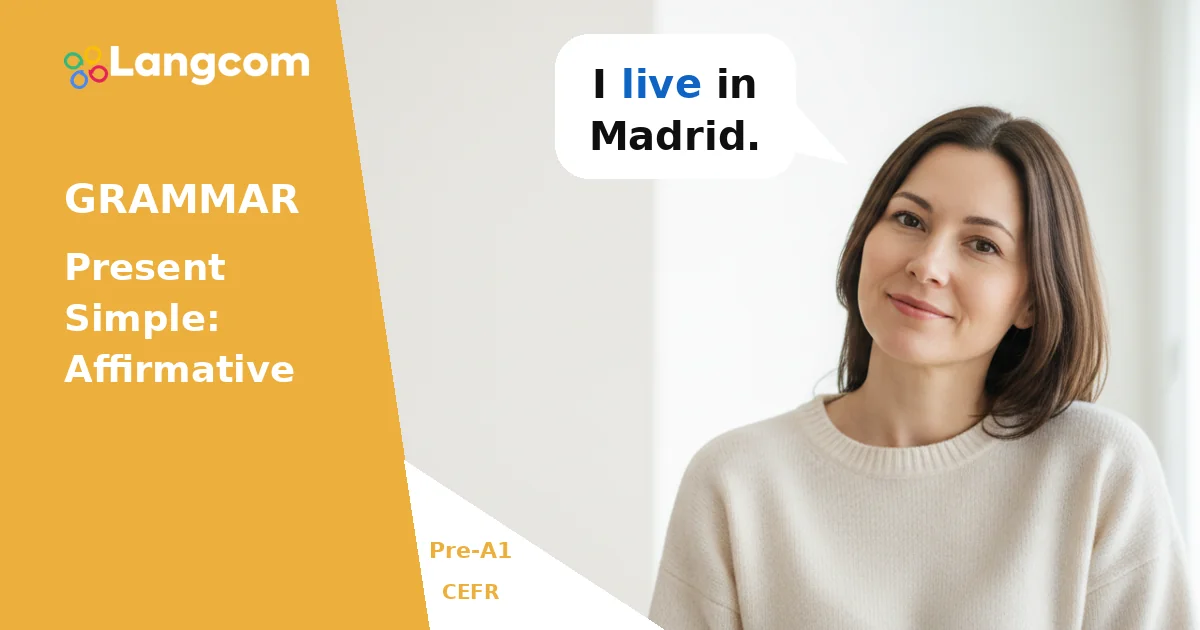
- I live in Madrid.
- You study English at Langcom.
- He works in an office.
- She watches TV every evening.
- It rains a lot in winter.
- We get up early on weekdays.
- They have two children.
التدريب
💬 هل تحتاج إلى إرشادات مخصصة؟
بصفتنا مركزًا معتمدًا للتحضير لاختبارات كامبريدج، يمكننا توجيهك نحو الدورة والشهادة المناسبتين لك. تحدث مع مستشارينا اليوم.
دردش مع مستشار على واتسابالأخطاء الشائعة لدى المتحدثين باللغة الإسبانية
Forgetting the -s for He/She/It
A common mistake for Spanish speakers is to forget to add -s أو -es to the verb when the subject is He, She, أو It. In Spanish, verb endings change for all subjects, but in English, the change is mostly for the third person singular.
- خطأ: She live in London.
- الصحيح: She lives in London.
- خطأ: He watch TV.
- الصحيح: He watches TV.
Using ‘have’ instead of ‘has’ for He/She/It
Remember that have changes to has for He, She, و It.
- خطأ: He have breakfast at 8 AM.
- الصحيح: He has breakfast at 8 AM.
الأسئلة الشائعة
What is the main use of the Present Simple Affirmative?
The main use is to talk about daily routines, habits, and facts that are generally true. For example, I drink water every day.
Do all verbs add -s for He/She/It?
Most verbs add -s. However, some verbs add -es (like watch → watches) or change -y to -ies (like study → studies). The verb have changes to has.
Why is the Present Simple important for Pre-A1 learners?
It is fundamental because it allows you to describe basic information about yourself, your family, and your daily life, which is essential for early communication in English. It’s a building block for more complex sentences.
Can I use ‘eat’ instead of ‘have’ for meals?
Yes, you can use eat for meals (e.g., I eat breakfast). However, have (e.g., I have breakfast) is also very common and natural in English.



0 تعليق