

What Are Prepositions of Place?
Prepositions of place tell us where something or someone is located. While they might seem simple, at, in, ، و on have specific rules and nuances that advanced learners need to master.
The choice often depends on whether you are talking about a precise point, an enclosed space, or a surface.
✍️ لست متأكدًا من مستواك؟
خُذ اختبار تحديد المستوى المجاني الخاص بنا واحصل على تعليقات مخصصة من ممتحنين معتمدين من كامبريدج.
قم بإجراء اختبار تحديد المستوى المجانيWhen Do We Use At?
نحن نستخدم at to indicate a specific point, a precise location, or a general area where an activity takes place.
- Specific points or addresses: This includes exact locations or buildings.
- Activities or events: When you are participating in or present at an event.
- Public places for their function: When you refer to the purpose of a place, not just the building itself.
- Ends of things: To describe a position at the extremity of something.
When Do We Use In?
In is used for enclosed spaces, larger geographical areas, or when something is contained within something else.
- Enclosed spaces or containers: For things that are inside boundaries.
- Large areas, countries, cities: For broad geographical locations.
- Liquids or solids: When something is immersed or mixed within a substance.
- Vehicles you sit inside: Typically for cars, but sometimes for other small vehicles.
- Books, newspapers, documents: When information is contained within these media.
- Digital/virtual spaces (less common for general internet): For specific files or documents online.
When Do We Use On?
On is used for surfaces, lines, or when something is attached to or resting upon something else.
- Surfaces: When an object is resting on top of another.
- Lines, roads, streets: For positions along a path or thoroughfare.
- Public transport (where you stand/walk): For larger vehicles like buses, trains, planes, and ships.
- Digital/media platforms: For content displayed on screens or broadcast.
- Sides: To indicate a position to the left or right.
- Floors of a building: To specify which level.
| حرف الجر | Main Use | أمثلة |
|---|---|---|
| At | Specific point, activity, or general proximity | at the station, at a party, at home, at the door |
| In | Enclosed space, container, large area, or liquid/solid | in the room, in London, in a box, in the water, in a car |
| On | Surface, line, public transport, or digital media | on the table, on the street, on a bus, on TV, on the first floor |
أمثلة
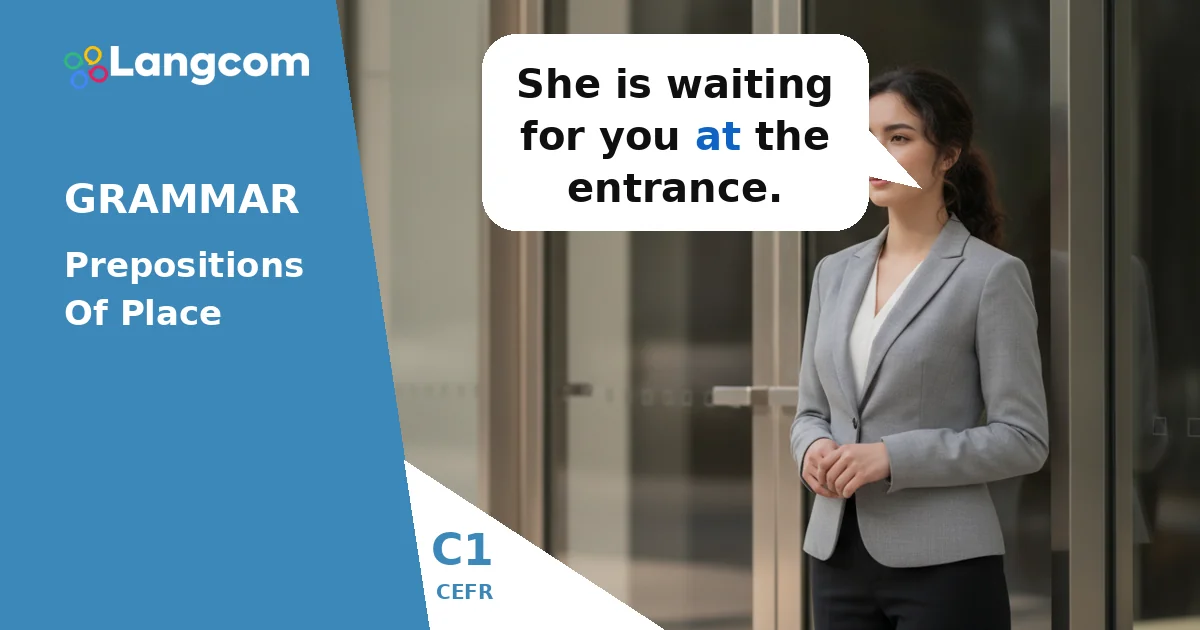
- She is waiting for you at the entrance.
- We met at a conference last year.
- The children are at school until 3 PM.
- My office is at the end of the corridor.
- The keys are in my bag.
- They live in a small village in the mountains.
- There's a mistake in the third paragraph.
- He's currently in his car, stuck in traffic.
- The book is on the shelf.
- We saw a great documentary on TV last night.
- The restaurant is on the main street.
- She prefers to travel on the train.
- The article is available on our website.
- Their apartment is on the fifth floor.
التدريب
هل أنت مستعد للحصول على شهادتك؟
يُعد برنامج Langcom الطلاب لامتحانات كامبريدج وIELTS وTOEFL وDELE وSIELE وMichigan.
ابدأ مع Langcomالأخطاء الشائعة لدى المتحدثين باللغة الإسبانية
Spanish speakers often confuse at, in, ، و on because the Spanish preposition 'en' can translate to all three. This leads to common errors:
- استخدام in the street بدلاً من on the street: In English, we typically walk on the street أو on the road. In the street might imply being *inside* the road material, which is incorrect.
- استخدام at home مقابل. in home: The correct idiomatic phrase is at home. In home is incorrect.
- مربك in the corner و at the corner: In the corner means inside a room, often tucked away. At the corner usually refers to an outside street corner or a specific point. For example, The sofa is in the corner of the living room. ولكن Meet me at the corner of Main Street and Elm Avenue.
- استخدام in the internet بدلاً من on the internet: For general online presence, on the internet أو on a website is correct.
Key Takeaways
- Use at for a specific point or activity (at the bus stop, at a party).
- Use in for enclosed spaces or large areas (in the room, in London).
- Use on for surfaces, lines, or public transport (on the table, on a bus).
- Small vehicles take in (in a car, in a taxi); larger public transport takes on.
- Spanish en covers all three - always check which specific English rule applies.
الأسئلة الشائعة
What is the main difference between at, in, and on for place?
The main difference lies in specificity and enclosure. At is for specific points or activities (at the station). In is for enclosed spaces or larger areas (in the city, in a box). On is for surfaces or lines (on the floor, on the street).
Can I say in the internet or on the internet?
For general reference to online content or presence, the correct preposition is on. على سبيل المثال،, I found this information on the internet أو The video is on YouTube. While you might occasionally hear in the internet in very specific, less common contexts, on the internet is the standard and most natural choice for C1 English.
How do these prepositions relate to the C1 Advanced (CAE) exam?
Mastering prepositions of place is crucial for the C1 Advanced (CAE) exam, particularly in the Reading and Use of English paper. You might encounter questions testing your knowledge of at, in, ، و on in tasks like Part 1 (Multiple-choice cloze) or Part 2 (Open cloze), where choosing the correct preposition is essential for grammatical accuracy and meaning.
Is there a rule for transport?
Yes, there's a general rule. We typically use in for small vehicles where you sit inside and cannot stand up, like in a car أو in a taxi. نحن نستخدم on for larger public transport where you can stand and walk around, such as on a bus, on a train, on a plane, ، أو on a ship.



0 تعليق