

What Are Idioms and Why Are They Important?
Idioms are special phrases. Their overall meaning is different from the meaning of the individual words. You cannot understand an idiom by translating each word separately.
- “It’s raining cats and dogs” does not mean animals are falling from the sky. It means “it’s raining very heavily.”
- Idioms are common in everyday conversation, literature, and media.
- They make your English sound more natural and sophisticated.
✍️ لست متأكدًا من مستواك؟
خُذ اختبار تحديد المستوى المجاني الخاص بنا واحصل على تعليقات مخصصة من ممتحنين معتمدين من كامبريدج.
قم بإجراء اختبار تحديد المستوى المجانيWhy Are Idioms Crucial for C1 Advanced English?
At the C1 level, you need to use English flexibly and effectively for social, academic, and professional purposes. Idioms are key to this.
- Fluency and Naturalness: Using idioms helps you sound less like a textbook and more like a native speaker.
- Understanding Nuance: Many idioms convey complex ideas or emotions concisely. Understanding them helps you grasp deeper meanings in conversations and texts.
- النجاح في الامتحانات: The C1 Advanced (CAE) exam often includes tasks that require understanding or using idiomatic expressions, especially in Reading & Use of English and Speaking parts.
How Can You Learn and Use Idioms Effectively?
Learning idioms takes time and practice. Focus on understanding their context and how they are used.
- Context is Key: Always learn idioms in full sentences or situations. This helps you understand their meaning and appropriate usage.
- Categorize Them: Group idioms by topic (e.g., body parts, colors, animals) or by their function (e.g., expressing happiness, disagreement).
- Active Listening and Reading: Pay attention to idioms in movies, podcasts, books, and articles. Note them down and try to guess their meaning from context.
- Practice Regularly: Try to incorporate new idioms into your speaking and writing. Start with a few and gradually expand your vocabulary.
| Idiom | المعنى |
|---|---|
| Lend an ear | To listen carefully and sympathetically to someone. |
| Keep an eye on | To watch something or someone carefully. |
| Get something off your chest | To talk about something that has been worrying you for a long time. |
| Have a chip on your shoulder | To hold a grudge or be easily offended. |
| Pull someone's leg | To play a joke on someone, usually by telling them something untrue. |
| See eye to eye | To agree with someone. |
| Twist someone's arm | To persuade someone to do something they do not want to do. |
أمثلة
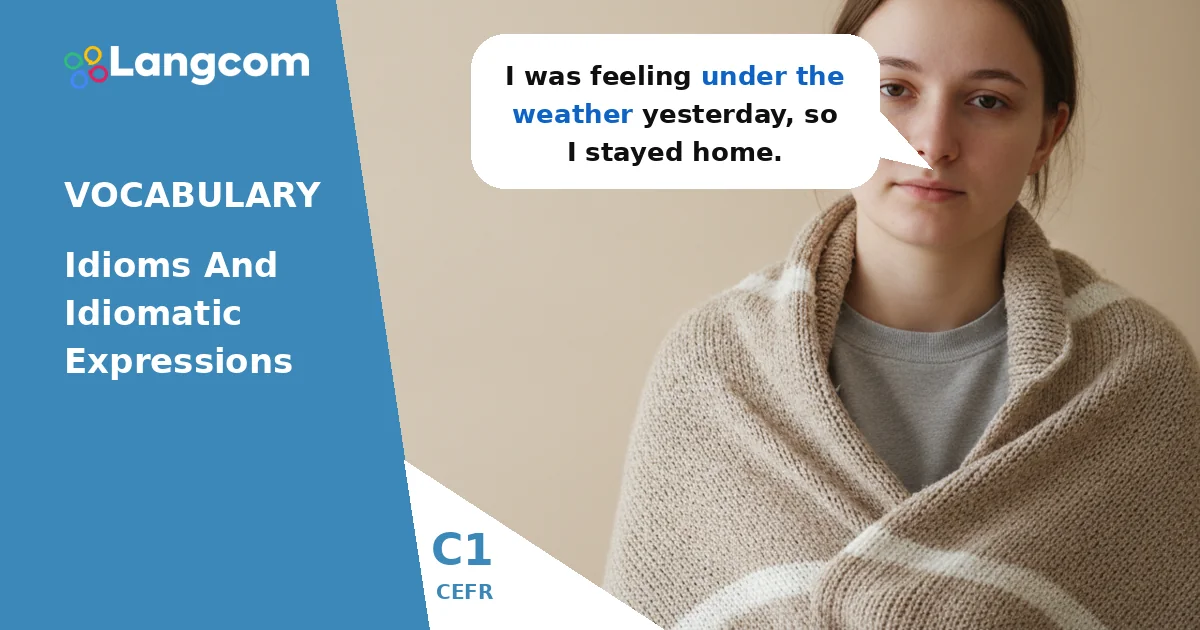
- I was feeling under the weather yesterday, so I stayed home.
- He finally bit the bullet and told his boss he was leaving.
- Don't worry about the presentation, just break a leg!
- After a long discussion, we finally saw eye to eye on the project.
- She twisted my arm, and I agreed to go to the party.
التدريب
هل أنت مستعد للحصول على شهادتك؟
يُعد برنامج Langcom الطلاب لامتحانات كامبريدج وIELTS وTOEFL وDELE وSIELE وMichigan.
ابدأ مع Langcomالأخطاء الشائعة لدى المتحدثين باللغة الإسبانية
Spanish speakers often make mistakes with idioms by translating literally from Spanish or by choosing an idiom that sounds similar but has a different meaning.
- Literal Translation: Do not translate Spanish idioms directly into English. For example, "estar hasta las narices" (to be up to the noses) means "to be fed up" أو "to be sick and tired of something," not literally "to be up to the noses."
- Incorrect Usage: Using an idiom in the wrong context or with incorrect grammar. For instance, saying "I have a cold foot" بدلاً من "I have cold feet" (meaning to be nervous about something).
- Overuse: While idioms are good, using too many in one conversation can sound unnatural. Use them thoughtfully.
الأسئلة الشائعة
What is an idiom in simple terms?
An idiom is a phrase where the meaning is not obvious from the individual words. For example, "to spill the beans" means "to reveal a secret," not literally to spill beans.
How do idioms help with C1 Advanced (CAE) exam preparation?
Idioms are vital for the C1 Advanced (CAE) exam, especially in the Use of English paper, where you might need to complete sentences with idiomatic expressions or identify their meaning. They also help you achieve higher marks in the Speaking and Writing papers by demonstrating a wider range of vocabulary and natural language use, which is a key assessment criterion.
Are idioms always informal?
No, not all idioms are informal. Some are quite formal and can be used in professional or academic settings. However, many common idioms are informal and best suited for casual conversation. Always consider the context and audience.
Can I create my own idioms?
No, idioms are fixed expressions that are part of a language's culture and history. You cannot create new ones and expect others to understand them. You must learn and use existing idioms correctly.




0 تعليق