
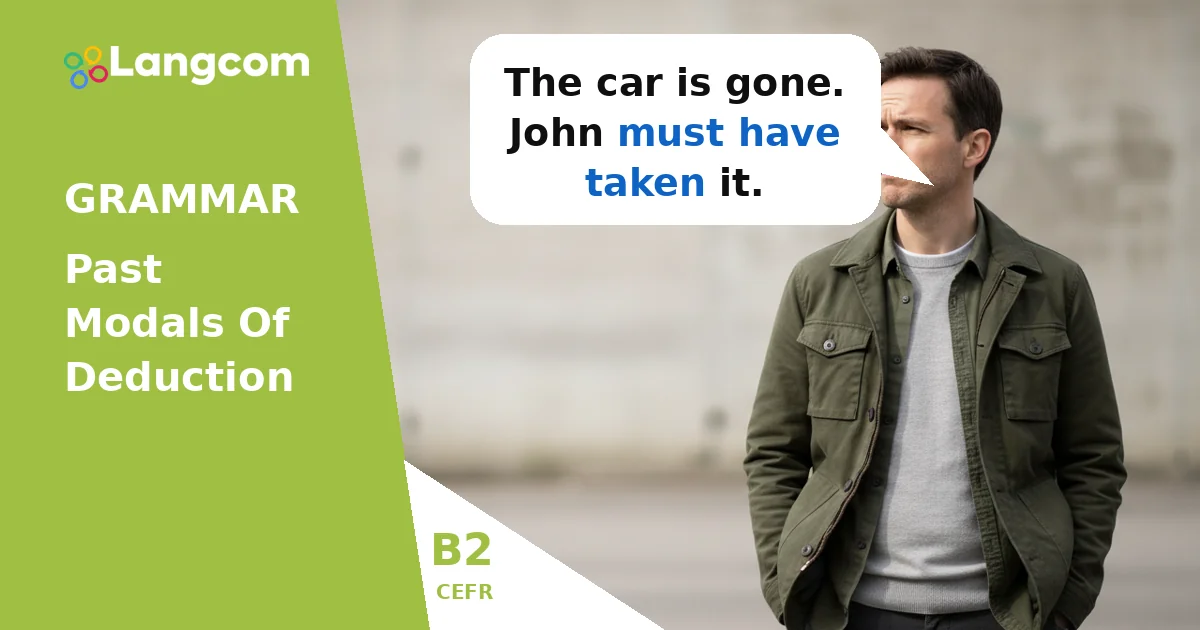

什么是过去推论情态动词?
过去推断情态动词是特殊动词形式,用于描述过去某件事发生的可能性。我们用它们来表达对过去事件的确定性或不确定性。.
当你无法确切知道发生了什么,但可以根据目前掌握的信息做出合乎逻辑的推测时,就可以使用这些句式。.
我们如何构成推论的过去时态情态动词?
所有过去推导模态的基本结构都很简单:
- Modal Verb + have + Past Participle (V3)
情态动词会根据你有多确定而有所变化。该 have 以及 past participle 永远保持不变。.
何时使用 Must Have + 过去分词
我们使用 must have + past participle 当我们几乎100%确信过去发生过某件事时,我们拥有支持这一结论的有力证据。.
- 例如 “The lights are off and the door is locked. They must have left.” (你非常确定他们已经离开了。)
- 例如 “She looks exhausted. She must have worked all night.” (你非常确定她通宵工作了。)
何时使用 May Have, Might Have, Could Have + 过去分词
我们使用 may have + past participle, might have + past participle, 或 could have + past participle 当我们认为某件事在过去是有可能发生的,但并不十分确定时(确定程度约为50%)。.
- 这三个情态动词通常可以互换使用,也就是说,你可以用其中任何一个来表达可能性。.
- 例如 “I can’t find my phone. I may have left it at home.” (It's possible you left it at home.)
- 例如 “He didn’t answer his phone. He might have been sleeping.” (It's possible he was sleeping.)
- 例如 “They didn’t come to the party. They could have forgotten about it.” (It's possible they forgot.)
何时使用 Can't Have + 过去分词
我们使用 can't have + past participle 当我们几乎可以100%地确定某件事在过去并没有发生时。我们掌握着确凿的证据,证明此事绝无可能发生。.
- 例如 “She was with me all day. She can't have stolen your wallet.” (It's impossible she stole it.)
- 例如 “He knows the way perfectly. He can't have gotten lost.” (It's impossible he got lost.)
表示可能性的否定形式: May Not Have 和 Might Not Have
要表达过去可能发生的不利事件,我们使用 may not have + past participle 或 might not have + past participle.
- 这与……不同 can't have, ,该表达方式强烈肯定某事并未发生。.
- 例如 “She didn't reply to my email. She may not have seen it.” (It's possible she didn't see it.)
- 例如 “They aren't here yet. They might not have received the invitation.” (It's possible they didn't receive it.)
| 模态表单 | 确定性程度 | 示例 |
|---|---|---|
| must have + V3 | Almost 100% sure (positive) | She must have forgotten. |
| may have + V3 | Possible (around 50% sure) | He may have gone home. |
| might have + V3 | Possible (around 50% sure) | They might have missed the bus. |
| could have + V3 | Possible (around 50% sure) | I could have left it there. |
| can't have + V3 | Almost 100% sure (negative) | You can't have seen him. |
| may not have + V3 | Possible (negative) | She may not have understood. |
| might not have + V3 | Possible (negative) | They might not have known. |
示例
- The car is gone. John must have taken it.
- I saw her leave an hour ago. She can't have finished her work already.
- He looks upset. He might have heard the bad news.
- They could have missed their train, that's why they're late.
- She didn't answer her phone. She may not have heard it ring.
- The window is broken. Someone must have thrown a rock.
- It was a secret. He couldn't have known about it.
练习
西班牙语母语者常犯的错误
西班牙语使用者在使用过去时推断情态动词时,常会犯以下几个常见错误:
- 使用错误的动词形式: 一个常见的错误是在情态动词后使用一般过去时,例如 “He must have went” 而不是 “He must have gone.” Remember, it's always modal + have + past participle.
- 令人困惑 can't have 与 couldn't have 用于强推理: 虽然 couldn't have 有时可以表示不可能,, can't have 在表达“某事并未发生”这一坚定结论时,这种表达方式更为强烈且更常见。例如,, “She can't have been at the party; I saw her at home.” 比……更强 “She couldn't have been at the party.”
- 直接从西班牙语翻译而来: 有时,学习者会直接从西班牙语的句式进行翻译,例如 “deber de haber” (必须有),但可能会将其与 “tener que haber” (必须有),这表示的是义务,而非推论。使用英语时,务必关注确定性的程度。.
常见问题
两者之间的主要区别是什么? must have 和 may have?
主要区别在于确定性的程度。我们使用 must have 当我们根据确凿证据,对某件过去的事情几乎100%确信无疑时,我们会使用 may have (或 might have, could have) 当我们仅能确定50%时,这只是表达一种可能性。.
我可以使用 couldn't have 而不是 can't have?
是的,你可以使用 couldn't have 用于表达过去时态中的不可能,类似于 can't have. 然而,, can't have 通常表达一种更强烈、更明确的结论,即某事并未发生。例如,, “He can't have seen me” 这是一个非常确凿的推论,而 “He couldn't have seen me” 这或许暗示由于种种情况,此事是不可能的,但也许并不那么绝对。.
是 may have 和 might have 总是可以互换的吗?
在表达过去时态的可能性时,, may have 和 might have 在很大程度上可以互换。但存在一个非常细微的区别,即 might have 有时可能暗示其概率略低于 may have, ,但在大多数日常对话中,这两种说法都可以用。.
过去推断情态动词与B2级英语考试有何关联?
过去时态的推断助动词在B2级考试中非常重要,特别是在需要表达观点、进行推断或对过去事件进行推测的题型中。例如,在写作任务或口语环节中,你可能需要分析一种情况,并就……做出合乎逻辑的推断。 must have happened 或 could have happened.




0 条评论