
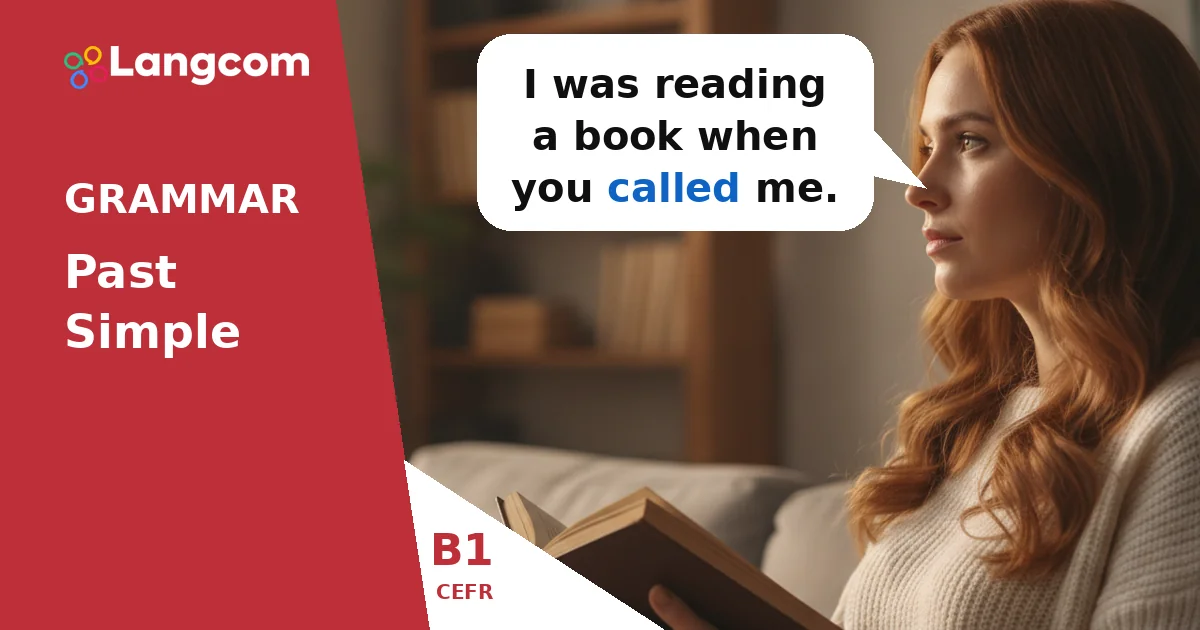

What is the Past Continuous?
The Past Continuous tense helps us talk about actions that were in progress at a specific moment in the past. Think of it as a “snapshot” of an ongoing action.
It describes something that started before a certain time in the past and continued after it. It focuses on the duration or the unfinished nature of the action at that point.
How do we form the Past Continuous?
To create the Past Continuous, we use the past form of the verb to be (was 或 were) followed by the main verb with an -ing ending.
The choice between was 和 were depends on the subject of the sentence. You can see the full forms in the table below.
When do we use the Past Continuous?
We use the Past Continuous in several situations to describe past events:
- For an action happening at a specific time in the past: This emphasizes that the action was ongoing at that exact moment.
- Emily was walking the dog at 5 PM. (At 5 PM, she was in the middle of walking.)
- For temporary actions that give extra information: These actions provide background details that are less important than the main event.
- It was raining, so I decided not to go out. (The rain was happening, influencing the decision.)
- For two or more actions happening at the same time in the past: This shows parallel activities.
- While I was doing my homework, he was playing the guitar. (Both actions happened simultaneously.)
- For an action that was in progress when another shorter action happened: The Past Continuous describes the longer, ongoing action, and the Past Simple describes the shorter, interrupting action.
- He was cleaning his bike when he hurt his hand. (Cleaning was ongoing; hurting was a sudden interruption.)
What words do we use with the Past Continuous?
We often use specific words to connect Past Continuous actions, especially when one action interrupts another or when two actions happen simultaneously:
- When: Often used to introduce the shorter, interrupting action (Past Simple) or sometimes the longer action.
- When Joe was walking home, it started to rain.
- While: Typically introduces the longer, ongoing action (Past Continuous).
- The phone rang while I was having breakfast.
- As: 类似于 while, it introduces an action happening at the same time.
- They arrived as we were leaving.
| Positive | 否 | Question | |
|---|---|---|---|
| I / He / She / It | was studying | wasn't studying | Was I studying? |
| You / We / They | were studying | weren't studying | Were you studying? |
示例
- I was reading a book when you called me.
- They were watching TV all evening.
- What were you doing at 8 AM yesterday?
- She wasn't listening to the teacher.
- While we were having dinner, the lights went out.
- The sun was shining, and the birds were singing.
练习
西班牙语母语者常犯的错误
Spanish speakers sometimes make specific mistakes with the Past Continuous due to differences in grammar structures:
- Confusing Past Simple and Past Continuous: In Spanish, "estaba haciendo" (Past Continuous) and "hice" (Past Simple) are distinct. English learners sometimes use the Past Simple for actions that were ongoing.
- 错误: I watched TV when she arrived. (Implies you finished watching, then she arrived.)
- 正确: I was watching TV when she arrived. (Implies watching was in progress.)
- Forgetting the auxiliary verb was/were: 动词 to be 是必不可少的。.
- 错误: She studying all morning.
- 正确: She was studying all morning.
- Incorrectly using was/were: Remember to match the auxiliary verb to the subject.
- 错误: They was playing football.
- 正确: They were playing football.
- Not using the -ing form: The main verb must end in -ing.
- 错误: We were eat dinner.
- 正确: We were eating dinner.
常见问题
What is the main difference between Past Simple and Past Continuous?
"(《世界人权宣言》) Past Simple describes completed actions in the past, like I ate dinner. "(《世界人权宣言》) Past Continuous describes actions that were in progress at a specific time in the past, like I was eating dinner when the phone rang.
Can I use when and while interchangeably?
Not always. While usually introduces the longer, ongoing action (Past Continuous), as in While I was sleeping, the storm started. When can introduce either the longer action or the shorter, interrupting action, as in When I was sleeping, the storm started 或 I was sleeping when the storm started.
Is the Past Continuous used in the B1 Preliminary exam?
Yes, the Past Continuous is an important tense for the B1 Preliminary exam. You might need to use it in writing tasks, such as telling a story, or in speaking tasks to describe past events.
What is the form of the Past Continuous?
The form is was/were + verb + -ing. 例如,, I was working, You were playing, She was reading.


0 条评论