

What is Money? (And Its Forms)
Money is what people use to buy things like food, clothes, or toys. It comes in different forms.
-
Cash: This is physical money. It means coins 和 bank notes 一起。.
-
Coins: These are small, round pieces of metal money. For example, 1 euro or 50 cents.
-
Bank notes: These are pieces of paper money. For example, a 10 euro note or a 20 dollar note.
Where Do We Keep Our Money?
We need special items to carry or keep our money safe.
-
Purse: This is a small bag, usually for women, to carry coins 和 bank notes.
-
Wallet: This is a small, flat case, usually for men, to carry bank notes and cards.
-
Money box: This is a container, often shaped like a pig, where you can save money, especially coins.
What Can We Do With Money?
There are many actions we can do with money in our daily lives.
-
Get pocket money: This means children receive a small amount of money regularly from their parents, often for doing chores.
-
Save money: This means keeping money for later, not spending it now. You put it aside for a future goal.
-
Spend money: This means using money to buy things. For example, you spend money on food.
-
Give away money: This means giving money to another person or an organization, often as a gift or to help them.
How Do We Know the Cost?
When you go shopping, you need to know how much something costs.
-
Price tag: This is a small piece of paper or plastic on an item in a shop. It shows how much the item costs.
| Word/Phrase | 含义 |
|---|---|
| Cash | Physical money: coins 和 bank notes |
| Coins | Small, round metal money |
| Bank notes | Paper money |
| Purse | Small bag for women to carry money |
| Wallet | Flat case for men to carry money and cards |
| Money box | Container to save money (often coins) |
| Get pocket money | Children receive money from parents |
| Save money | Keep money for later use |
| Spend money | Use money to buy things |
| Give away money | Give money to someone else or charity |
| Price tag | Label showing an item's cost |
示例
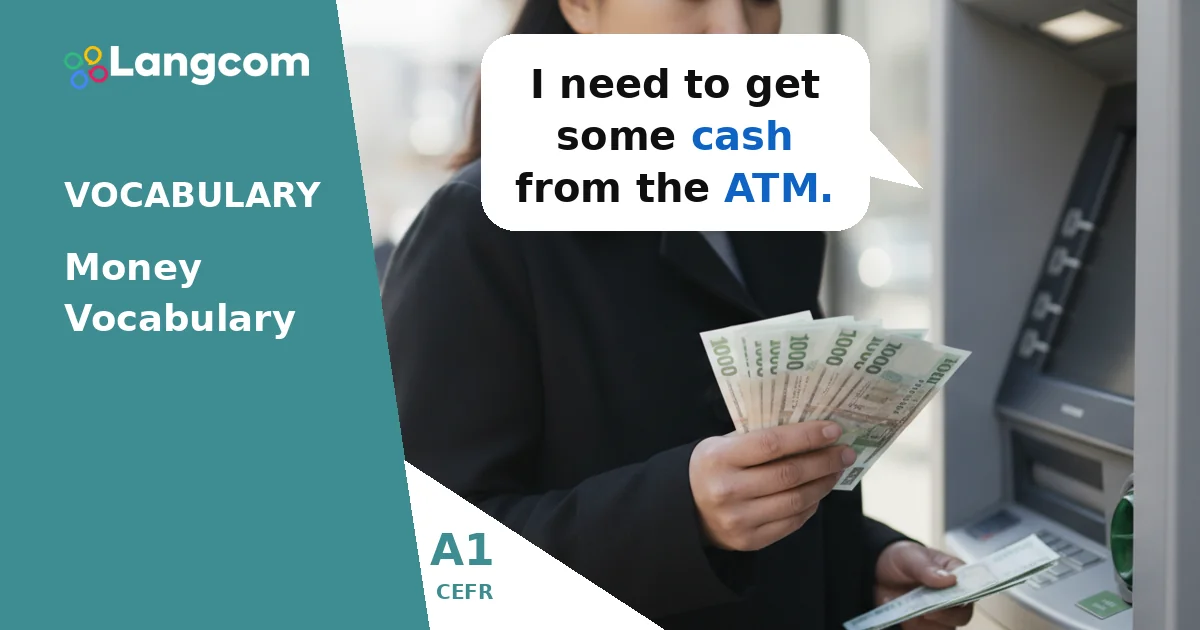
- I need to get some cash from the ATM.
- I have five coins in my hand.
- She has a 20-euro bank note.
- My mother keeps her money in her purse.
- My father always carries his wallet.
- I put my coins in my money box every day.
- Children often get pocket money on Saturdays.
- I want to save money for a new bicycle.
- He likes to spend money on books.
- They decided to give away money to charity.
- The price tag says this shirt costs 15 dollars.
练习
西班牙语母语者常犯的错误
Spanish speakers sometimes make small mistakes with money vocabulary. Here are some common ones:
-
Cash vs. Money: Money is a general word for currency. Cash is specific: it means physical coins 和 bank notes. 你可以这么说 I have money in the bank (not I have cash in the bank). But you can say I pay with cash.
-
Purse vs. Wallet: In English, a purse is typically for women and often holds coins 和 bank notes. A wallet is typically for men and holds bank notes and cards. In Spanish, 'bolso' or 'cartera' can be more general, so remember the gender difference in English.
-
Bank notes vs. Bills: In British English, we say bank notes. In American English, people often say bills. 这两种说法都正确,但 bank notes is the word we are focusing on here.
常见问题
What is 'pocket money'?
Pocket money is a small amount of money that parents regularly give to their children, often for small expenses or as a reward for chores.
What is the difference between a 'purse' and a 'wallet'?
A purse is generally a small bag for women to carry money and other small items. A wallet is usually a flat case for men to carry bank notes and cards.
What does 'cash' mean?
Cash refers to physical money, specifically coins 和 bank notes, as opposed to money in a bank account or digital payments.
Can I say 'bills' instead of 'bank notes'?
Yes, you can. Bills is the common term for paper money in American English, while bank notes is more common in British English. Both are understood.




0 条评论