
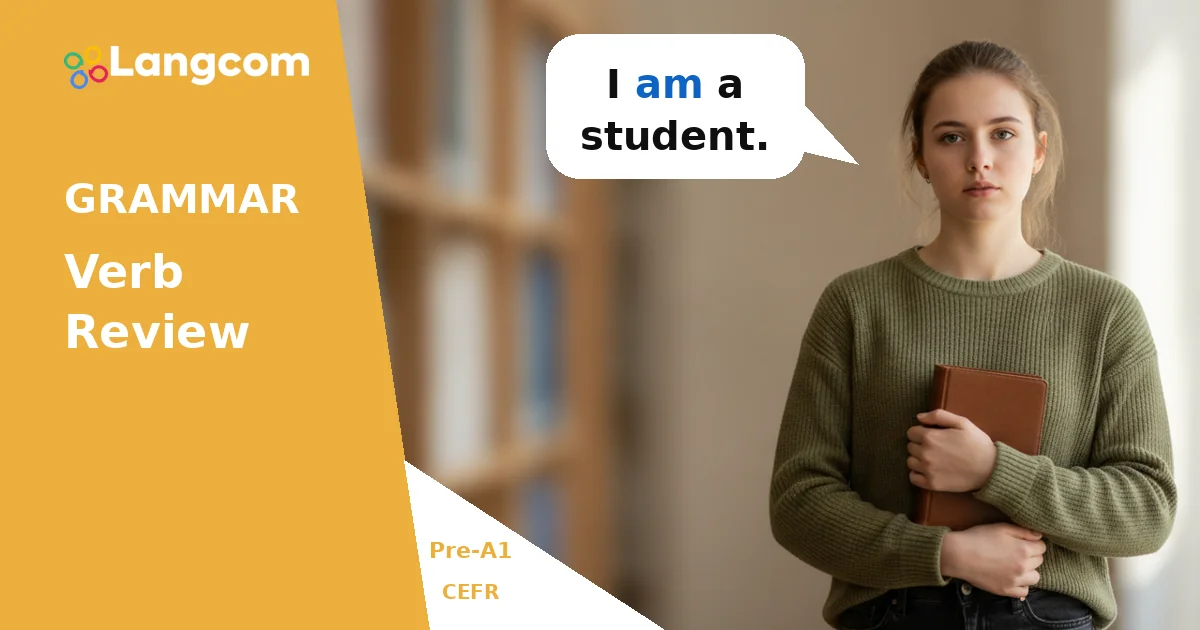

例如,你使用 be 用于描述自己或他人,例如 I am happy. Have got 表示所有格,例如 She has got a book. Can 表示能力,例如 He can swim. 要谈论真实存在的事物,你需要使用 there is 或 there are, ,就像……一样 There is a park. 最后,一般现在时有助于你谈论习惯和喜好,例如 I like coffee. 掌握这些基本动词,将有助于你用英语清晰、自信地进行交流。.
对初学者来说,哪些动词最重要?
在Pre-A1级别,有些动词非常重要。它们能帮助你构建基础句型,并谈论许多话题。这些动词就像英语的基础一样。.
我们将探讨五种关键的动词类型:
- 动词 to be (am, is, are)
- 动词 have got (have got, has got)
- 情态动词 can
- 这些表达式 there is 和 there are
- "(《世界人权宣言》) simple present 对于其他动词
如何使用系动词“to be”?
我们使用动词 to be 要讨论的是:
- 身份: I am a student.
- 描述: She is happy.
- 地点: They are at home.
的形式 to be 根据主题调整:
- I am
- You are
- He/She/It is
- We are
- They are
对于否定句,我们需要添加 not. 我们经常使用缩写形式:
- I am not
- You aren't (或 You are not)
- He/She/It isn't (或 He/She/It is not)
- We aren't (或 We are not)
- They aren't (或 They are not)
什么时候用“have got”?
我们使用 have got 用来表示所有权。这意味着某物属于某人。在英语口语中非常常见。.
的形式 have got 根据主题调整:
- I have got
- You have got
- He/She/It has got
- We have got
- They have got
对于否定句,我们需要添加 not 在……之间 have/has 和 got. 我们经常使用缩写形式:
- I haven't got (或 I have not got)
- You haven't got (或 You have not got)
- He/She/It hasn't got (或 He/She/It has not got)
- We haven't got (或 We have not got)
- They haven't got (或 They have not got)
如何用“can”来谈论能力?
我们使用 can 谈谈能力。这指的是一个人能够做什么。在 can, 我们总是使用另一个动词的原形。.
Can 它的特别之处在于,它不会因学科的不同而改变:
- I can swim.
- You can speak English.
- He/She/It can fly.
- We can play football.
- They can sing.
对于否定句,我们需要添加 not 之后 can. 该缩写是 can't:
- I can't swim. (或 I cannot swim.)
- You can't speak French.
- He/She/It can't fly.
如何用“there is”或“there are”来表示某物存在?
我们使用 there is 和 there are 表示某物位于某处。我们使用 there is 首先(单数)和 there are 用于许多事情(复数)。.
- 单数: There is a book on the table.
- 复数: There are two chairs in the room.
对于否定句,我们需要添加 not 之后 is 或 are. 我们经常使用缩写形式:
- 单数否定形式: There isn't a pen here. (或 There is not a pen here.)
- 复数否定形式: There aren't any students in the class. (或 There are not any students in the class.)
其他动词的简单现在时是什么?
我们使用 simple present 用于描述习惯、日常作息以及普遍适用的情况。它还用来表达喜好和厌恶。.
对于大多数学科(I, You, We, They),动词形式为原形:
- I like pizza.
- You play tennis.
- We live in Madrid.
对于 He, She, It, we add -s 或 -es to the verb:
- He likes coffee.
- She plays football.
- It rains a lot in winter.
For negative sentences, we use don't (for I, You, We, They) or doesn't (for He, She, It) before the base form of the verb:
- I don't like tea.
- She doesn't work on Sundays.
| Verb Type | Affirmative Example | Negative Example |
|---|---|---|
| To Be | I am happy. | I am not happy. |
| She is a student. | She isn't a student. | |
| They are friends. | They aren't friends. | |
| Have Got | I have got a book. | I haven't got a book. |
| He has got a car. | He hasn't got a car. | |
| Can | I can swim. | I can't swim. |
| She can sing. | She can't sing. | |
| There Is / There Are | There is a park. | There isn't a park. |
| There are trees. | There aren't trees. | |
| Simple Present | I like coffee. | I don't like coffee. |
| He works here. | He doesn't work here. |
示例
- I am a student.
- She is happy.
- They are at home.
- It isn't cold today.
- I have got a new book.
- He has got a blue car.
- We haven't got much time.
- I can speak a little English.
- Birds can fly.
- You can't park here.
- There is a cat on the chair.
- There are two apples in the basket.
- There isn't a supermarket near here.
- I like pizza.
- She likes coffee.
- We don't watch TV often.
- He doesn't play football.
练习
西班牙语母语者常犯的错误
Spanish speakers sometimes make these common mistakes:
- 使用 to have for age or feelings: In Spanish, you say 'Tengo 20 años' (I have 20 years). In English, we use to be: I am 20 years old. (非 I have 20 years old.) Similarly, for hunger or thirst, it's I am hungry, 而不是 I have hungry.
- Forgetting the -s 用于 he/she/it in the simple present: Remember, for he, she, it, the verb usually ends in -s. 例如,, She likes (非 She like).
- 使用 not directly with other verbs: For most verbs in the simple present, you need don't 或 doesn't for negatives. For example, I don't speak Spanish (非 I not speak Spanish).
常见问题
What is the difference between is and are?
Is is for singular subjects (one person or thing), like He is 或 The book is. Are is for plural subjects (two or more people or things), like They are 或 The students are.
Can I use have instead of have got for possession?
是的,你可以使用 have for possession, especially in American English or more formal contexts. However, for beginners, have got is very common and natural in British English. Both I have a car 和 I have got a car are correct.
How do I make questions with these verbs?
对于 to be 和 can, you swap the subject and the verb: Are you happy? 或 Can you swim? 对于 have got, you swap have/has with the subject: Have you got a pet? For the simple present (other verbs), you use Do 或 Does at the beginning: Do you like coffee? 或 Does she speak English?
Why is the -s important in the simple present?
"(《世界人权宣言》) -s at the end of the verb for he, she, it (third person singular) is a grammatical rule in English. It helps show who is doing the action. Forgetting it is a common mistake for learners, but it's important for correct English.

0 条评论