

What Are Multi-Word Verbs?
Multi-word verbs are combinations of a verb and one or two small words, called particles. These particles can be prepositions or adverbs.
The most common type is a phrasal verb, which is a verb combined with an adverb or a preposition. Sometimes, a multi-word verb can have three parts: verb + adverb + preposition.
- The meaning of a multi-word verb is often idiomatic. This means you cannot guess the meaning from the individual words. For example, “put off” does not mean to physically put something away from you; it means to postpone.
- Multi-word verbs can be transitive (they take an object) or intransitive (they do not take an object).
- They can also be separable or inseparable. If a verb is separable, you can place the object between the verb and the particle. If it’s inseparable, the object must come after the particle.
Why Are Multi-Word Verbs Important for C1 English?
At the C1 level, using multi-word verbs correctly shows that you have a sophisticated command of English. They are a key part of sounding like a native speaker.
- Natural Communication: Native speakers use multi-word verbs constantly in everyday conversations. Using them makes your English sound more natural and less formal.
- Vocabulary Expansion: They significantly expand your vocabulary, allowing you to express ideas more precisely and concisely.
- C1 Advanced (CAE) Exam: Multi-word verbs are frequently tested in the C1 Advanced exam, especially in the Use of English paper (Part 1 and Part 4, Key Word Transformations) and the Speaking paper. Demonstrating a wide range of these verbs can boost your score.
- Understanding Context: Many multi-word verbs have multiple meanings depending on the context. Learning them helps you understand different situations better.
Key C1 Multi-Word Verbs and Their Meanings
Let's look at some common C1 multi-word verbs and their uses. Pay attention to their specific meanings and whether they are separable or inseparable.
- Look after: To take care of someone or something. This verb is inseparable. "Could you look after my cat while I'm on holiday?"
- Put off: To postpone; to decide or arrange to do something at a later time. This verb is separable. "Don't put off your homework until the last minute."
- Carry on: To continue doing something. This verb is inseparable. "Please carry on with your work while I'm gone."
- Hand in: To give something to a person in authority, especially work or an assignment. This verb is separable. "Students must hand in their essays by Friday."
- Pass on: To give something to someone else, or to transmit information. This verb is separable. "Please pass on my message to Maria."
- Come round: To visit someone at their house, or to regain consciousness. This verb is inseparable. "She fainted but came round after a few minutes."
- Break up: To end a relationship; to separate into smaller pieces. This verb is often inseparable when talking about relationships. "They decided to break up after five years together."
- Turn down: To refuse an offer or request; to reduce the volume or intensity of something. This verb is separable. "He turned down the job offer because it was too far away."
- Join in: To participate in an activity with others. This verb is inseparable. "Everyone was singing, so I decided to join in."
- Feel like: To have a desire or inclination for something or to do something. This verb is inseparable. "I don't feel like cooking tonight; let's order pizza."
| Multi-Word Verb | 含义 | Separability |
|---|---|---|
| look after | To take care of someone or something. | Inseparable |
| put off | To postpone; to delay doing something. | Separable |
| carry on | To continue doing something. | Inseparable |
| hand in | To submit work or a document to an authority. | Separable |
| pass on | To give something to someone else; to transmit information. | Separable |
| come round | To regain consciousness; to visit someone's house. | Inseparable |
| break up | To end a relationship; to separate into smaller parts. | Inseparable (for relationships) |
| turn down | To refuse an offer or request; to reduce volume/intensity. | Separable |
| join in | To participate in an activity with others. | Inseparable |
| feel like | To have a desire or inclination for something. | Inseparable |
示例
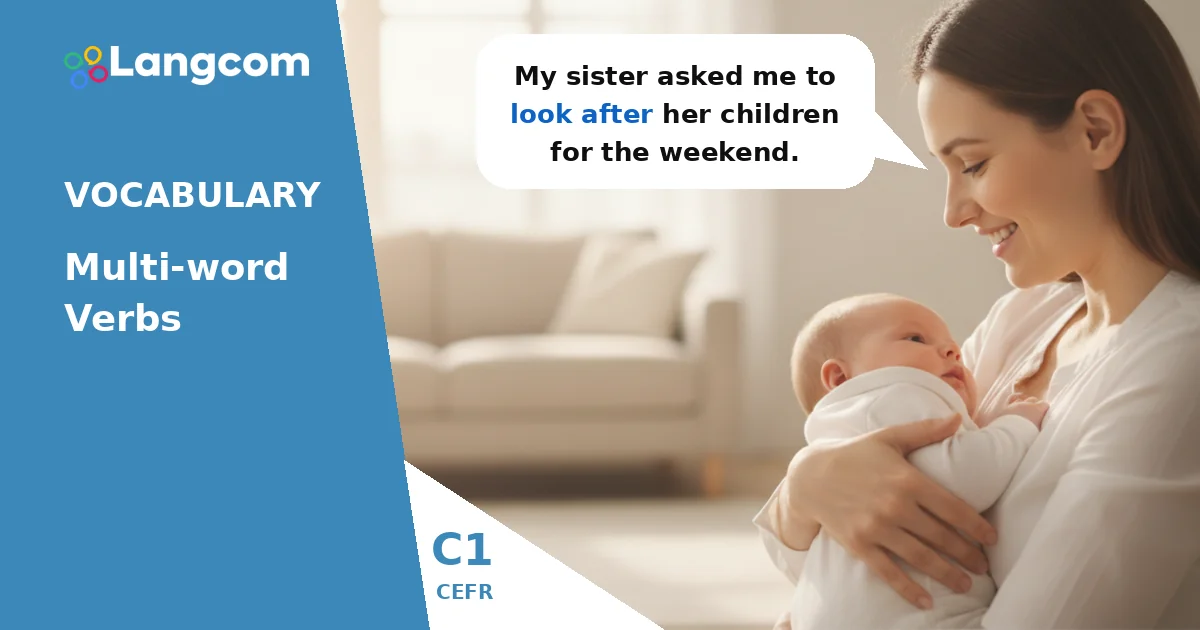
- My sister asked me to look after her children for the weekend.
- We had to put off the meeting until next week because of the storm.
- Despite the difficulties, they decided to carry on with their plans.
- Don't forget to hand in your project before the deadline.
- Could you pass on this information to your colleagues?
- After the accident, it took her a while to come round.
- The band decided to break up after their last tour.
- She turned down a fantastic opportunity to work abroad.
- Even though I was shy, I managed to join in the conversation.
- I really feel like having a long nap this afternoon.
练习
西班牙语母语者常犯的错误
Spanish speakers often make specific mistakes with multi-word verbs:
- 直译: Trying to translate multi-word verbs word-for-word from Spanish. For example, translating "posponer" directly to "postpone" is correct, but not using the common multi-word verb "put off" can make your English sound less natural.
- Forgetting Particles: Omitting the particle, which changes or destroys the meaning. For instance, saying "I looked the children" 而不是 "I looked after the children."
- Confusing Separability: Incorrectly separating inseparable verbs or not separating separable ones. For example, saying "I carried the work on" (incorrect) instead of "I carried on the work" (correct, inseparable). Or saying "I handed in my essay" when "I handed my essay in" is also possible and often more natural.
- Over-formal Language: Avoiding multi-word verbs entirely and always using more formal single-word equivalents. While sometimes appropriate, this can make your English sound stiff and unnatural in casual contexts.
常见问题
What is the difference between a phrasal verb and a multi-word verb?
The terms are often used interchangeably. Generally, a "phrasal verb" is a type of multi-word verb that combines a verb with an adverb or preposition (or both) to create a new meaning. "Multi-word verb" is a broader term that includes phrasal verbs as well as other verb combinations like prepositional verbs (verb + preposition, always transitive and inseparable) and phrasal-prepositional verbs (verb + adverb + preposition).
How can I improve my knowledge of C1 multi-word verbs for the CAE exam?
To improve, you should actively learn them in context, not just lists. Read advanced texts, listen to podcasts, and watch English movies, paying attention to how multi-word verbs are used. Keep a vocabulary notebook, noting down the verb, its meaning, an example sentence, and whether it's separable. Practice using them in your speaking and writing. For the C1 Advanced exam, focus on common verbs and their various meanings, as they often appear in the Use of English parts, especially Key Word Transformations.
Are all multi-word verbs idiomatic?
Most multi-word verbs are idiomatic, meaning their overall meaning cannot be easily guessed from the individual words. However, some are more transparent. For example, "sit down" is quite literal. But for C1 learners, the focus is usually on the more idiomatic and less predictable ones, like "put off" 或 "come round."
What does 'separable' and 'inseparable' mean for multi-word verbs?
"Separable" means you can place the object between the verb and the particle, or after the particle. For example, "turn down the music" 或 "turn the music down." If the object is a pronoun, it *must* go between: "turn it down." "Inseparable" means the object must always come after the particle. For example, "look after the children" is correct, but "look the children after" is incorrect.


0 条评论