

Learning the names of body parts in English is essential for A2 learners. This vocabulary helps you describe people, talk about health, and understand simple instructions in daily life. For example, you can say My head hurts when you feel unwell, or She has long hair to describe someone. Mastering these words, such as head, hand, foot, eye, , 和 leg, is also very useful for the Cambridge A2 Key (KET) exam. You might need to identify body parts in pictures, describe someone’s appearance, or talk about feeling unwell in speaking or listening tasks. Knowing these basic terms will build a strong foundation for more complex English conversations and significantly improve your overall communication skills in English.
Why is “Parts of the Body” Vocabulary Important?
Knowing body parts helps you talk about many things in English.
- You can describe people: She has long hair.
- You can talk about health: My head hurts.
- You can understand directions: Touch your nose.
- This vocabulary is important for the A2 Key (KET) exam.
Essential Body Parts for A2 English
Here are some common body parts you should know at A2 level:
- Head: head, eye, ear, nose, mouth, neck
- Upper Body: arm, hand, finger, back, stomach
- Lower Body: leg, foot, toe
Using Body Parts in Sentences
Let's see how to use these words in simple sentences.
- I have two eyes and one nose.
- She can move her fingers.
- My leg is tired after running.
- He has a pain in his back.
| Singular | Plural |
|---|---|
| foot | feet |
| tooth | teeth |
| hand | hands |
| eye | eyes |
| leg | legs |
示例
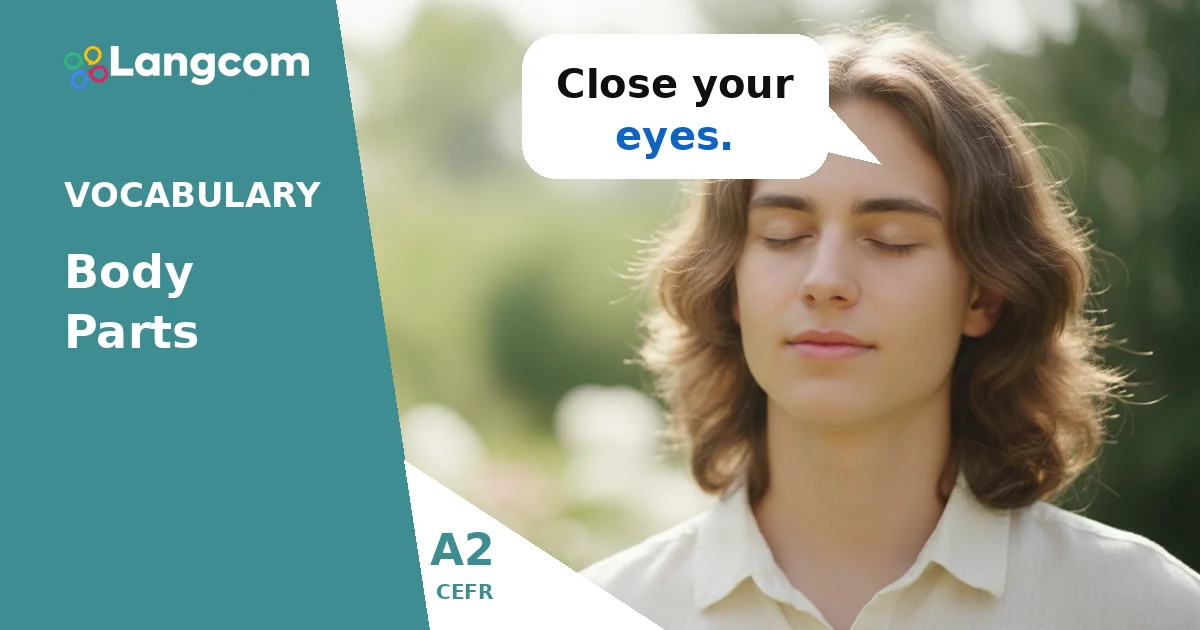
- Close your eyes.
- My ears are cold.
- He has a big nose.
- Open your mouth, please.
- I can touch my head.
- She has a long neck.
- My hand is small.
- I have ten fingers.
- My stomach feels full.
- He hurt his foot.
- She has strong legs.
- My back hurts sometimes.
练习
西班牙语母语者常犯的错误
讲西班牙语的人有时会犯以下错误:
- Singular vs. Plural: In English, many body parts have irregular plurals.
- One foot / Two feet (非 *two foots*)
- One tooth / Two teeth (非 *two tooths*)
- Using "the" vs. "my/his/her": We often use possessive adjectives for body parts.
- I hurt my arm. (非 *I hurt the arm.*)
- She closed her eyes. (非 *She closed the eyes.*)
常见问题
Why is knowing body parts important for the A2 Key exam?
The A2 Key (KET) exam often includes questions about describing people, talking about health, or understanding simple instructions. Knowing words like head, hand, , 和 leg will help you in speaking, listening, and reading tasks.
What is the difference between hand 和 arm?
您的 arm is the whole part from your shoulder to your hand. Your hand is just the end part of your arm with fingers.
How do I say "my stomach hurts" in English?
你可以说 My stomach hurts 或 I have a stomach ache.



0 条评论