
When do we use the Present Simple Affirmative?
We use the Present Simple Affirmative to talk about things that are true all the time or happen regularly.
- Daily routines and habits: Things you do every day or often. I get up at seven o’clock.
- Facts and general truths: Things that are always true. The sun rises in the east.
- Schedules and timetables: Fixed events. The train leaves at 9 AM.
How do we form the Present Simple Affirmative?
The form of the verb changes for He, She, 和 It.
- For I, You, We, They, we use the base form of the verb. I watch TV.
- For He, She, It, we add -s 或 -es to the base form of the verb. She watches TV.
Here are some rules for adding -s 或 -es:
- Most verbs: Add -s. work → works, eat → eats
- Verbs ending in -s, -ss, -sh, -ch, -x, -o: Add -es. watch → watches, go → goes
- Verbs ending in a consonant + -y: Change -y to -ies. study → studies (but play → plays because it’s a vowel + -y)
Special verb: ‘have’
The verb have is special in the Present Simple Affirmative.
- For I, You, We, They, we use have. I have breakfast.
- For He, She, It, we use has. He has breakfast.
We often use have to talk about meals, like have breakfast, have lunch, 或 have dinner. You can also use eat for meals, but have is very common.
| Subject | Verb: <span data-no-translation>WORK</span> | Verb: <span data-no-translation>WATCH</span> | Verb: <span data-no-translation>STUDY</span> | Verb: <span data-no-translation>HAVE</span> |
|---|---|---|---|---|
| I | work | watch | study | have |
| You | work | watch | study | have |
| He | works | watches | studies | has |
| She | works | watches | studies | has |
| It | works | watches | studies | has |
| We | work | watch | study | have |
| They | work | watch | study | have |
Examples
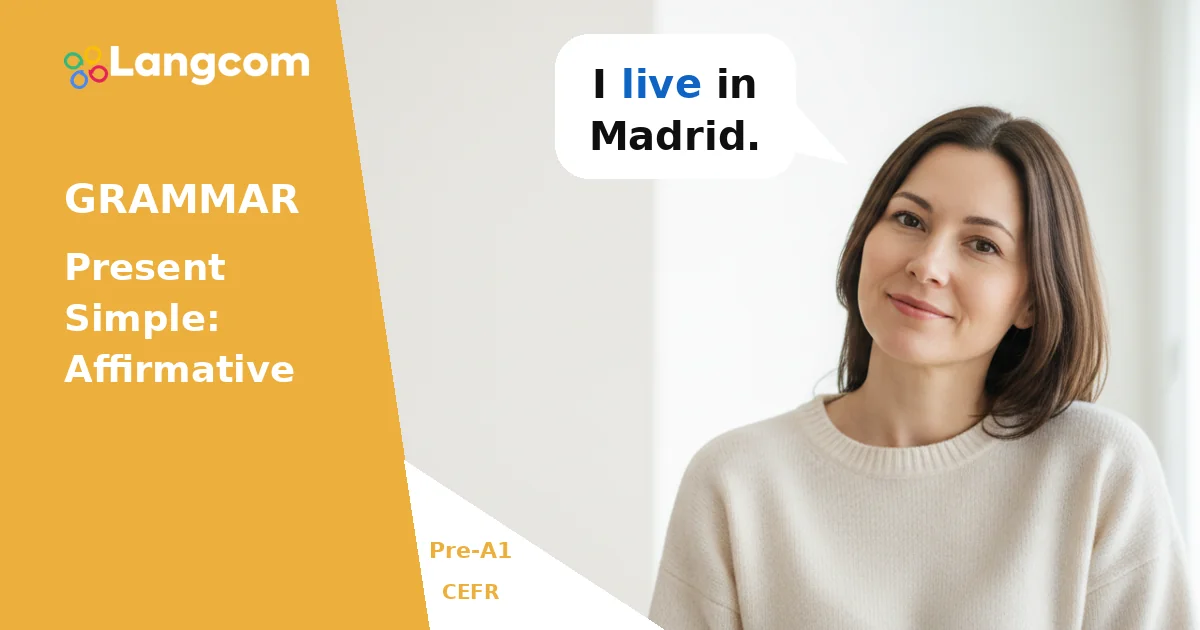
- I live in Madrid.
- You study English at Langcom.
- He works in an office.
- She watches TV every evening.
- It rains a lot in winter.
- We get up early on weekdays.
- They have two children.
Practice
Common mistakes for Spanish speakers
Forgetting the -s for He/She/It
A common mistake for Spanish speakers is to forget to add -s 或 -es to the verb when the subject is He, She, 或 It. In Spanish, verb endings change for all subjects, but in English, the change is mostly for the third person singular.
- Incorrect: She live in London.
- Correct: She lives in London.
- Incorrect: He watch TV.
- Correct: He watches TV.
Using ‘have’ instead of ‘has’ for He/She/It
Remember that have changes to has for He, She, 和 It.
- Incorrect: He have breakfast at 8 AM.
- Correct: He has breakfast at 8 AM.
常见问题
What is the main use of the Present Simple Affirmative?
The main use is to talk about daily routines, habits, and facts that are generally true. For example, I drink water every day.
Do all verbs add -s for He/She/It?
Most verbs add -s. However, some verbs add -es (like watch → watches) or change -y to -ies (like study → studies). The verb have changes to has.
Why is the Present Simple important for Pre-A1 learners?
It is fundamental because it allows you to describe basic information about yourself, your family, and your daily life, which is essential for early communication in English. It’s a building block for more complex sentences.
Can I use ‘eat’ instead of ‘have’ for meals?
Yes, you can use eat for meals (e.g., I eat breakfast). However, have (e.g., I have breakfast) is also very common and natural in English.



0 条评论